
💡 The Glow That Defined a Generation of Car Guys
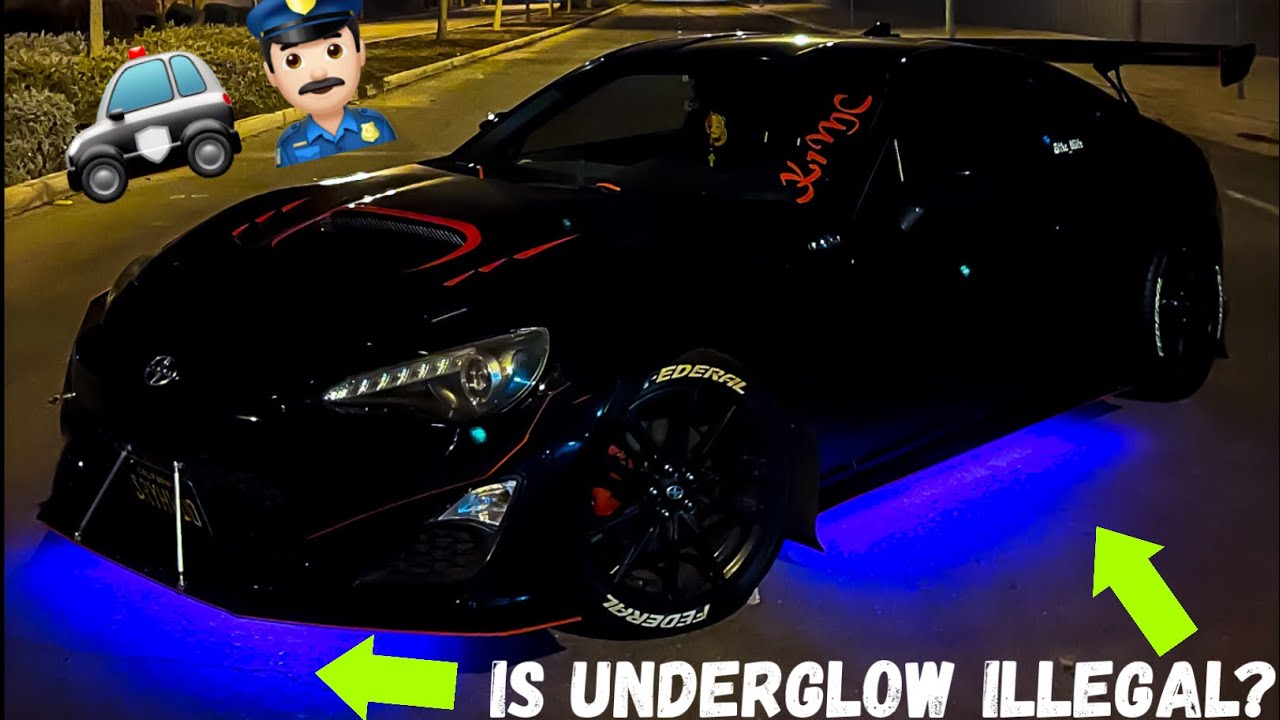
If you grew up watching 2 Fast 2 Furious or scrolling car forums in the 2000s, underglow probably lived in your head rent-free before you ever owned a car. That electric blue or violent green haze pulsing off the bottom of a body kit at a red light. Neon tubes zip-tied to a subframe, running off a cheap controller, glowing under a car that was very likely also sitting on a stretched budget.
Underglow wasn't subtle. That was the point.
And then, somewhere in the last fifteen years, it mostly disappeared from public roads. Not because car guys stopped wanting it. Because states started writing laws that made it illegal, expensive, or both. Today underglow exists in a weird legal gray zone: fully banned in some states, tightly restricted in most, and only genuinely legal in a small handful if you follow very specific rules about color and visibility.
This is the actual story of what happened, the laws that are still on the books right now, and how to get that glow without becoming a magnet for a traffic stop.
🚔 It Was Never About the Lights Themselves
Here's the part most people get wrong: cops and legislators generally don't care that your car glows. They care what color it glows, and who else on the road might mistake it for something it's not.
Every US state regulates vehicle lighting through some version of the Uniform Vehicle Code, and the two colors that trigger almost every underglow law are red and blue. That's not a coincidence. Red and blue are the colors reserved for emergency vehicles, and most state vehicle codes explicitly prohibit civilian vehicles from displaying red or blue lights visible from specific distances, in specific directions, or at all.
The logic goes like this: if a civilian car can throw red or blue light from underneath, a driver behind it at night, especially in rain or fog, could genuinely mistake it for a police car, an ambulance, or a fire truck. That's a real hazard, not a hypothetical one. Several states cite exactly this reasoning in the statute language itself.
So underglow laws almost never say "no colored lights on the underside of your car." They say something closer to: no lights visible from the front that aren't white or amber, no red lights visible from the front, no blue lights period, and (in a lot of states) no lights of any color visible directly from the sides or front that could be confused with authorized emergency equipment.
Green picked up extra scrutiny in some states too, since a handful of law enforcement and volunteer fire vehicles use green lighting for scene command or command-post identification. It's rarer, but it's on the books in places like Louisiana and parts of the Midwest.
🗺️ The Actual State-by-State Reality (And Why It's So Confusing)
There is no single federal underglow law. Vehicle lighting is regulated at the state level, which means the rules genuinely change the second you cross a state line, and "is underglow legal" doesn't have one answer.
Broadly, states fall into three buckets:
- Effectively banned or extremely restricted: States like California, Virginia, and Georgia have language strict enough that any visible underglow, regardless of color, can get you cited under equipment violations, even if the specific color would technically be allowed elsewhere. California's vehicle code (CVC 25400 and related sections) is one of the most cited examples nationally because it explicitly restricts colored lights visible from the front or sides of the vehicle to very narrow exceptions.
- Color-restricted but technically legal: The largest bucket. States like Texas, Florida, and Ohio generally allow underglow as long as it's not red, not blue, not visible from the front in a way that could be confused with turn signals or emergency lighting, and doesn't flash or strobe. White and amber are almost universally the safest colors here. Purple, pink, and green sit in murkier territory depending on brightness and visibility angle.
- Genuinely permissive: A smaller number of states have looser language that mostly just prohibits red/blue and flashing patterns, leaving more room for creative colors as long as you're not running them through an intersection at 2am with a cop three cars back.
The honest answer for almost every state: white and amber underglow is close to universally legal. Anything else is a risk you're taking on, not a right you have. Local jurisdictions can also layer on their own restrictions on top of state law, so a color that's fine in unincorporated county land can still get you pulled over inside city limits.
Spota tip: if you're planning a build around underglow and want to actually drive it, not just show it, check your specific state's vehicle code before you buy anything. A quick search for "[your state] vehicle code underglow" or "colored lights vehicle code [your state]" gets you the actual statute language in under five minutes, and it'll save you a ticket down the line.
📉 Why the Trend Actually Faded (It Wasn't Just the Laws)
Legal risk explains part of the decline, but it's not the whole story. A few other things happened at the same time that pushed underglow out of the mainstream car scene.
The technology got associated with a specific era. Underglow peaked culturally alongside cold cathode tubes, the early-2000s tuner boom, and a very specific aesthetic that a lot of car guys eventually grew out of or actively moved away from. As the scene shifted toward stance, JDM restoration, and more "clean" builds through the 2010s, underglow started reading as dated rather than aggressive. Trends in car culture move in cycles, and underglow's first wave got tied hard to a specific look that fell out of favor.
Enforcement got more visible, which killed the casual version of the trend. In the early days, a lot of underglow was low-effort: cheap kits, minimal wiring, thrown on without much thought to legality. As states clarified their laws and started actually enforcing them at inspections and traffic stops, the casual "why not" crowd mostly dropped off. What was left was a smaller group of enthusiasts who actually cared about doing it right, which naturally shrinks the volume of cars you see running it.
Insurance and inspection friction added real cost. In states with vehicle safety inspections, non-compliant lighting can be an automatic fail. That turns underglow from a weekend project into something that can actually keep your car off the road, which is a much bigger deterrent than a hypothetical ticket.
LED strip lighting evolved into something more flexible. Interior ambient lighting, wheel well accents, and grille lighting scratched a similar itch with far less legal exposure, since those applications are much less likely to be visible from the angles that trigger emergency-vehicle-confusion laws. A lot of the audience that wanted "glowing car" energy migrated to those instead.
🔦 Neon Tubes vs. LED Strips: The Tech Actually Changed Too
Part of underglow's story is a hardware story, and it matters for understanding why the trend looks so different today than it did in 2004.
First-generation underglow ran on cold cathode fluorescent tubes, the same basic technology used in old-school computer case lighting. Cold cathode tubes are glass, they're fragile, they run hot enough to worry about heat cycling near plastic undercarriage panels, and they typically only came in a handful of fixed colors: you bought a blue kit or a green kit, and that was your color for the life of the tubes. Dimming wasn't really a thing. It was full brightness or nothing, which is part of why 2000s underglow reads as so aggressive in old photos and videos. There was no subtlety available even if you wanted it.
Modern underglow is almost entirely LED-based, and that shift changed the entire risk and cost calculation. LED strips are flexible, they run cool, they survive road debris and moisture far better than glass tubes ever did, and critically, RGB LED controllers let you pick any color on the spectrum from an app or remote instead of committing to one color at purchase. That's a double-edged upgrade for the legal question: it makes it trivially easy to stay in a compliant white or amber range for daily driving, but it also makes it trivially easy to flip into a banned red or blue color at a stoplight, which is exactly the kind of casual violation that gets a build a reputation with local law enforcement.
Price dropped hard too. A basic four-tube cold cathode underglow kit in the mid-2000s ran $80 to $150 and required real wiring knowledge to install cleanly. A comparable app-controlled RGB LED kit today runs $30 to $80 on the low end, with plug-and-play wiring harnesses that don't require cutting into the factory harness at all. The barrier to entry basically evaporated, which is part of why the "why did I see fewer underglow cars" perception doesn't quite match reality. It's not that fewer people are running it. It's that the kits are cheap enough now that a lot of it lives in garages and driveways, only switched on for shows, meets, and photos rather than daily commutes.
💸 What Getting It Wrong Actually Costs
The consequences for non-compliant underglow vary a lot by state, and it's worth being specific instead of just saying "you'll get a ticket," because the real cost adds up in ways a lot of people don't expect until it happens to them.
- The base citation. Most states classify improper vehicle lighting as a non-moving equipment violation, typically $25 to $150 depending on jurisdiction. That part is usually the cheapest piece of the whole situation.
- Fix-it tickets and re-inspection fees. States with mandatory equipment compliance, including several that also do periodic safety inspections, can require proof the offending lights were removed or disabled before the ticket clears, sometimes with an additional re-inspection fee on top of the citation.
- Points on a license in stricter states. A smaller number of states treat certain lighting violations as a moving violation rather than a fix-it equipment issue, which can add points and affect insurance premiums, not just the one-time fine.
- Impound risk in extreme cases. Rare, but real: a handful of jurisdictions have specifically cited illegal red or blue underglow as grounds for impound when combined with other violations, on the theory that a vehicle that can visually impersonate an emergency vehicle is a public safety issue, not just a paperwork one.
- Insurance friction. Aftermarket lighting modifications, especially ones tied to a citation, can complicate a claim if an accident happens while the lights were in use, particularly if an insurer can argue the modification contributed to reduced visibility of the vehicle's actual signals or invited a rear-end collision from a confused driver.
None of this means underglow is some reckless, dangerous mod. It means it's one of the few genuinely popular car mods where the letter of the law varies this much by zip code, and where a $50 part can create real, recurring cost if you don't check the rules first.
🎨 How Car Guys Are Actually Getting the Look in 2026
Underglow didn't die. It got smarter. Here's what the current legal-adjacent version of the trend actually looks like on builds that still turn heads at meets without turning heads at traffic stops.
- App-controlled RGB kits with a hard color lock. A lot of modern kits let you lock the controller to white or amber only for road use, then unlock the full color range for shows, private events, or parked "car meet mode" where the vehicle isn't moving on a public road.
- Wheel well and rock light setups instead of true underglow. Rock lights (originally designed for off-road trucks and Jeeps) sit higher and point more downward than traditional underglow tubes, which puts them in a legal gray area that's generally friendlier since they're less visible from a driver's typical sightline.
- Interior ambient strips paired with exterior accent lighting. Splitting the glow between the cabin (fully legal in every state, any color) and very limited, white/amber-only exterior accents gets most of the visual payoff with almost none of the legal risk.
- Show-only wiring with a physical disconnect. Serious show car builders run a dedicated switch or fuse pull that fully isolates the underglow circuit, so the car is provably "off" for the drive to and from an event and only active once parked. It's extra effort, but it's the cleanest way to have both worlds.
The through-line: the underglow enthusiasts who are still doing it in 2026 are doing it deliberately, with an actual understanding of their state's law, not just zip-tying a kit under the car and hoping for the best. That's a genuinely different relationship with the mod than the 2000s version had, and honestly it's made the builds that do run it stand out more, since it's rarer than it used to be.
❌ Three Underglow Myths That Refuse to Die
A lot of bad information gets passed around car meets and forums about underglow law. These three come up constantly, and all three are wrong or at least dangerously incomplete.
"It's fine as long as it's not on while I'm driving." Not accurate in most states. A large share of underglow statutes cover whether the equipment is installed and capable of being displayed, not just whether it's actively lit at the moment an officer looks at your car. Some states are more lenient here than others, but "I'll just turn it off if I see a cop" is not a legal strategy, it's a bet, and it's a bet you lose if you're pulled over for something unrelated and the officer notices the hardware.
"Purple and pink aren't red or blue, so they're automatically legal." This trips up a lot of people, and it's genuinely understandable why. The problem is that vehicle codes generally don't define colors with hex-code precision. They rely on what a reasonable observer would perceive, and a bright enough purple or magenta LED can visually read as red or blue at a distance, at night, through a windshield, in rain. Several citations nationally have been issued specifically over "technically purple" lighting that an officer reasonably interpreted as blue-adjacent. If a color sits close to the banned end of the spectrum, it's a real risk even if it's not literally the banned hex value.
"It's a state law issue, so as long as I'm not in a strict state, I'm totally in the clear." State law is the floor, not the ceiling. Cities and counties can and do add their own equipment ordinances on top of state vehicle code, and HOA-adjacent or private property rules add another layer on top of that for where you can even park a car with the lights visible. "Legal in my state" doesn't automatically mean "legal everywhere you might drive it," especially if a build gets driven to shows or meets across state lines.
🏁 A Trend That Got More Selective, Not Extinct
Underglow's story is less "car culture killed a trend" and more "the law forced a trend to grow up." The cars still exist. The scene that appreciates a perfectly synced glow under a clean build hasn't gone anywhere. What changed is that doing it right now takes actual research instead of a credit card and a Saturday afternoon.
If you're building toward a show car and want the look, treat it the way serious builders do: know your state's code, pick your colors accordingly, and build it show-only if you want real freedom with the palette. It's more work than it used to be. It's also a lot less likely to end your night with a citation instead of a compliment.
Building out a car with details like this? Log the mod in your Spota Garage and track it alongside the rest of your build progression, from the parts list to the before-and-after shots.