
🎈 The Car That Breathes
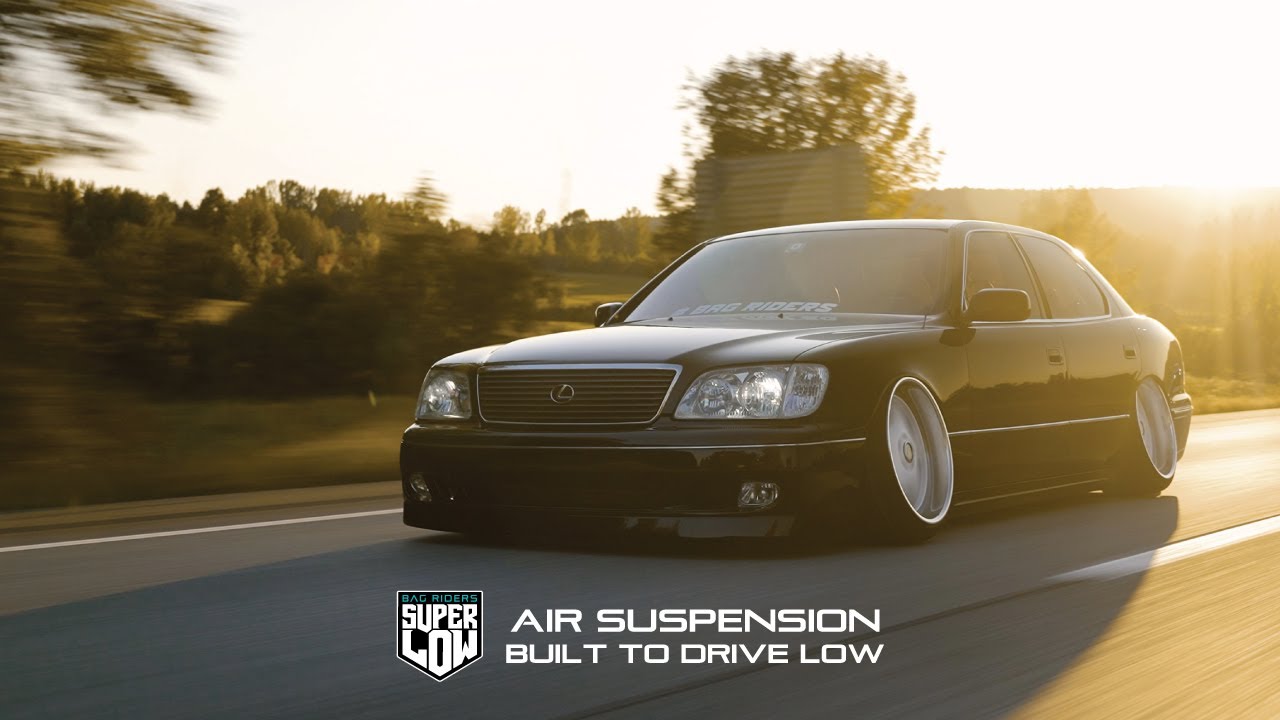
You've seen it happen. A car rolls up to a stoplight looking completely normal, maybe even a little tall. Then it hisses, sinks four inches, and the whole thing is suddenly kissing the pavement. Light turns green, it hisses again, rises back up, and drives off like nothing happened.
That's a bagged car. And depending on who you ask, it's either the smartest suspension setup in the entire hobby or the single most offensive thing you can bolt to a chassis.
There is no in-between in this argument. Ask a drift guy about air ride and you'll get a lecture about sidewall flex and body roll. Ask someone at a stance meet and they'll tell you coilovers are a compromise nobody should still be making in 2026. Both of them are right about their own use case and wrong about the other guy's, which is exactly why this fight never ends.
Let's actually look at what's happening under a bagged car, why it earns so much hate, and why the people who run it will never go back.
🔧 How Air Ride Actually Works
Forget the stereotype for a second and look at the mechanics, because most of the hate comes from people who've never had one apart.
A bagged suspension swaps your springs for air-filled rubber bags (also called air struts or air bags, not to be confused with the airbag in your steering wheel). Those bags sit where your coils used to live, mounted to the same strut or shock body in most kits. Air gets pumped in and out of them by a compressor system, and that system is really the whole show:
- Compressor(s): Usually a pair, filling a tank with compressed air. Bigger compressors fill faster, which matters more than people think.
- Air tank: Stores pressurized air so the system doesn't have to compress on demand every time you hit a button. Tank size determines how many times you can air up and down before you're waiting on the compressors to catch up.
- Valves (manifold): Electronic valves that route air into or out of each individual bag. A quality manifold can control all four corners independently.
- Management system: The brain. Ranges from a simple analog switchbox with paddle switches to a full digital controller with Bluetooth, presets, and ride height sensors that can return the car to the exact same height every single time.
- Air line: Usually DOT-approved nylon tubing running from the tank to each bag through the valves.
Hit a preset and the management system opens the right valves, air rushes in or out, and the corner height changes in seconds. Good management systems can do all four corners independently, which is how you get a car that sits dead level even when it's parked nose-down on a driveway.
The bags themselves come in a few shapes. Sleeve style bags (tall, cylindrical, look almost like an accordion) give more usable travel and a softer ride. Double bellows bags are shorter and stiffer, better for cars that need to clear more suspension geometry in a tighter space. Which one a shop specs for your car depends entirely on how much room there is in your strut tower and how low you actually want to go.
⚡ Why Builders Won't Shut Up About It
Ask anyone running air ride why they made the switch and you'll get some version of the same list.
It solves the daily-driver problem. Slammed coilovers look incredible in photos and destroy your front lip on every driveway, speed bump, and parking garage ramp between your house and the highway. Air ride lets you run the car at a sane, safe height for actual driving, then drop it to show-stopping low the second you park. You get both looks out of one car.
It's endlessly adjustable. Coilovers require a wrench, a jack, and twenty minutes to change ride height by half an inch. Air ride changes ride height in the time it takes to hit a button. Want it slightly higher for a track day, slightly lower for a photo, dead level for a long highway run? Same car, same setup, completely different stance in seconds.
It's a flex in its own right. A car that visibly rises and falls, hisses air, and settles onto the ground is a spectacle. At a meet, a bagged car doing a "lay down" draws a crowd the same way a loud exhaust does. It's theater, and car culture has never been shy about theater.
Ride quality can genuinely be better. A well-tuned air ride setup rides softer than a stiff coilover setup at the same static height, because the air spring rate changes progressively as the bag compresses, unlike a fixed-rate coil.
None of that is imaginary. This is real engineering solving a real, longstanding problem: looking low without living low.
🚫 Why Purists Call It Fake
Now the other side, because the hate isn't random noise.
"It's not a real suspension setup." The core objection from performance-minded car guys: air bags are, at their limit, still an air spring holding up the corner weight of the car, and air compresses under load in a way a solid steel coil doesn't. Push a bagged car hard into a corner and you can get spring rate that changes mid-turn as the bag compresses further, which is the opposite of what you want from a suspension component in a high-load situation. For anyone chasing lap times, that's disqualifying on its own.
It adds real weight and complexity. A full air ride setup means compressors, a tank, a manifold, wiring, air lines, and a management brain, all bolted somewhere in the trunk or spare tire well. That's extra weight sitting behind the rear axle (bad for handling balance) and a genuinely complicated system with a lot more failure points than four springs and four shocks.
Failure modes are ugly. A blown air line, a dead compressor, or a bag that finally splits doesn't gracefully degrade like a worn coilover does. It can drop that corner of the car straight to the bump stops, sometimes with the car moving. Anyone who's watched a bagged car settle onto one flat corner in a parking lot understands why some people won't trust it on the highway.
It's tuned for the photo, not the road. The purist argument, boiled all the way down: air ride optimizes for how the car looks parked, at the expense of how it behaves moving. For a build whose entire job is to be driven hard, that's a real tradeoff, not a snobbish one.
Both sides are describing the same system and reaching completely different conclusions, because they're optimizing for completely different things. That's the whole fight in one sentence.
📜 Where This Fight Actually Started
Air ride isn't new. Trucks and low-riders have been running air bags since the 1980s, mostly for practical reasons: haul heavy loads without sagging the rear end, or drop a truck low for a show without permanently ruining the ride height for everyday use. Lowrider culture in particular built an entire competitive scene around hydraulics and, later, air systems, complete with hopping competitions where the goal was height and bounce, not just static stance.
The version of air ride that shows up at import and stance meets today borrowed the hardware but rewired the goal. Instead of hopping or hauling, the target became the "lay" (the car sitting completely flat, tires tucked, frame or subframe touching pavement) and the transition from driveable to slammed in seconds. That shift, from utility to spectacle, is exactly when the performance crowd started paying attention, and exactly when the arguments started.
By the mid-2010s, air management technology had gotten good enough (faster valves, smarter controllers, presets you could save and recall) that it stopped being a novelty and started being a legitimate suspension category with its own vendors, its own forums, and its own hierarchy of "good" versus "cheap" setups. That maturity is a big part of why the debate still rages: air ride isn't a fringe curiosity anymore, it's mainstream enough that it shows up on cars that also see real track time, which puts the two camps in direct contact instead of just arguing past each other online.
💸 What It Actually Costs (And Why That Fuels the Argument)
Part of the tension is financial, and it's worth being honest about it. A decent air ride kit with a real compressor setup, a quality manifold, and a usable management system runs anywhere from $3,000 to well over $6,000 installed, before you factor in a tank, wiring, and the labor to mount everything cleanly in a trunk. High-end setups with digital height sensors and app control push that number higher still.
That's meaningfully more than a comparable set of quality coilovers, which is exactly why the "form over function" criticism has teeth. A builder spending that much on ride height alone is making a clear statement about priorities, and track-focused car guys read that statement as "looks over speed," fairly or not. Air ride owners tend to read the same price tag as "I paid for adjustability and I'm not sorry."
There's also a maintenance reality nobody advertises on Instagram. Compressors wear out. Air lines can develop slow leaks that aren't obvious until a corner sags overnight. Bags themselves have a service life and eventually need replacement, especially on cars that get laid out daily instead of just for shows. None of that is disqualifying, but it's an ongoing cost of ownership that a torsion spring or a coil simply doesn't have, and it's part of why some builders who tried air ride early on quietly went back to coilovers.
🛠️ The Middle Ground Nobody Talks About
The stance vs. performance framing makes it sound binary, but a lot of the scene has quietly found a third option: air ride tuned conservatively, run mostly at a sane daily height, and only slammed for photos and shows. That's not "fake," it's just using the adjustability for what it's actually good at (ground clearance management) instead of chasing a static slammed look 24/7.
There's also a growing lane of higher-end air management systems built specifically to address the performance objections: faster valving for quicker response, better dampers paired with the bags so the shock (not the bag) does most of the actual damping work, and stiffer bag construction for cars that still see track time. It's not the same as a dedicated track coilover setup, and nobody serious claims it is, but the gap has narrowed a lot from where it was a decade ago.
Spota tip: if you're documenting a bagged build in your Garage, the ride-height changes are content on their own. A before/after Photo Op at full slam versus daily height tells a better story than either shot alone, and it's exactly the kind of progression the Garage is built to track.
🎯 So Who's Actually Right?
Neither side, and both of them, depending entirely on what the car is for.
If the car's job is lap times, autocross runs, or anything where consistent, predictable spring behavior under hard load matters more than parking-lot theater, coilovers (or a well-sorted stock setup) are the right call, full stop. If the car's job is to be a head-turner at meets, a daily driver that also happens to lay frame on command, or a rolling art piece that needs to squeeze under a garage door it was never designed to fit under, air ride solves a problem coilovers genuinely can't.
The argument survives because both camps are building for different goals and judging the other camp by their own rulebook. That's not going away, and honestly, it's part of what makes this hobby fun to argue about at 11pm in a parking lot.
Bag it, coil it, whatever gets your car where you want it. Just know what you're actually trading off before you weld the brackets on.