
💨 The Sound Every Turbo Owner Learns to Hate
You mash the throttle and instead of the shove you're expecting, you get a hiss. A faint pssst somewhere under the hood, boost gauge climbing slower than it used to, power that feels soft, like the car is wearing a weighted vest nobody asked for.
Most people's first move is to blame something expensive. The tune's bad. The injectors are maxed out. The turbo's dying. Somebody in the group chat says "probably need a bigger turbo." Nobody, at first, checks the fifteen-dollar coupler that's been slowly working itself loose since the last time someone popped the intake off.
That's the boost leak trap. It's the single most common problem on modified turbo cars, it's almost never expensive to fix, and it still manages to send more people down expensive diagnostic rabbit holes than almost anything else under the hood. If you've spent any time in a turbo car forum, a Discord tuning server, or the comments under a dyno video that came in "way lower than expected," you already know the ritual: someone posts a sad graph, and within four replies somebody says "check for a boost leak first."
This is why that's always the right first move, what's actually leaking, and why finding the leak is somehow both trivially easy and maddeningly hard depending on where it decides to hide.
🌀 What a Boost Leak Actually Is
A turbocharged engine works by compressing air and forcing it into the cylinders under pressure, more air means more fuel can be burned, which means more power. That compressed air has to travel from the turbo's compressor housing, through an intercooler, through a maze of piping and couplers, past a throttle body, and into the intake manifold before it ever reaches a cylinder.
Every single joint in that path is a place air can escape instead of doing its job. A boost leak is exactly what it sounds like: pressurized air finding a way out of the system before it gets where it's supposed to go.
It doesn't take much. A coupler that's a hair loose, a hose clamp that's backed off half a turn, a hairline crack in an intercooler pipe from an old fitment issue, a vacuum line that's dry-rotted and split. Under normal atmospheric pressure none of that matters. The moment the turbo starts building boost, though, that same tiny gap becomes an escape hatch, and the engine ends up trying to make power with less air than it thinks it's getting.
The result is a car that feels down on power, builds boost slower, sometimes throws a check engine light for lean conditions or low boost pressure, and in bad cases actually confuses the tune. Most aftermarket tunes and standalone ECUs are calculating fuel delivery based on expected boost and airflow. Feed that math bad information and the car can run leaner than intended right when it's under the most load, which is exactly the situation nobody wants their engine in.
🔍 Why It's Always the Usual Suspects
Boost leaks aren't random. They cluster around the same handful of weak points on almost every modified car, which is exactly why the "check these first" list has become common knowledge in every turbo car community.
- Silicone couplers between pipes. These are the rubber-and-fabric sleeves that connect sections of intercooler piping. They clamp on both ends, and clamps loosen over time from heat cycling, vibration, and just being bolted to a car that drives on real roads.
- Hose clamps that were never torqued right in the first place. A worm-gear clamp installed by hand, tight enough to feel secure, is not the same as one actually torqued to spec. This is the single most common cause of a fresh leak right after someone installs an aftermarket intercooler or piping kit.
- The blow-off valve or diverter valve. If it's not seating properly, whether from a bad diaphragm, a worn spring, or debris on the seat, it bleeds boost every time it's supposed to be fully closed.
- Vacuum and boost reference lines. Tiny rubber hoses that route signal pressure to the wastegate actuator, boost controller, or various sensors. They're cheap, they're old on higher-mileage cars, and they crack without anyone noticing until boost starts wandering.
- Intercooler end tank seams and gaskets. Especially on aftermarket intercoolers that weren't perfectly matched to the car's factory piping, where a slightly-off angle puts constant stress on a seam that was never designed to flex that way.
- Throttle body gaskets and intake manifold gaskets. Less common as a first-time culprit, but a classic "I already checked everything else" discovery.
Here's the part that makes this genuinely annoying: a leak at any one of these points can produce almost identical symptoms. Slower boost buildup, lower peak boost, a rougher idle, a check engine light for a lean condition. There's no single "boost leak feeling" that points to one specific spot. The car just feels wrong, and the hunt begins.
🧪 How Car Guys Actually Find Them
There's an entire subgenre of automotive YouTube built around boost leak testing, and for good reason: it's one of the few diagnostic procedures where you can actually watch the problem happen in real time instead of guessing from a data log.
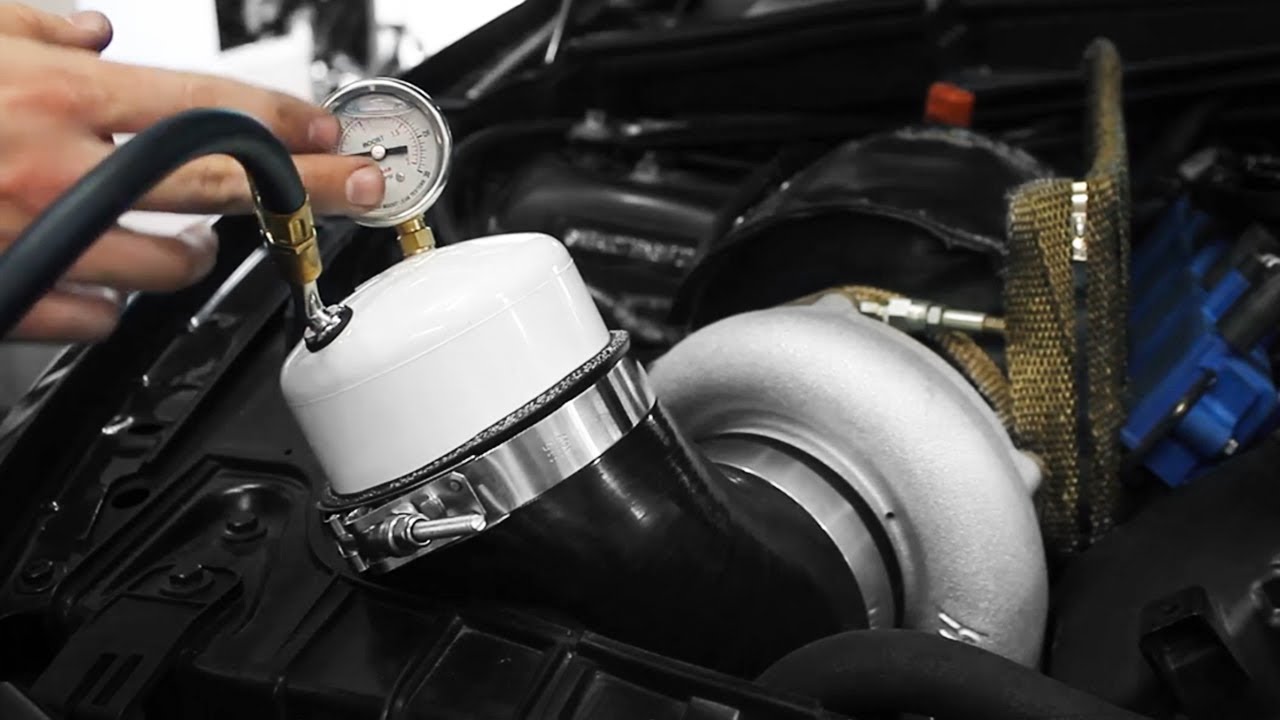
The classic method is a boost leak tester. It's a simple tool: a plug that seals off the throttle body inlet, connected to an air compressor fitting and a gauge. You pressurize the intake system to a set PSI with the engine off, then listen. A system with no leaks holds pressure. A system with a leak drops pressure, and if you spray soapy water around every coupler and joint while it's pressurized, the leak announces itself with bubbles.
The lower-budget version is just an air compressor, a rag stuffed in the intake, and your own ears. Pressurize the system, walk the engine bay, and listen for the hiss. It's less precise but it works, and it's how plenty of people find their first leak before they ever own a dedicated tester.
Smoke testing takes it further. A smoke machine forces visible smoke through the pressurized system, and any leak shows up as a little cloud drifting out from wherever it's escaping. It's overkill for a quick check but it's the go-to when a leak is small enough to not hiss audibly or when soapy water just isn't finding it.
Data logging catches leaks that only show up under real load. Some leaks are so small they don't show up on a static pressure test but absolutely show up as boost that tapers off mid-pull instead of holding steady. Logging boost pressure against RPM and comparing it to what the tune expects is how a lot of "it's fine at idle but weak at redline" leaks eventually get found.
Spota tip: if you're documenting a diagnostic session or a fix for your Garage timeline, a quick clip of the soapy-water bubble test is one of the more satisfying "problem solved" moments to capture. It's visual, it's quick, and it actually shows the fix working instead of just telling people about it.
🎯 Why Boost Leaks Get Blamed Last Instead of First
This is the part that makes boost leak culture almost funny in hindsight. Despite being the most common issue, it's usually the last thing people check, not the first, and there's a real reason for that pattern.
Bigger problems feel more satisfying to diagnose. Nobody wants to believe their car is down on power because of a fifteen-dollar clamp. It's a lot more interesting to suspect the tune is wrong, the injectors are undersized, or the turbo is tired. Those are bigger, more technical-sounding explanations, and car culture has a soft spot for the dramatic diagnosis over the boring one.
A boost leak doesn't always announce itself loudly. Small leaks are genuinely subtle. The car doesn't die, doesn't stall, doesn't throw a dramatic fault. It just feels a little softer than it used to, and "a little softer" is easy to write off as imagination, or to blame on the weather, the gas station, or "the car just feeling different today."
Recent work is the first place people look, and boost leaks don't always come from recent work. If someone just installed a new intercooler, sure, they check the fresh couplers. But a clamp that's been slowly loosening for eight months since the last install has no obvious trigger event, so it doesn't get suspected until everything else has already been ruled out.
The forums have basically institutionalized the fix for this pattern: check for a boost leak before you touch anything else. It's the automotive equivalent of "have you tried turning it off and on again," except it's actually right an enormous percentage of the time.
⚡ What a Leak Actually Costs You
The power loss from a real boost leak isn't subtle once you understand what's happening. A turbo system that's supposed to hold, say, 20 PSI but is bleeding air at a joint might only be building 16 or 17 PSI by the time it reaches the intake manifold. That's not a small difference. Boost pressure and power output aren't perfectly linear, but a multi-PSI shortfall on a tuned car is very much a felt difference, not a theoretical one.
Beyond raw power, there's a knock-on effect that matters more: a leak downstream of the mass airflow sensor can throw off the whole fueling calculation, because the engine's computer is working off a measurement of air that no longer matches what's actually reaching the cylinders. Depending on tune logic, that can mean running leaner than intended under boost, which is the kind of condition that causes real engine damage over time, not just a slow Tuesday at the track.
There's also a wastegate side effect worth knowing about. Some leaks, especially ones near the wastegate actuator or boost reference line, don't just bleed power, they confuse the wastegate into opening earlier or later than it should, which is why some leaks cause boost spiking or fluttering instead of just underboosting. It's not always a clean "less power," sometimes it's "unpredictable power," which is arguably worse.
🔧 The Fix Culture Around It
Once a leak is found, the fix is usually cheap and fast, and that's exactly why boost leaks have this weird reputation of being both terrifying and trivial at the same time. A re-tightened clamp, a replaced coupler, a fresh vacuum line, and the car is back to full boost within the hour.
That's also spawned a whole culture of preventative habits among people running higher boost or bigger power builds:
- T-bolt clamps over worm-gear clamps on any coupler that sees real boost pressure, since T-bolts distribute clamping force evenly around the coupler instead of concentrating it at one screw, and they're far less likely to back off over time.
- Periodic re-torque checks on all piping clamps after a heat cycle or two, especially after any fresh install, since new couplers tend to compress slightly and clamps that were tight on day one can go slightly loose by week two.
- Upgrading factory couplers to reinforced silicone on higher-mileage cars, since factory rubber connectors age, harden, and crack well before most owners think to inspect them.
- A pre-track-day or pre-dyno leak check as standard ritual, the same way people check tire pressure before a drive. Cheap insurance against showing up and wasting a session chasing a mystery.
None of this is exotic knowledge. It's the kind of thing that gets passed down in forum threads and Discord servers because it's been learned the hard way by a lot of people who spent a weekend chasing a "tune problem" that turned out to be a two-dollar hose.
🏁 The Boring Answer Is Usually the Right One
Boost leaks don't make for a great story. Nobody's flexing about the time they found a loose clamp. But that's exactly why they're worth understanding: they're the most common reason a turbo car underperforms, they're almost always cheap to fix, and they still manage to fool people into chasing tunes, injectors, and turbos that were never the problem to begin with.
If your car has felt a little off lately, softer boost, a check engine light that won't quite explain itself, power that doesn't match what the dyno sheet promised, do the boring thing first. Grab some soapy water, pressurize the system, and go listen. It's the fastest fifteen minutes you can spend before spending real money on something the car never actually needed.
For more on how forced induction actually behaves once boost is doing its job, why turbo lag still exists in 2026 and why turbo cars need a cool-down cover the other two ends of the same system. Check them out under under-the-hood if you want the full picture of what's actually happening between the turbo and the road.