
🌀 The Two Seconds Everyone Pretends Don't Exist
Stomp the throttle in a turbo car and there's a beat. A half-second, maybe a full second, where the engine just kind of... thinks about it. RPMs climb, nothing happens, and then all at once the boost gauge swings and the car finally does what you asked it to do three car lengths ago.
Every manufacturer swears this is solved. Every dealer will tell you their new twin-scroll, electrically-assisted, variable-geometry masterpiece has "zero lag." Every YouTube comment section has a guy insisting turbo lag "isn't a thing anymore."
It's still a thing. It will always be a thing, to some degree, as long as a turbocharger is spun by exhaust gas instead of magic. What's changed is how well engineers have learned to hide it, and that's a very different claim than eliminating it.
This is the actual physics of why lag exists, why it can never fully go away, and why the cars that manage it best still aren't lag-free, they're just lag-disguised.
⚙️ What Turbo Lag Actually Is (Not the Simplified Version)
Most explanations stop at "the turbo needs exhaust gas to spin up, so there's a delay." True, but incomplete. There are actually three separate delays stacked on top of each other, and people usually only talk about one of them.
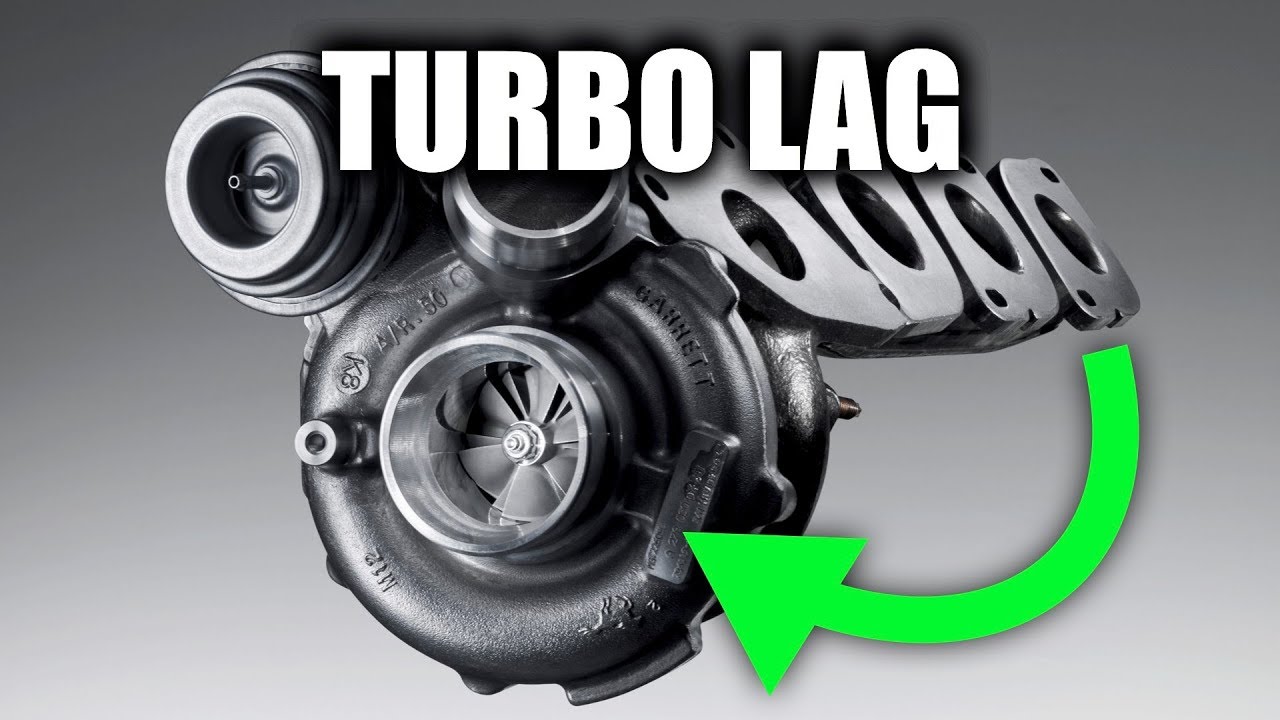
1. Turbine spool delay. The turbine wheel has mass. Spinning a piece of metal from idle speed to 100,000+ RPM takes energy and time, even with a small, light wheel. This is rotational inertia, and it's non-negotiable physics. A smaller turbine spools faster because it has less mass to accelerate, which is exactly why manufacturers keep shrinking turbos and running more of them in parallel instead of one big one.
2. Exhaust gas availability delay. At low RPM and light throttle, there simply isn't much exhaust gas flowing. The turbo can't spool on gas that doesn't exist yet. This is why lag is worst from a dead stop or during gentle cruising, and mostly disappears once you're already at higher RPM with the engine already breathing hard, sometimes called being "in the powerband."
3. Boost threshold delay. Even once the turbine is spinning, it has to build enough compressor-side pressure to actually push meaningful air into the cylinders. Spooling and making usable boost aren't the same moment. A turbo can be "spinning" well before it's actually doing useful work.
Stack those three together and you get the lag you feel: throttle input, wait, RPM climb, wait, and then the shove.
Spota tip: if you're filming a rolling shot or a Photo Op launch clip for your Garage, that lag window is actually useful. It's the moment right before the car "wakes up," and it reads great on camera if you frame the shot to catch the transition.
🏎️ Why Small Turbos Didn't Kill Lag, They Just Moved It
The industry's answer to lag for the last fifteen years has been simple on paper: make the turbo smaller. Less rotational mass, faster spool, less lag. This is true, and it's why a modern 2.0L turbo-four with a tiny single-scroll turbo can feel more responsive off the line than a big single turbo on a built engine making triple the power.
But smaller turbos come with a tradeoff nobody puts on the spec sheet: they run out of breath earlier. A small turbine that spools instantly at 2,000 RPM can also choke and stop making additional boost by 5,500 RPM, because it simply can't flow enough air past that point. So the lag moved. Instead of a long, obvious delay off idle, you get a shorter delay off idle and then a "wall" up top where the turbo just stops helping.
This is why so many small-turbo econoboxes feel peppy around town and completely flat once you're actually trying to use the whole rev range. The lag didn't disappear, it got redistributed to a part of the powerband most daily drivers never explore.
Twin-scroll turbos help by separating the exhaust pulses from different cylinders so they don't cancel each other out, which improves low-end spool without shrinking the turbine as aggressively. Sequential twin-turbo setups (a small turbo for low RPM, a bigger one that kicks in later) try to get the best of both, but they add complexity, weight, and failure points. There's no free lunch here. Every fix is a tradeoff, not a solution.
⚡ Why Electric Turbos Are the Closest Thing to an Actual Fix
The genuinely new development in the last few years is the electrically-assisted turbocharger, sometimes called an e-turbo or electric supercharger hybrid. Instead of waiting for exhaust gas to spin the turbine, a small electric motor spins the turbo shaft directly the instant you hit the throttle, using power from the car's electrical system (usually a 48-volt mild-hybrid setup, since a 12-volt system can't deliver enough current fast enough).
This actually attacks the root cause. It doesn't matter that exhaust gas isn't available yet, because the motor is doing the spinning instead. By the time exhaust flow catches up and takes over, the turbo is already at speed. Cars using this tech (a handful of performance sedans and a growing number of hybrids) genuinely do feel closer to naturally aspirated response than anything that's come before.
It's still not zero lag. There's a small delay for the electric motor to engage, current has to ramp, and the system has to hand off from electric assist to exhaust-driven spin without a stumble. It's a much smaller window measured in milliseconds instead of a full second, but "much smaller" and "zero" are different words for a reason.
It's also expensive, adds weight, adds a failure-prone component (that motor lives in an extremely hot environment right next to the exhaust manifold), and isn't something you're retrofitting onto your K24 swap in your driveway. For the vast majority of turbo cars people actually own and mod, this technology doesn't exist yet and won't for a long time.
🧠 The Marketing Lie Everyone Repeats
"Zero turbo lag" is one of the most repeated phrases in automotive marketing, and it's never been literally true. What manufacturers actually mean is "lag reduced to a point most customers won't consciously notice in a magazine test drive," which is a real accomplishment but a completely different sentence.
Car reviewers repeat "no perceptible lag" because compared to the boosty, laggy turbo cars of the 90s and 2000s, modern small-turbo engines really do feel dramatically better. That's a fair comparison. But "better than a laggy 90s turbo" and "instant, linear power delivery like a big naturally aspirated V8" are not the same claim, and the marketing blurs that line on purpose because "instant" sells better than "improved."
Ask anyone who's driven a modern turbo four back to back with a modern naturally-aspirated V8 or a genuinely responsive NA six. The turbo car still has a texture to its power delivery: a slight hesitation, a building surge, a moment where you can feel the car deciding to go. The NA car just goes, immediately, proportional to how far your foot is down. That difference is turbo lag, still very much alive, just smaller than it used to be.
🛞 Why Some Car Guys Actually Want the Lag
Here's the part that surprises people outside the culture: plenty of enthusiasts don't want lag eliminated. They want it managed, sure, nobody's nostalgic for a turbo that does nothing below 4,000 RPM in a car they drive daily. But the moment of anticipation, the building whistle of the turbo spooling, the surge when boost finally comes on, that's part of the appeal of turbo cars specifically.
This is why the classic "laggy" turbo cars (old Supras, old WRXs, old Evos, anything running a big single turbo swap) still have a cult following instead of being remembered as broken. A GT35 on a built 2JZ spooling late and then hitting like a light switch isn't a design flaw to the people who own one, it's the entire personality of the car. Take that away and you don't have a "fixed" Supra, you have a different car.
This is also why so many builds intentionally run a bigger single turbo than the factory would ever spec, trading low-end response for a massive top-end number and a huge boost spike. It's not that these builders don't understand lag. They're choosing it, on purpose, because instant linear power was never the goal in the first place. If you've spent any time around a big-turbo meet, you already know the sound of a car sitting at idle for thirty seconds while someone explains their spool characteristics like it's a personality trait. It kind of is.
🔧 What Actually Reduces Lag (If You're Building a Car)
If you're the one speccing a turbo setup instead of just buying whatever the factory ships, there are real, physical ways to reduce lag, not marketing ones:
- Smaller turbine housing (lower A/R ratio): spools faster, sacrifices some top-end flow
- Ball-bearing center cartridge instead of journal bearing: less internal friction, faster spool, costs more and is more failure-prone if oil quality slips
- Twin-scroll manifold matched to a twin-scroll turbo: keeps exhaust pulses from interfering, genuinely helps spool without shrinking the turbine
- Lighter turbine wheel material (like a ceramic or titanium-aluminide blend): less rotational mass to accelerate, expensive and mostly reserved for OEM or high-end aftermarket units
- Smaller displacement per cylinder with more cylinders: more frequent, smaller exhaust pulses spool a turbo more evenly than fewer, bigger pulses
- Anti-lag systems: genuinely reduce perceived lag by keeping the turbo spinning between throttle inputs, at the cost of component life, fuel economy, and your neighbors' patience
None of these eliminate lag. They all shift the tradeoff curve: how quickly it spools versus how much it can ultimately flow. Every turbo, on every car, on every build sheet, is a negotiation between those two numbers. The turbo that spools instantly and flows a truck's worth of air at redline doesn't exist and never will, because it would require a turbine with zero mass and infinite compressor capacity at the same time.
🏭 The OEM Tricks That Cheat the Physics (Without Actually Cheating It)
Automakers figured out decades ago that if you can't eliminate lag, you can at least buy your way around it with clever engineering that doesn't touch the turbo itself.
Anti-lag via ignition timing. Some performance cars retard ignition timing slightly when you lift off the throttle in certain drive modes, keeping combustion happening later in the cycle so there's still hot exhaust gas flowing to the turbine even when you're not on the gas. This is a tamer, street-legal cousin of the rally-style anti-lag that shoots flames out the exhaust. It keeps the turbo "spun up" between throttle inputs so the next pull feels instant, at the cost of a little efficiency and some extra heat in the exhaust system.
Sequential turbo setups in production cars. The old Mazda RX-7 FD and the Porsche 911 Turbo (early variable twin-turbo generations) both used a small turbo to handle low RPM and brought a second, larger turbo online as revs climbed. Done well, the handoff is nearly seamless and gives you both a responsive bottom end and a strong top end. Done poorly (and the RX-7's system had a reputation for this when things went wrong), the handoff itself becomes a new lag point, a stumble right in the middle of the powerband instead of a bad start off idle.
Variable geometry turbochargers (VGT). Common on diesels and some gas performance engines, VGT turbos use adjustable vanes in the turbine housing that change the effective A/R ratio on the fly, acting small at low RPM for fast spool and opening up at high RPM for flow. It's mechanically elegant and genuinely effective, but the vanes live in an incredibly hot, high-stress environment and are a well-known long-term wear item. You're trading lag for a maintenance item down the road, which is the same tradeoff car culture has been making since the first turbo kit, just moved to a different part of the car.
Smaller displacement, more cylinders, more turbos. Modern performance engines increasingly split power across more, smaller turbos instead of one big one (some V8s and V10s run one small turbo per bank or even per two cylinders). More, smaller turbines spool faster in aggregate than one big one would, even though the total compressor capacity ends up similar. It's the small-turbo tradeoff applied at the whole-engine level instead of the single-turbo level.
None of these are secret. They're all publicly documented engineering choices, and every one of them is a variation on the same theme: hide the delay, don't remove it.
🔍 Is Your Lag Normal, or Is Something Wrong?
Not every hesitation under boost is just "how turbos work." If you own a turbo car and something feels off, there's a real difference between inherent lag and a symptom of an actual problem.
Normal lag feels consistent every single time. Same RPM, same gear, same delay, every pull. It gets shorter as RPM climbs and mostly disappears once you're already spinning fast enough to be "in boost."
Abnormal lag or hesitation is usually inconsistent, gets worse over time, or shows up alongside other symptoms. A few things worth actually checking if your turbo car feels laggier than it used to:
- Boost leaks: a cracked intercooler pipe, a loose clamp, or a failing diverter valve lets pressurized air escape before it reaches the engine, so the turbo has to work harder and longer to build the same usable boost
- Worn wastegate or actuator: a wastegate that isn't holding closed properly bleeds off exhaust gas that should be spinning the turbine, extending spool time
- Carbon buildup on the turbine or intake valves (especially on direct-injection engines): restricted flow anywhere in the path makes everything slower
- Failing turbo bearings: excess play in the shaft, often accompanied by a whining or whistling noise that gets worse, is a sign the turbo itself is on its way out
- A tune that's too aggressive for the hardware: pushing a stock turbo well past its efficient range with an aftermarket tune can actually make lag worse, not better, once the turbo is being asked to do more than it was sized for
If your lag has gotten noticeably worse recently rather than just "always felt like this," it's worth a real diagnosis instead of assuming it's just the nature of turbos. Sometimes it is. Sometimes it's a $40 hose clamp.
🏁 The Bottom Line
Turbo lag isn't a bug that got patched. It's a physical property of spinning something up using a fluid, and it will exist in some form for as long as turbochargers use exhaust gas or any real-world electric motor to spin a shaft that has mass. What's actually happened over the last decade is engineers getting extremely good at compressing that delay into a window most drivers don't consciously register, and hybrid e-turbo tech is compressing it further still.
But "compressed" isn't "gone." The next time someone tells you their car has zero turbo lag, ask them to floor it from a dead stop at 1,500 RPM and pay attention to the half-second before the car actually pulls. It's there. It's just gotten really good at hiding.
If you're out documenting builds for your Garage or hunting down cars for a Playlist in your city, the sound and feel of a car's spool is honestly one of the most identifiable things about it once you know what to listen for: it's practically a fingerprint. Related reading: check out why turbo cars need a cool-down for what happens on the other end of the boost cycle, or browse more culture breakdowns in Under the Hood.
Lag isn't going anywhere. Neither is the argument about it.