
🐑 The Wolf in Grandma's Clothing
A beige Buick pulls up next to a modified Civic at a red light. The Civic driver glances over, sees a wheezing old sedan with a cracked bumper and a church parking sticker, and doesn't even bother revving. Light turns green. The Buick disappears into the distance like it was shot out of a railgun, and the Civic driver spends the rest of the night trying to figure out what just happened.
That's the entire appeal of a sleeper car in one sentence. It's not about being fast. Plenty of cars are fast. It's about being fast while looking like the least threatening vehicle in the parking lot, and watching the exact moment someone realizes they made a very expensive mistake.
Car culture has a lot of flex styles. Wide body kits flex with visuals. Big turbos flex with sound. Sleepers flex with information asymmetry, and that's a much rarer, much more addictive kind of power.
Let's get into why this specific build philosophy has such a chokehold on car people, and why the ugliest cars in the lot sometimes deserve the most respect.
🤫 What Actually Makes a Car a Sleeper
A sleeper isn't just "a fast car that looks stock." It's a specific and fairly narrow category with real rules, at least according to the people who take it seriously.
The core requirements:
- The exterior stays boring, or gets more boring. No badges that give it away, no aggressive aero, no aftermarket wheels that scream "I have a tune." Some builders go further and actively downgrade the look: faded paint, a missing hubcap, a car seat in the back.
- The performance has to be real and substantial, not just "quicker than stock." A sleeper needs enough of a gap between what it looks like it can do and what it actually does that the reveal lands as a genuine shock.
- The badge or body style should suggest the opposite of performance. A grocery-getter sedan, a minivan, a work truck, a base-model economy car. The more mundane the starting point, the better the story.
- It has to keep functioning like a normal car, at least on the outside. AC works. It fits in a normal garage. Nobody at the grocery store looks twice.
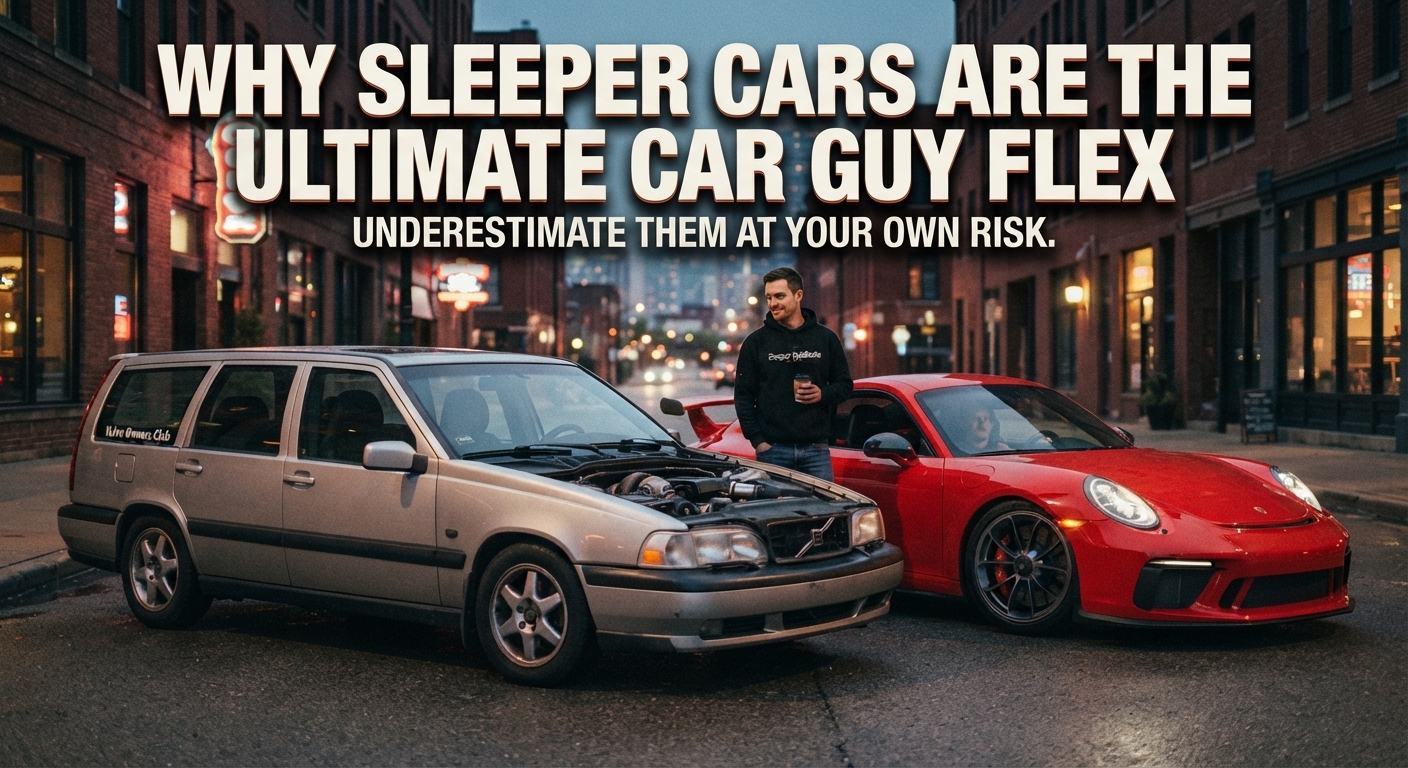
A modified WRX with a big wing isn't a sleeper. It's a fast car that announces itself. A visually stock Volvo wagon running a swapped turbo six that will walk away from a Hellcat? That's a sleeper, and that's the whole genre.
🧠 The Psychology: Why This Specific Flex Hits Different
Car culture is obsessed with status, and most status in car culture is visual. You see a widebody GT-R, you immediately know what it is and roughly what it cost. The information is right there on the surface.
Sleepers flip that completely. The status isn't visible until the owner chooses to reveal it, usually at the exact moment it does the most damage to someone else's ego. That control over information is a different kind of power than a loud exhaust note.
There's also a very specific kind of satisfaction that comes from being underestimated on purpose. Most car people have been dismissed at some point, either for their build, their car, or just for being a "car guy" in general. A sleeper lets you weaponize that dismissal. You want people to underestimate you. That's the trap.
And there's a story element too. A widebody build has a story about parts and money. A sleeper build has a story about a moment: the light turning green, the other driver's face, the exact second the gap between expectation and reality opens up. Car people love telling that story more than they love talking about their turbo size.
🏎️ The Legendary Sleepers That Built the Genre
Certain platforms have basically become sleeper folklore, repeated in forum threads and YouTube comments for years.
- The Buick GNX and turbo Regal. An 80s grandpa sedan that could out-accelerate a Corvette off the line. This is the sleeper that started the modern mythology, and it's still the reference point people compare every new sleeper build against.
- The Volvo wagon with a swapped or built engine. Boxy, safe, boring, the anti-sports-car. Which is exactly why a heavily built Volvo wagon running low 10s is such a perfect punchline.
- Minivans with drag-built drivetrains. There's an entire subculture of minivan drag builds specifically because nothing reads as "less threatening" than a minivan. The visual mismatch is the whole point.
- Panther-platform Crown Victorias and Grand Marquises, especially ex-police units, turbocharged or swapped. Boat-like sedans that used to chase criminals now chase quarter-mile times, and the "is that an unmarked cop car" hesitation is half the fun.
- Base-trim Camrys and Accords with built V6s or swaps. The most anonymous cars on American roads, which makes them some of the most satisfying platforms to hide serious power in.
None of these get built to impress people who already know cars. They get built to humble people who think they do.
🔧 What Actually Goes Into Building One
Sleepers take more discipline than flashy builds, not less. It's genuinely harder to make a car both fast and invisible than it is to make a car fast and loud.
Common approaches builders lean on:
- Engine swaps into unassuming bodies. Dropping a performance engine into a chassis nobody expects it in, keeping the factory badges and trim so nothing on the outside gives it away.
- Stock-appearing forced induction. Hidden intercoolers, tucked piping, boost controllers wired discreetly so a glance under the hood doesn't immediately reveal anything.
- Deliberately worn or aged exteriors. Some builders won't even wash the car regularly, on purpose, because a dirty, slightly beat-up exterior reads as "not worth racing" faster than a clean one.
- Stock wheels and tires, sometimes even slightly mismatched ones, because aftermarket wheels are one of the first things any car person clocks.
- Quiet exhaust setups, even when that means sacrificing some of the sound most builders chase, because a loud exhaust defeats the entire purpose of the build.
The irony is that sleeper builders often spend more time thinking about what to hide than what to add. Every visual decision runs through one filter: does this give it away.
🕵️ How to Actually Spot a Sleeper (Before You Get Embarrassed)
Most people find out a car is a sleeper the hard way, at a stoplight, after it's too late. But there are tells if you know where to look, and forums have basically turned this into a shared body of folk knowledge passed down through threads and comment sections.
Things that hint a "boring" car might not be:
- Exhaust tips that don't match the trim level. A base sedan with a slightly larger, slightly more purposeful-looking exhaust tip than the badge suggests is worth a second look.
- Tire and brake mismatches. Stock wheels but noticeably wider tires, or aftermarket brake calipers peeking out behind factory-style wheels, is a classic tell. Builders can hide bodywork easily. Hiding brakes big enough to stop real power is harder.
- A driving stance that sits slightly lower than stock, without the visual drama of a full stance build. Subtle suspension work without matching cosmetic changes is a strong signal.
- Sound over idle. Even a quiet exhaust often gives away a different cam profile or a built engine at idle if you know what a stock version of that car is supposed to sound like.
- The driver's confidence at the line. This one's not mechanical, but it's real. Sleeper owners tend to have a very specific calm when someone next to them revs. They're not nervous. They already know how this ends.
None of these are guarantees, and that's the point. A true sleeper is built to survive scrutiny from someone who's actually looking, not just someone glancing over from the next lane.
💸 The Economics Nobody Talks About
There's a financial angle to sleeper culture that doesn't get discussed as much as the psychology, and it's a big part of why the genre persists.
Building a visually loud car is often more expensive per horsepower than building a sleeper, because a huge percentage of the budget on a show-focused build goes toward things that don't make the car faster at all: wide body panels, paint, wheels, interior work. A sleeper build routes almost the entire budget into the drivetrain, since there's nothing to spend on cosmetically.
That also means sleepers tend to hold their resale value differently. A wild widebody build appeals to a narrower buyer looking for that exact aesthetic. A sleeper with documentation and receipts appeals to anyone who wants serious performance without the insurance premium, the attention from police, or the resale penalty that comes with a car that visually screams "modified." Insurance is actually a real, practical reason plenty of builders choose the sleeper route in the first place: a car that looks stock on paper and in person can genuinely cost less to insure than the same mechanical build wrapped in a visual package that flags it as a performance vehicle.
There's also a maintenance argument. Cosmetic mods, especially wide body kits and aggressive aero, are exposed to road damage, curbs, and weather in ways that don't affect a car's outward appearance if you never touch it. A sleeper's "bodywork" is just the factory bodywork, which means factory-level durability and zero risk of cracking a $3,000 fender flare on a parking curb.
🌍 Sleeper Culture Isn't the Same Everywhere
The specific cars that qualify as sleepers shift depending on where you are, because "unassuming" is relative to what's normal on the road around you.
In the American Midwest and South, a built full-size sedan or an old police interceptor reads as invisible because those cars are everywhere and nobody expects performance from them anymore. In places with heavier JDM influence, a visually stock Japanese sedan hiding an engine swap plays the same role, because those chassis are common enough to disappear into traffic. In parts of Europe, a diesel-badge estate car hiding a built turbo engine has become its own mini-genre, precisely because "diesel wagon" is about as far from "fast" as a car badge can get.
This regional variation is part of what keeps the genre alive online. A build that would be an obvious sleeper in one city might not register as surprising at all in another, so builders are constantly hunting for the next platform that's still invisible in their specific local context.
🛑 Where the Line Gets Blurry
Not everyone agrees on where "sleeper" ends and "just a fast normal car" begins, and forums argue about this constantly. A tuned WRX with subtle mods isn't really a sleeper, since a WRX already reads as a performance car to most people. A Tesla with ludicrous mode isn't a sleeper either, since electric torque is basically expected at this point and nobody's genuinely shocked anymore.
The purest sleepers exploit outdated assumptions about what a certain badge, body style, or era of car is capable of. That's part of why the genre keeps evolving. As more people learn that a base Camry V6 can be quick, or that Buicks used to build genuine muscle cars, the pool of genuinely surprising platforms keeps shrinking, and builders keep having to dig for the next car nobody expects.
Spota tip: if you're chasing sleepers instead of building one, that's exactly the kind of Photo Op moment a city playlist is built for. The unassuming daily that turns out to be hiding something is the spot worth grabbing before anyone else clocks it.
🎯 Why This Flex Isn't Going Anywhere
Car culture will always have room for wide bodies, big wings, and paint jobs that stop traffic. But there's a reason sleepers keep coming back as one of the most respected build styles in the scene: they reward patience, discipline, and a genuinely good story over pure visual noise.
Anyone can buy a body kit. Building a car that humbles people without ever raising its voice takes actual restraint, and restraint is rare in a hobby built around showing off. That contradiction, flexing by refusing to look like you're flexing, is exactly why sleepers earn more respect than almost anything else on four wheels.
Next time something boring and beige pulls up next to you at a light, maybe don't rev.
Related reading: check out Why Every Hellcat Owner Is on Borrowed Time and browse more culture breakdowns in Under the Hood.