
⛽ The Pump Argument That Never Dies
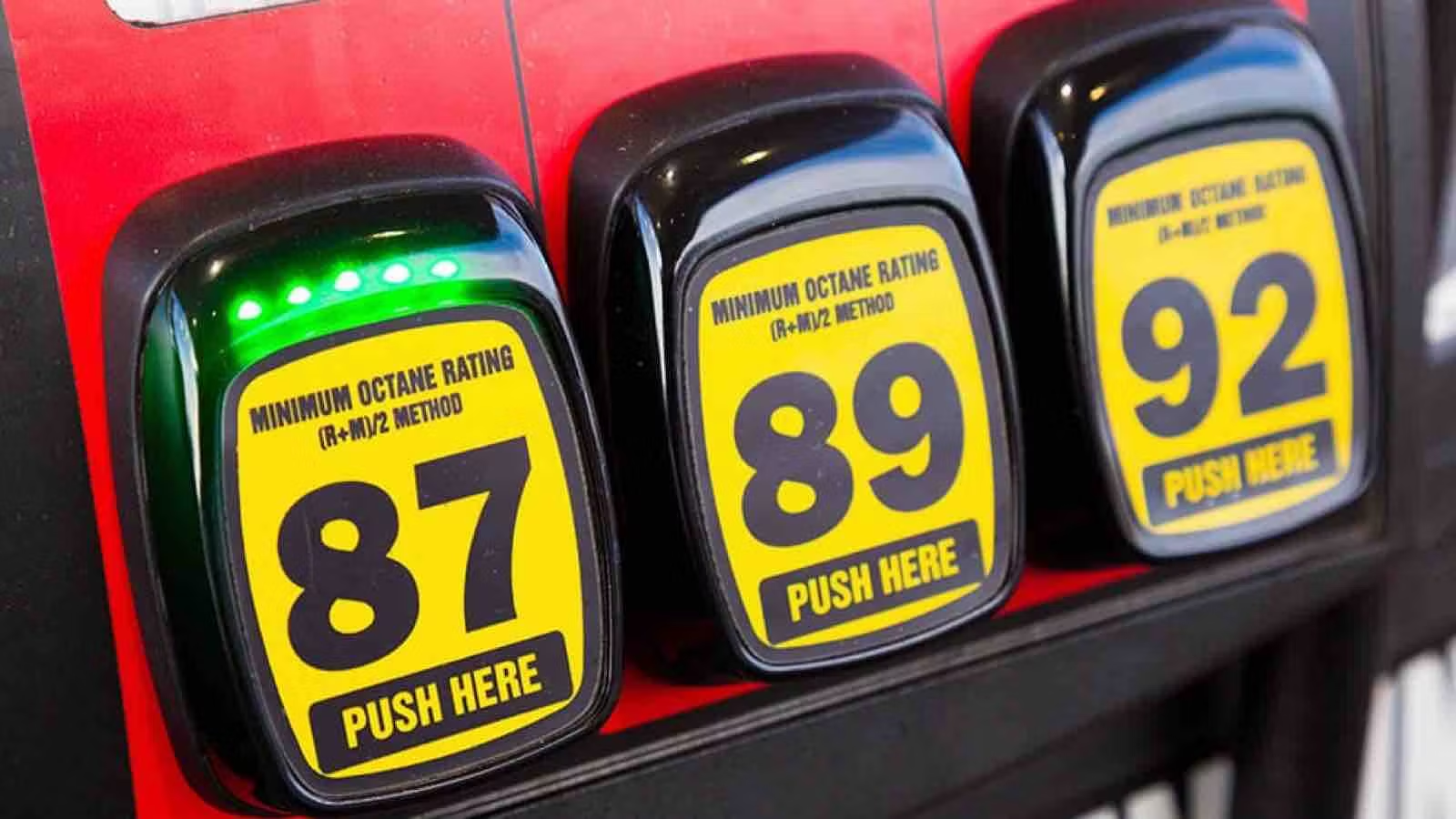
Stand at any gas station long enough and you'll see it. Somebody's fueling up a base-model sedan with 93 octane like it's holy water, and the guy next to them is running 87 in a car that specifically calls for premium. Neither one can fully explain why they're doing it. They just know they're right.
Octane is one of those topics that turns car people into armchair chemists. Everyone's got a theory. Premium cleans your engine. Premium gives you more power. Premium is a scam oil companies invented to charge you fifty cents more a gallon for the same gas. All three of those claims get repeated constantly, and all three are wrong in ways that matter.
Here's the actual answer, no myths, no marketing copy, just what octane does and who should care.
🔥 What Octane Rating Actually Measures
Octane rating has nothing to do with power, cleanliness, or quality. It measures one thing: how resistant the fuel is to detonating early under compression and heat.
In a normal, healthy combustion cycle, the spark plug fires and ignites the air-fuel mixture at exactly the right moment, and the resulting explosion pushes the piston down in a controlled, useful way. That's combustion working the way it's supposed to.
Knock (also called detonation or pre-ignition) is what happens when the air-fuel mixture ignites on its own, before the spark plug fires, because it got too hot and too compressed. Instead of one clean explosion, you get multiple uncontrolled ones happening out of sync with the engine's timing. You'll hear it as a metallic pinging or rattling sound under load, usually during acceleration or towing.
Higher octane fuel is simply more resistant to that early ignition. It doesn't burn "cleaner." It doesn't contain more energy. A gallon of 93 doesn't have more usable power sitting inside it than a gallon of 87. What it has is a higher resistance to detonating before it's supposed to, which lets an engine run a higher compression ratio or more aggressive ignition timing without knocking itself apart.
That's it. That's the whole chemistry lesson. Everything else is downstream of that one fact.
🚗 Who Actually Needs Premium
This is where the pump-side arguments usually go sideways, because "needs premium" and "recommended for premium" are two completely different categories, and most people don't know which one applies to their car.
Cars that require premium (91+):
- High-compression naturally aspirated engines (many performance V6s and V8s, older Euro performance cars)
- Turbocharged and supercharged engines running higher boost pressure, where cylinder pressures are already elevated and knock risk is real
- Engines with aggressive factory tuning that assumes premium fuel in the ECU's timing maps
If your owner's manual says "premium fuel required" and not just "recommended," running 87 in that car isn't a style choice. The ECU will pull timing to protect against knock when it detects lower-octane fuel, and you'll lose real power and efficiency doing it. Long-term, some engines that are pushed hard on fuel they weren't designed for can suffer accelerated wear, though modern knock sensors are good at preventing catastrophic damage. You're mostly just leaving performance on the table, not destroying the engine outright, but you are working against the tune the manufacturer built.
Cars that "recommend" premium are a gray area. The engine will run fine on regular. You might lose a small amount of power and efficiency that's genuinely hard to notice in daily driving. This is where a lot of the pump religion lives: people running premium in a car that only recommends it because it feels like the responsible thing to do, even though the actual measurable difference is marginal.
Cars that call for regular (87): this covers the overwhelming majority of vehicles on the road, including plenty of cars people assume need premium because they're "nice" or "expensive." Running premium in one of these does nothing. The engine isn't tuned to take advantage of the higher knock resistance, so you're paying more per gallon for a benefit your car literally cannot use.
💸 The Myth of "Premium Cleans Your Engine"
This one deserves its own section because it's the most common wrong belief in car culture, and it's wrong in a subtle way that makes it hard to argue against.
All gasoline sold in the US, regular and premium alike, is required by EPA regulation to contain detergent additives that keep intake valves and fuel injectors clean. That's been federal law since 1995. So in the most literal sense, no, premium doesn't clean your engine better than regular, because both are legally required to contain cleaning agents.
Where the myth gets its legs is that some brands market a "top tier" detergent package that exceeds the federal minimum, and some of those top-tier gas brands only offer that enhanced formula in their premium grades. So in specific cases, at specific stations, premium from a Top Tier-certified brand might carry more detergent than regular gas from a non-Top Tier station. But that's a brand and formulation difference, not an octane difference. You can get the same cleaning benefit from Top Tier-certified regular gas, and a full list of Top Tier brands is public and worth bookmarking if engine cleanliness is actually your concern.
Octane and detergent content are two completely separate variables that got merged into one myth because they both happen to live at the same pump.
🧠 The Psychology of Buying Premium Anyway
So why do so many car guys buy premium even when their car doesn't need it? A few real reasons, and they're not all irrational:
- Peace of mind. Even a marginal, hard-to-measure benefit feels worth an extra $3-5 per fill-up to someone who's put real money into their car. That's not stupid, that's a rational response to loving something you own.
- Placebo that isn't entirely placebo. Some drivers genuinely report smoother idle or slightly better throttle response on premium, even in cars that don't require it. Part of that is expectation. Part of it can be real, especially in higher-mileage engines that have accumulated some carbon buildup and benefit from a fuel blend with better detergent additives, independent of octane.
- Identity. In car culture, what you put in your tank is a small, constant signal about how seriously you take your build. Nobody's checking your receipts, but plenty of people are checking their own habits against an internal standard of "taking care of the car right."
- Modified engines change the math entirely. The moment you add a tune, an intake, a turbo upgrade, or anything that increases cylinder pressure or advances timing beyond stock, the factory's fuel recommendation stops applying. A modified engine that was fine on regular gas stock can absolutely need premium after the mods go in, and this is the one scenario where "just try it and see" is actually bad advice: run whatever octane your tuner specified, because guessing wrong here is how you find out what knock sounds like in person.
🔧 How to Actually Know What Your Car Needs
Skip the forum debates and go straight to the source:
- Check the fuel door. Most manufacturers stamp the minimum octane requirement right on the inside of the fuel door flap.
- Check the owner's manual. It will use one of two phrases: "premium fuel required" or "premium fuel recommended." That word choice is the entire answer. Required means required. Recommended means optional with a small tradeoff.
- If you've modified the engine, go by what your tuner specified for the calibration, not the factory sticker. A tune written for 93 octane run on 87 is a real knock risk, not a theoretical one.
- Listen for knock. A light pinging sound under acceleration or load, especially in hot weather or while towing, is your engine telling you it needs more octane resistance than it's currently getting. Modern ECUs will pull timing automatically to protect against this, which is safer but costs you power, so persistent knock is worth addressing with fuel or a mechanic, not ignoring.
Whatever's actually stamped on your fuel door, that debate at the pump isn't going anywhere, and honestly, that's part of the fun of car culture: everyone's got a strong opinion about something that takes ten seconds to actually verify. If you want more of these deep dives into the stuff car people argue about constantly, check out why every Hellcat owner is on borrowed time for the reliability side of the same instinct, or browse the full under the hood archive.
Spota tip: your Garage profile tracks the mods that actually change what your engine needs, so when you upgrade the turbo or drop in a tune, your build's history shows exactly when the fuel requirements changed too.
Fill it with whatever it actually needs. Your engine doesn't care about your ego, only your ECU's timing maps do.