
🌀 The Argument That Never Dies
Every car forum has this thread. Every group chat has had this fight. Somebody posts a dyno sheet, and within four replies somebody else is typing "torque is what you feel, horsepower is just a number" like it's scripture.
The other side fires back just as fast. "Horsepower is torque, you just don't understand the math." Both sides are convinced they're right. Both sides have been having this exact argument since before either of them was born.
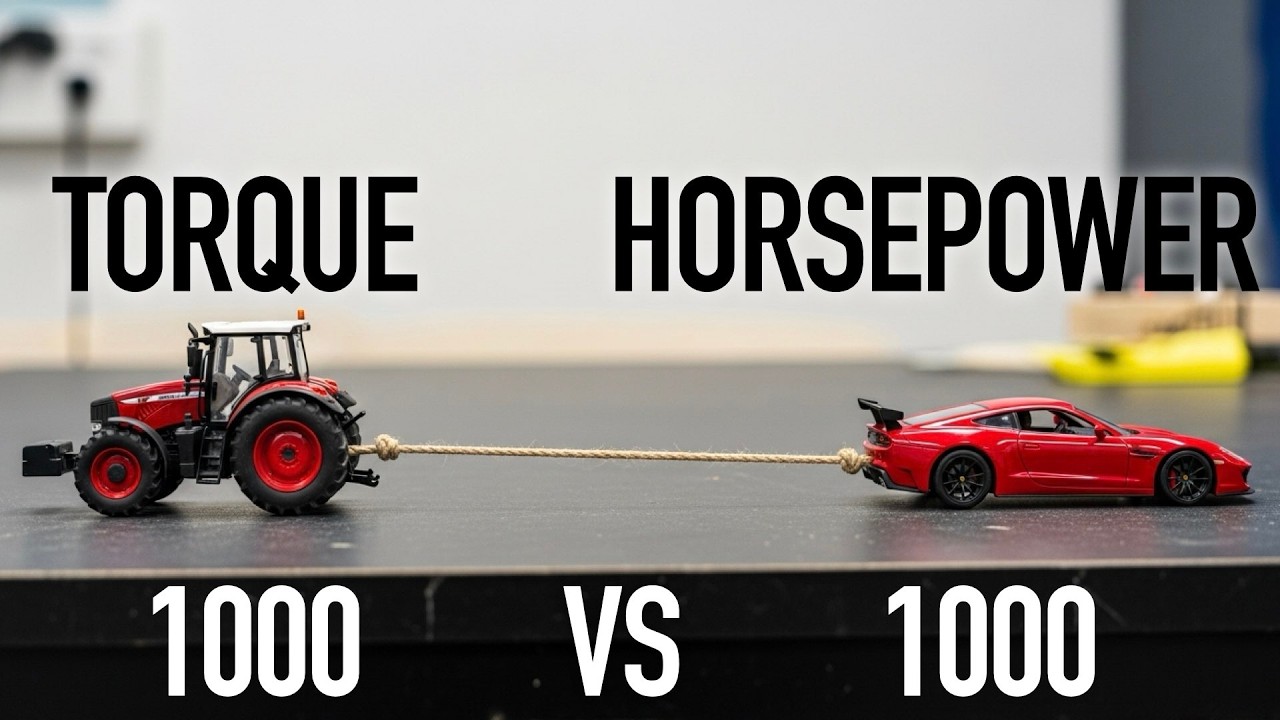
Here's the uncomfortable truth: they're both right, and they're both talking past each other. Torque and horsepower aren't rivals. They're two different ways of describing the same physical thing, measured at different points in the story. But the feel of each one is different enough that car people have built entire identities and buying decisions around picking a side.
Let's actually break down what these numbers mean, why the argument feels so unresolvable, and why your gut is right even when your math is wrong.
🔧 What Torque Actually Is
Torque is a twisting force. It's the engine's crankshaft trying to rotate against resistance, measured in pound-feet (lb-ft) in the US or Newton-meters (Nm) almost everywhere else.
Picture a wrench on a bolt. The length of the wrench times the force you apply to the end of it is torque. A longer wrench, or more force at the end of it, means more torque. Nothing about that description involves time or speed. Torque is pure twisting force, full stop.
In an engine, torque comes from cylinder pressure pushing down on a piston, which pushes on a connecting rod, which twists the crankshaft. More cylinder pressure at a given RPM means more torque at that RPM. That's why big-displacement engines and heavily boosted engines make huge torque numbers even at low RPM: more air and fuel getting crushed and ignited means more pressure shoving the piston down.
This is why torque is what you feel in your seat. When you mash the throttle and get shoved backward, that's torque multiplied through the drivetrain, acting on the mass of your body. A truck that can tow 12,000 lbs isn't doing it with horsepower. It's doing it with torque, applied low in the RPM range where it can actually move a heavy trailer from a dead stop.
⚡ What Horsepower Actually Is
Horsepower is a rate. Specifically, it's how fast work gets done, and it factors in both torque and RPM.
The formula that ends every one of these debates, whether people want to hear it or not:
Horsepower = (Torque × RPM) ÷ 5,252
That number, 5,252, isn't arbitrary. It's the exact RPM at which any engine's torque and horsepower curves cross on a dyno graph. Below 5,252 RPM, torque is numerically higher than horsepower. Above it, horsepower is higher. It's not a coincidence or a trick, it's just the math of the conversion factor lining up at that point.
Horsepower answers a different question than torque does. Torque asks "how hard is the engine twisting right now." Horsepower asks "how much work can this engine do over time." A high-revving 4-cylinder that only makes 150 lb-ft of torque can still make big horsepower if it can spin that torque figure out to 9,000 RPM instead of stopping at 4,000. That's the entire reason motorcycle engines and old Honda VTEC engines can put up horsepower numbers that seem absurd for their displacement: they're not making huge twisting force, they're making moderate force very fast, very often.
This is why horsepower is what wins races. Top speed and sustained acceleration are about how much work the engine can crank out per second, not how hard any single power stroke twists the crank. A car with big horsepower and a wide, high-revving powerband will run down a torquey but low-revving car once both are up to speed, even if the torquey car left the line harder.
🚛 Why Diesel Guys and Import Guys Live in Different Worlds
This is where the culture war really lives, and it's not actually a disagreement about physics. It's a disagreement about what job the car is supposed to do.
Diesel truck culture is a torque culture for a reason. A diesel pulling a 15,000 lb gooseneck trailer doesn't care about redline. It cares about not stalling at 1,200 RPM while dragging a house-sized load up a grade. Diesels make torque low and keep it flat, because that's exactly what towing and hauling actually require. Nobody towing a trailer wants an engine that only makes power at 8,000 RPM. The whole diesel truck world evolved around torque because torque is the metric that actually correlates with the job diesels do.
Import and sport-compact culture is a horsepower culture for the opposite reason. A canyon-carving Miata or a track-day Civic Type R isn't dragging anything. It's trying to carry speed through corners and make the most of every ounce of weight. High-revving, naturally aspirated engines that make their peak numbers near redline reward a driver who can keep the engine in its power band through a gearbox. That world evolved around horsepower and RPM because that's the metric that predicts lap times.
Neither camp is wrong about their own use case. The Cummins guy towing a job site trailer genuinely does not care what his truck makes at 7,000 RPM, because his truck will never see 7,000 RPM. The Type R guy tracking his car genuinely does not care about torque at idle, because idle isn't where he's driving. The argument feels unresolvable because it's actually two different questions dressed up as one.
🏁 Which One Actually Wins a Street Race
Here's the part that annoys the torque-only crowd: in a straight-line race between two similarly-weighted cars, horsepower correlates more directly with how fast you get to the end of the track, because horsepower already accounts for how the torque curve behaves across the whole rev range, not just at one point.
But torque still decides how the race feels off the line, and off-the-line feel is a huge part of why torque has such a strong emotional pull. A low-RPM torque monster snaps your head back immediately. A peaky, high-horsepower engine might actually be faster by the finish line while feeling less dramatic doing it. Car people remember the feeling, not the stopwatch, which is a huge part of why torque wins the argument even when horsepower wins the race.
Weight matters more than either number in isolation. A 3,000 lb car with 300 horsepower will out-accelerate a 5,000 lb car with 400 horsepower in almost every real-world scenario, because power-to-weight ratio, not raw horsepower, is what actually predicts acceleration. This is why enthusiasts obsess over curb weight almost as much as they obsess over the dyno sheet: a car that's light enough doesn't need to win either argument to be fast.
🛠 A Few Numbers Worth Knowing
- A stock Toyota 22R 4-cylinder makes about 116 lb-ft of torque and 105 horsepower, torque-heavy and slow-revving, built for trucks that needed to pull, not sprint.
- A Honda S2000's F20C makes only about 153 lb-ft of torque but revs to 9,000 RPM, letting it make 240 horsepower out of a 2.0L engine with zero forced induction.
- A modern diesel pickup can make 1,000+ lb-ft of torque while topping out well under 500 horsepower, because it's tuned to dominate at low RPM and never needs to rev high.
- A modern turbo 4-cylinder in something like a Civic Type R makes torque and horsepower numbers that are almost identical (around 300 of each), because forced induction flattens the torque curve out across a wider RPM range than naturally aspirated engines can manage.
None of these engines are "wrong." They're each built for the specific job their torque and horsepower numbers describe.
📟 Why Your Dyno Sheet Might Be Lying to You
This is where the argument gets even messier, because not all horsepower numbers are measured the same way, and most people arguing online have no idea.
Manufacturer horsepower ratings are almost always crank horsepower, measured at the flywheel before power passes through the transmission, driveshaft, differential, and wheels. Every one of those components eats a little bit of power through friction and heat. By the time that power actually reaches the pavement, you've lost somewhere between 15 and 25 percent of it, depending on the drivetrain.
Dyno numbers you see posted on forums are almost always wheel horsepower, measured with rollers under the driven wheels. That's a real, honest number for what the car is actually putting down, but it's not directly comparable to a manufacturer's crank figure without doing the math on drivetrain loss first.
This is exactly why a "300 horsepower" car can dyno at 240 to the wheels and both numbers are technically correct. It's also exactly why arguments break out when someone posts a dyno sheet as proof their car "isn't as fast as advertised." They're comparing two different measurement points and calling it a contradiction.
Dyno type matters too. A dynojet-style dyno and a Mustang dyno (chassis dynos that measure the wheels spinning rollers) will read differently from an engine dyno (which measures the crank directly, before the drivetrain). Even two chassis dynos of the same brand can read a few percent apart depending on calibration, weather correction factors, and how the car is strapped down. None of this is a conspiracy. It's just why "my buddy's car dynoed higher" arguments are almost always comparing apples to a slightly different kind of apple.
🧮 SAE vs. Gross Horsepower: The Muscle Car Trap
If you've ever wondered why a 1970 muscle car rated at 375 horsepower feels nowhere near as fast as a modern 375 horsepower car, the answer isn't nostalgia. It's the measurement standard.
Before 1972, American automakers rated engines in gross horsepower: tested with no accessories attached, no exhaust restriction, no emissions equipment, sometimes even without a functioning cooling fan. It was a best-case, lab-bench number that had almost nothing to do with how the engine performed sitting in the actual car.
After 1972, the industry switched to SAE net horsepower, measured with the engine fully dressed the way it actually ships: accessories, exhaust, air filter, emissions gear, all of it. Net numbers are dramatically more honest, which is exactly why horsepower ratings across the entire industry appeared to crater overnight in the early 70s. The engines didn't get weaker. The way we were allowed to lie about them got fixed.
This is a huge, underrated reason muscle car debates between old-school and modern car guys go nowhere. A "425 horsepower" 1969 big block and a "425 horsepower" modern V8 are not the same claim, even though the number on the page is identical.
🚫 Myths That Won't Die
"Horsepower is just marketing, torque is what's real." Both numbers come from the exact same measurement (cylinder pressure over time), they're just expressed two different ways. Neither one is more "real" than the other, they answer different questions.
"You can't have horsepower without torque." True, but trivial. You also can't have torque output at any RPM without some amount of horsepower being produced at that RPM, since horsepower is derived from torque and RPM together. The relationship goes both directions.
"Bigger torque number always means a stronger engine." Not necessarily. A tractor engine can have a torque number that dwarfs a sports car's and still be a fraction as powerful overall, because it never gets anywhere near the RPM needed to convert that torque into meaningful work over time.
"Forced induction is cheating." Turbos and superchargers don't break the torque-horsepower relationship, they just let a smaller engine act like a bigger one by cramming more air in. The math still works exactly the same way once the boost is accounted for.
🔩 What This Actually Means When You're Modifying a Car
This isn't just a bar-stool argument, it actually changes what mods make sense for your car.
If you daily drive in stop-and-go traffic or tow anything, prioritizing low-end torque (bigger displacement, more boost at low RPM, taller gears) will make the car feel dramatically faster in real-world use, even if the peak horsepower number doesn't move much.
If you track your car or care about top-end pull, prioritizing horsepower and where the power band lives (cam timing, headwork, higher redline, shorter gearing) matters more than chasing a bigger torque number that peaks at 2,500 RPM and falls off a cliff after that.
A wide, flat torque curve is genuinely the best of both worlds, and it's why tuners obsess over "area under the curve" more than any single peak number. A car that makes 90 percent of its peak torque from 2,000 RPM all the way to redline will feel faster in nearly every real-world situation than a car with a higher peak number that only shows up in a narrow band.
🎯 So Who's Actually Right
Both of them. That's the annoying answer, but it's the true one. Torque tells you how an engine feels right now. Horsepower tells you what an engine can do over time. A truck guy and a track guy aren't disagreeing about physics, they're prioritizing different halves of the same equation because their cars do different jobs.
Next time the thread starts up again, you don't have to pick a side. You can just point out that the guy towing a trailer and the guy chasing a lap record are both right, about their own car.
Spota tip: pull up your car's specs in your Garage and you'll see both numbers side by side. It's a small thing, but seeing your own torque and horsepower curves next to each other makes this whole debate click in a way a forum post never will.
If you want to go deeper on engine culture, check out why rotary engines are so beloved despite being so unreliable or browse more explainers in Under the Hood.
The dyno sheet doesn't lie. It just doesn't tell the whole story either.