
🐐 "Just LS Swap It"
Type almost any car problem into a forum search bar. Not enough power. Engine blew. Want something reliable. Want something loud. Within three replies, somebody says it: just LS swap it.
It's not a suggestion anymore. It's a reflex. Miata guys LS swap Miatas. Truck guys LS swap trucks that already came with LS engines, just newer ones. There are LS-swapped Volvos, LS-swapped Jeeps, LS-swapped boats, and yes, at least one very real LS-swapped riding lawnmower on YouTube with actual dyno numbers.
The joke writes itself because it's mostly true. But underneath the meme is a genuinely rational engineering decision that's been made independently, by hundreds of thousands of people, for almost 30 years straight. That's not random. That's a pattern with real physics and real economics behind it.
Let's break down why the LS became car culture's default answer, why it actually deserves the reputation, and where the meme starts writing checks the swap can't cash.
🔧 What "LS" Actually Means
The Family, Not the Engine
"LS" isn't one engine. It's GM's small-block V8 family that launched with the LS1 in the 1997 C5 Corvette and ran through multiple generations, displacements, and platforms until GM moved to the LT family in 2014. Somewhere along the way, "LS" became shorthand for the whole lineage, LS1, LS2, LS3, LS6, LS7, LSX, even the Vortec truck versions (5.3L, 6.0L) that share the same architecture.
That's part of why the swap culture is so deep. You're not choosing between one engine and its alternatives. You're choosing between dozens of displacement, output, and cost combinations that all bolt up roughly the same way.
Why It Spread So Far
GM put these engines in almost everything for two decades: Corvettes, Camaros, Firebirds, GTOs, Silverados, Suburbans, Escalades, even some Buicks and Cadillacs. That means junkyards, salvage auctions, and Facebook Marketplace are absolutely flooded with them. A running LS out of a wrecked Silverado with 120,000 miles can show up for $800-1,500. Compare that to sourcing a clean JDM 2JZ or a healthy Coyote and the price gap alone explains a lot of the appeal.
📐 The Physics: Why It Actually Fits
Size and Weight
This is the part that separates the LS from "cheap power" and turns it into "the swap that just works." The LS block is remarkably compact and light for a V8. A cast-iron LS short block weighs around 430-460 lbs, and aluminum-block versions (LS1, LS2, LS3, LS6, LS7, LS9) drop closer to 380-400 lbs, right in the neighborhood of a lot of inline-six and even some V6 engines.
That matters enormously for swap geometry. A V8 that's roughly the same physical footprint and weight as the factory engine it's replacing means the swap isn't fighting the car's suspension geometry, weight balance, or firewall clearance nearly as hard as a big-block or a modern direct-injected V8 with more accessories crowding the bay.
Why this matters for swaps:
- Fits engine bays designed around inline-fours and sixes
- Doesn't wreck factory weight distribution as badly as heavier V8s
- Deep aftermarket of mounts and headers built specifically around this footprint
- Compact accessory drive options (LS accessory kits) keep the front of the engine narrow
Simplicity Under the Valve Covers
LS engines use a pushrod, two-valve-per-cylinder design instead of an overhead cam layout. That sounds like a step backward on paper, and for peak-RPM screamers, it kind of is. But for swap logistics, it's a massive advantage:
- Shorter engine overall: no cam towers or timing chains stretching the front of the engine forward
- Simple accessory drive: no complex VVT wiring or dual-cam timing to manage
- Fewer sensors to fake out: easier to run a standalone harness without fighting a factory ECU that expects a dozen inputs from systems that no longer exist in the donor car
That last point is huge. A big reason LS swaps dominate compared to, say, swapping a modern turbo four-cylinder, is that the wiring and tuning ecosystem around LS engines is so mature that a competent shop (or a patient hobbyist with a laptop) can get one running reliably in a weekend using a standalone harness.
💰 The Parts Economy Nobody Else Has
Three Decades of Aftermarket Investment
When an engine platform runs for that long, in that many vehicles, at that volume, the aftermarket doesn't just support it. It builds an entire industry around it. Headers, oil pans, motor mount kits, transmission adapter plates, standalone harnesses, cam packages, forged internals, turbo manifolds: all of it exists off the shelf for nearly every popular swap combination (LS-into-Miata, LS-into-Fox-body-Mustang, LS-into-S13, LS-into-BMW E30).
What that means practically:
- You're not fabricating one-off parts, you're bolting together a known-good recipe
- Someone has already solved the clearance problems for your specific car
- Written guides, forum threads, and YouTube builds exist for almost every combination
- Resale value stays strong because the next owner knows exactly what they're buying into
Compare that to a swap using a rare, low-production engine. Even if the engine itself is fantastic, you're paying a fabrication tax for every mount, every adapter, every wiring solution because nobody's done it a thousand times before you.
Power Potential Per Dollar
Stock LS engines already make solid numbers (LS3 is rated around 430 hp from the factory in Camaros and Corvettes), but the real draw is how cheaply that number climbs. A set of long-tube headers, a cam swap, and a tune can push a naturally aspirated LS well past 450-500 rear-wheel horsepower for a fraction of what comparable gains cost on a lot of other platforms. Add forced induction, and the factory-strong bottom end (especially on later LS3/L92-style blocks) can often handle 600-700+ horsepower with stock internals if the tune is conservative.
Spota tip: if you're building one of these out and want the progression documented properly instead of scattered across three different forum threads, that's exactly what the Garage is for. Log the swap, the parts, the dyno pulls, all of it stays attached to the car's actual timeline.
🚗 Where LS Swaps Actually Show Up
The Classics
Some LS swap combinations are so common they've basically become their own sub-genre of car culture:
- Fox-body Mustangs: already V8-friendly chassis, LS swap adds modern reliability and power over the factory 5.0
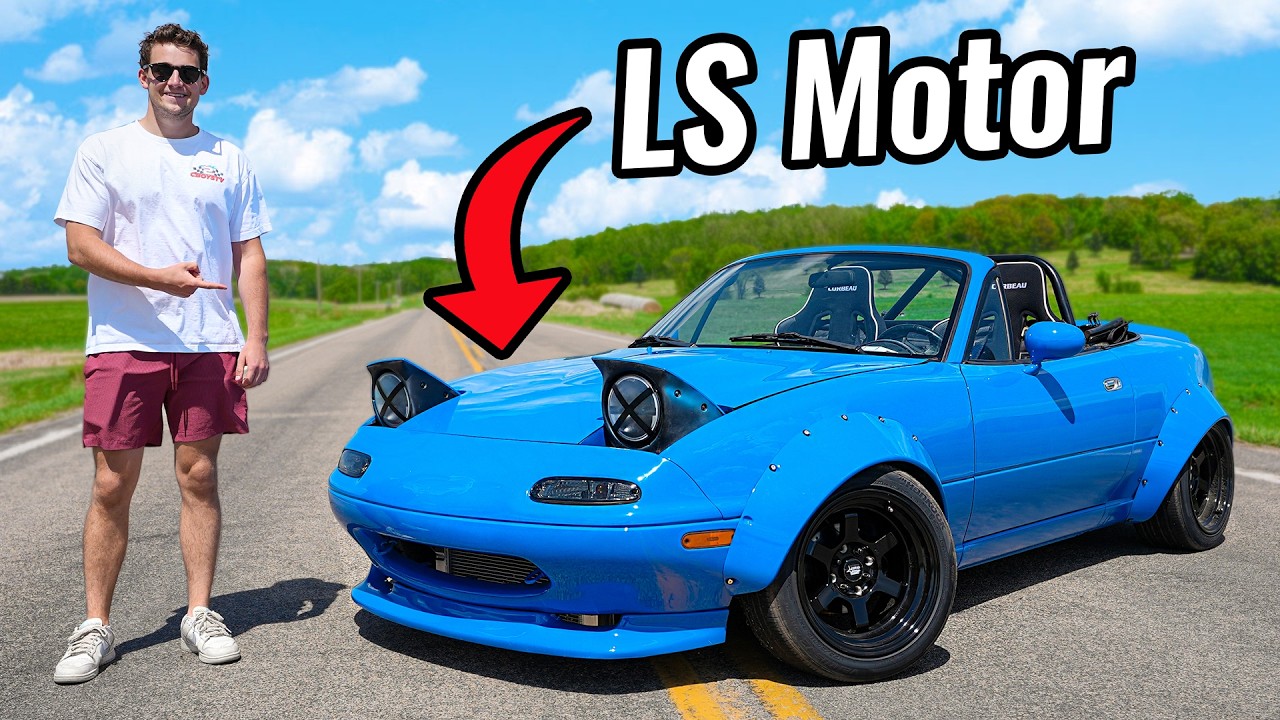
- Miatas (NA/NB): the "LS Miata" meme is real and it's a genuinely brutal little car when done right, huge power-to-weight
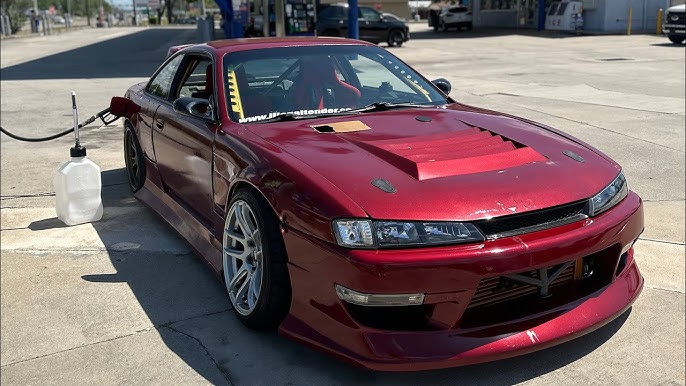
- 240SX/S-chassis: RWD, lightweight, drift-friendly, LS swaps are almost as common as the factory SR20 at this point
- G-body GM cars (Monte Carlo, Grand National, Cutlass): factory GM chassis, LS drops in with minimal drama
- Trucks and Jeeps: often already had a lesser LS or a completely different engine, swap in a stronger LS variant for towing or off-road torque
- Boats: marine LS conversions are a whole niche industry unto themselves, prized for weight and reliability over traditional marine V8s
The Ones That Get Memed
Then there's the extended universe: the LS-swapped riding mower, the LS-swapped golf cart, the LS-swapped rear-engine VW Beetle. These exist because once a platform gets culturally established as "the answer," people start applying it as a joke that's also technically functional. That's exactly how memes propagate in car culture: start with something genuinely useful, push it to its logical (and illogical) extreme.
⚖️ Where the Meme Runs Into Reality
It's Not Actually a Weekend Project
"LS swap it" gets said casually, but a proper swap involves motor mounts, transmission mating, wiring, fuel system upgrades, cooling system rework, exhaust routing, driveshaft or axle modifications, and usually a tune. Even with every off-the-shelf part available, a first-time swap realistically eats a few weekends minimum, and a lot more if you're fabricating anything custom or dealing with a chassis that doesn't have a well-documented swap kit.
Common surprises first-timers hit:
- Steering shaft or oil pan clearance issues depending on the chassis
- Factory fuel system not flowing enough for the new engine
- Cooling system needing a bigger radiator and different routing
- Wiring gremlins from a rushed standalone harness install
- Driveshaft length or transmission tunnel clearance problems
Weight Distribution Isn't Free
Yes, the LS is light for a V8. It's not light compared to the four-cylinder or inline-six it's usually replacing. Dropping one into a Miata or a 240SX shifts weight distribution toward the front, and if the suspension and chassis setup isn't adjusted to compensate, you can turn a balanced chassis into a nose-heavy one. The best LS-swap builds account for this with corner-balancing, spring rate changes, and sometimes battery relocation to the trunk to claw back some balance.
Reliability Depends Entirely on Execution
The LS's reputation for bulletproof reliability is earned in factory form and in swaps done correctly. It evaporates fast when corners get cut: cheap standalone harnesses with bad grounds, undersized fuel systems leaning out the engine under boost, sketchy motor mounts that let the engine walk and tear up wiring. A lot of "LS swaps are unreliable" horror stories trace back to installation shortcuts, not the engine itself.
🧠 Why the Meme Says Something Real About Car Culture
It's Community Knowledge Compounding
The reason "LS swap everything" is funny is the same reason it's useful: it represents thousands of individual builders sharing what worked, refining the process, and converging on a default. That's how car culture actually improves over time, not through manufacturer R&D, but through a decentralized, forum-and-YouTube-driven feedback loop where the community collectively de-risks a build path until it becomes the obvious answer.
It's the same instinct that drives people to document builds, post dyno pulls, and argue about torque numbers at 11 PM. The LS swap became the default because enough people cared enough to solve the problem publicly, over and over, until it stopped being a gamble.
That's the same energy behind why car guys become mechanics after buying mods: nobody plans to become an expert in fuel systems and wiring harnesses, but chasing a build far enough usually gets you there. If you're deep in a swap build (or thinking about starting one), browse more of under the hood for the reliability and mechanical deep-dives that tend to come up mid-build.
The Punchline Is the Point
"Just LS swap it" works as a joke precisely because it's not wrong often enough to be pure sarcasm. That's rare for a meme. Most car culture memes exaggerate a kernel of truth into absurdity. This one barely has to exaggerate at all, which is exactly why it's stuck around for almost two decades and shows no sign of dying.
❓ FAQs
What does "LS swap" actually mean?
Replacing a car's factory engine with a GM LS-series V8 (or a closely related Vortec truck engine), typically sourced from a wrecked Corvette, Camaro, or GM truck, using aftermarket mounts, headers, and a standalone wiring harness.
Why is the LS engine so popular for swaps specifically?
It's compact and light for a V8, mechanically simple (pushrod design, no complex VVT wiring to manage), extremely common in junkyards after 25+ years of production, and supported by a massive aftermarket of swap-specific parts for almost every popular chassis.
How much does a typical LS swap cost?
A budget swap using a junkyard engine, basic mounts, headers, and a standalone harness can land in the $4,000-7,000 range including labor if you're doing most of the work yourself. Full turnkey shop builds with forged internals and a proper tune can run well past $15,000.
Is an LS swap reliable?
Yes, when done correctly. The engine itself has an excellent reliability reputation. Most LS swap failures trace back to installation shortcuts: bad wiring, undersized fuel systems, or poor motor mount setups, not the engine platform itself.
What cars are most commonly LS swapped?
Fox-body Mustangs, Miatas, 240SX/S-chassis cars, G-body GM cars, and trucks/Jeeps are the most common and best-documented swaps, with extensive aftermarket support and established build guides.
Does an LS swap hurt handling?
It can if the weight distribution isn't addressed. The LS is light for a V8, but usually still heavier than the four-cylinder or six-cylinder it's replacing, so front weight bias increases unless the build compensates with suspension changes or component relocation.
How much power can a stock LS handle?
Later LS3/L92-style blocks with stock internals commonly handle 600-700+ horsepower on forced induction with a conservative tune, though this varies by specific engine generation and build quality.
The LS swap became car culture's punchline because it became car culture's answer first. Every joke about swapping one into a lawnmower is standing on top of thirty years of people actually solving the problem, one build thread at a time.