
⚖️ The Number Nobody Puts on a Sticker
Ask a car guy how fast his car is and he'll rattle off horsepower before you finish the question. Ask him what his car weighs and half the time he has no idea. That's backwards, and the enthusiasts who actually win at the track figured it out a long time ago.
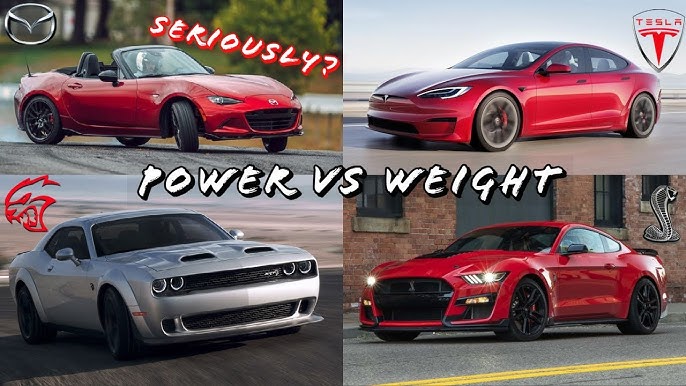
Horsepower is the number dealerships sell. Power-to-weight is the number that decides what actually happens when you put your foot down. A 300 horsepower Miata will run circles around a 400 horsepower truck, not because the math is close, but because one of them is hauling around two extra tons of steel doing absolutely nothing for you.
This isn't some secret. Racers have known it since before horsepower wars were a marketing strategy. But it's having a real moment in mainstream car culture right now, as more enthusiasts get priced out of raw power and start looking for a cheaper way to go faster: taking weight out instead of stuffing more engine in.
Let's get into why the ratio matters more than either number alone, why cutting weight is the most underrated mod in the game, and why the cars everyone actually respects on a back road are usually lighter than you'd think.
🧮 The Physics Nobody Argues With
Power-to-Weight Is Just Acceleration, Explained
Power-to-weight ratio is horsepower divided by weight, usually expressed as horsepower per ton or per pound. It's not a vibes stat. It's close to a direct measurement of how hard a car can accelerate, because acceleration is force divided by mass, and horsepower is just a measure of how much force an engine can apply over time.
The basic relationship:
- More horsepower, same weight = faster acceleration, straightforward
- Same horsepower, less weight = faster acceleration, just as real
- More horsepower, more weight = you might not actually be faster at all
- Less horsepower, way less weight = frequently beats a heavier car with way more power
That last one is the one that breaks people's brains the first time they see it happen at a track day. A stripped-out, sub-2,500-pound car with 200 horsepower has a power-to-weight ratio of roughly 160 hp/ton. A 3,800-pound sports coupe needs almost 300 horsepower just to match that number. The lighter car isn't cheating. It's just not fighting its own mass on every corner exit.
Why Horsepower Alone Is a Marketing Trick
Horsepower numbers are easy to slap on a window sticker and easy to brag about at a meet. Weight is inconvenient. It doesn't sound impressive, it changes with every option package and passenger, and manufacturers have zero incentive to advertise it since modern safety regulations, sound deadening, infotainment hardware, and emissions equipment have made basically every new car heavier than the generation before it.
That's the quiet reason horsepower figures have climbed so aggressively over the last two decades. A lot of that power isn't buying you extra performance. It's buying back the performance that curb weight quietly stole.
📉 The Weight Creep Nobody Talks About
Every Generation Gets Heavier
Look at almost any nameplate across three or four generations and the pattern is identical. The Honda Civic ballooned from around 2,100 pounds in the late '80s to well over 2,900 pounds today. The Ford Mustang has gained close to a thousand pounds since the Fox Body era. Even the Miata, the car whose entire philosophy is "light is right," has crept up generation over generation, and Mazda has had to actively fight that trend on purpose just to keep the formula intact.
Where the extra weight comes from:
- Crash safety structure: More reinforcement, more airbags, more crumple engineering
- Sound deadening: Modern buyers expect a quiet cabin, and that costs mass
- Infotainment and electronics: Screens, wiring harnesses, sensors, cameras
- Emissions hardware: Catalytic converters, particulate filters, extra plumbing
- Comfort features: Power everything, bigger seats, climate control zones
- Bigger wheels and brakes: Larger factory wheel sizes trend up every redesign
None of this is evil. Cars are safer and quieter than they've ever been, and that's genuinely good. But it means the "sporty" trim of a modern compact often weighs what a mid-size sedan weighed twenty years ago, and manufacturers have had to keep pace by adding horsepower just to keep 0-60 times from getting embarrassing.
The Turbo Four Compromise
This is a big part of why nearly every performance car under $50,000 now runs a turbocharged four-cylinder instead of a bigger naturally aspirated engine (a debate that deserves its own deep dive). A turbo four is lighter over the front axle than a comparable six or eight, which helps offset weight gained everywhere else in the car, while still hitting the power-to-weight target buyers expect from a "fast" trim level.
🏁 Why Racers Never Stopped Caring
Lotus Had It Figured Out Decades Ago
Colin Chapman, the founder of Lotus, built an entire racing and road car philosophy around one sentence: "simplify, then add lightness." Lotus cars were never the most powerful thing on the grid. They were consistently among the lightest, and that let a modest engine punch far above its horsepower number. That philosophy is why enthusiasts still cross-shop a 25-year-old Elise against cars with double the power and lose, more often than they'd like to admit.
Where weight obsession shows up hardest in motorsport:
- Time attack and autocross: Every pound removed is measurable lap time, no debate
- Drag racing: Weight reduction is one of the first mods in any serious build sheet
- Spec racing classes: When power is locked by rules, weight is the only variable left
- Rally: Weight transfer and unsprung mass directly change how a car rotates
Anyone who's actually competed will tell you the same thing: cutting fifty pounds is often cheaper and more effective than chasing fifty extra horsepower, and it usually improves braking and cornering too, not just acceleration.
It's Not Just Straight-Line Speed
Power-to-weight gets talked about mostly in acceleration terms, but weight affects everything else about how a car drives. Braking distance scales with mass. Tire wear scales with mass. Suspension load, chassis stress, and how quickly a car changes direction all scale with mass. A lighter car isn't just quicker in a straight line, it stops shorter, corners harder on the same tires, and is gentler on brakes and suspension components over time. That's why weight reduction shows up in nearly every serious performance build, not just the drag-strip focused ones.
🔧 How Enthusiasts Actually Cut Weight
The Easy Wins
Common weight reduction steps, roughly in order of effort:
- Removing spare tire and jack: Often 30-50 pounds for basically zero effort
- Deleting rear seats: A track-only move, but a real one, often 40-80 pounds
- Lightweight wheels: Forged wheels cut both weight and rotational mass, which matters more than static weight
- Polycarbonate or lightweight glass: Common on dedicated track builds, less common on street cars
- Sound deadening removal: Controversial since it makes the cabin louder, but it's real weight
- Battery relocation or lithium swap: Popular in the drift and time attack scenes
- Lightweight seats and harnesses: Swapping heavy power seats for fixed-back racing buckets
The Tradeoffs Nobody Skips Talking About
Every one of these has a cost. Pull the spare tire and you're stuck with a repair kit and a phone call if you get a flat on a road trip. Pull the rear seats and the car stops being useful for anything but track days. Go too aggressive with sound deadening removal and the cabin turns into a drum on the highway. This is exactly why weight reduction is treated as a build philosophy decision, not a universal mod: a street car and a dedicated track car should not be optimized the same way, and the enthusiasts who get burned are usually the ones who copy a stripped-out build sheet onto a car they still commute in every day.
Spota tip: if you're logging a build in your Garage, weight reduction milestones are some of the most satisfying progress markers to track over time, right alongside the visible mods. It's a lot easier to see the payoff of "removed 90 pounds this month" when it's sitting next to your lap time notes instead of buried in a forum post you'll never find again.
🚗 The Cars That Prove the Point
Light Cars Punch Above Their Number
A few well-known examples of the ratio in action:
- Mazda Miata (ND): Around 155-181 horsepower depending on trim, but under 2,400 pounds, which is why it's still one of the most respected handling cars on the market despite modest power
- Lotus Elise/Exige: Famously light, famously quick for the power on paper, exactly the Chapman philosophy in production form
- Caterham Seven: Barely over 1,000 pounds in some configurations, which means even modest four-cylinder power delivers supercar-level acceleration numbers
- Original Mini Cooper: A cult classic specifically because a small engine in a tiny, light body feels genuinely quick
Compare any of those to a heavier car with double the horsepower and the lighter car frequently wins the "fun on a back road" argument, even when it loses the straight-line drag race. That's the split enthusiasts are actually chasing: raw numbers get you bragging rights at a meet, but power-to-weight is what makes a car feel alive from behind the wheel.
Sleeper Culture and Weight Play a Role Too
There's some overlap here with why sleeper builds are the ultimate flex: a lot of the best sleepers aren't just hiding power under a stock-looking body, they're hiding a build that quietly shed weight nobody would notice from the outside. It's a lot easier to sandbag a car's reputation when the spec sheet reads "unremarkable" and the actual power-to-weight ratio reads "not unremarkable at all."
🛠 Why This Matters More As Cars Get Bigger
The auto industry isn't trending toward lighter cars anytime soon. EVs, in particular, are adding significant weight from battery packs, which is reviving the power-to-weight conversation in a new form, since EV enthusiasts are now running into the exact same physics that combustion car guys have argued about for decades, just with a battery instead of an engine block as the extra mass.
That's part of why the debate around where V8s are headed keeps circling back to weight too. It's not only about the sound or the displacement. It's about whether the platform underneath the engine is light enough to let that power actually do something, instead of getting absorbed by a curb weight number that keeps climbing every model year.
Enthusiasts who understand this stop asking "how much horsepower does it have" as the only question. They start asking what it weighs, what the ratio comes out to, and whether the platform was built to let that number matter. That's the difference between a car that's fast on a spec sheet and a car that's actually fast to drive.
📐 How to Actually Work Out Your Own Ratio
The Math Takes Thirty Seconds
You don't need a dyno or an engineering degree to figure out where your car actually stands. Grab your engine's rated horsepower and your car's curb weight (both are public for basically every production car, and easy enough to estimate on a modified one), then divide weight by horsepower to get pounds per horsepower, or flip it and multiply by 2,000 to get horsepower per ton.
A rough scale for pounds per horsepower:
- Under 8 lbs/hp: Genuinely quick, supercar or dedicated performance-car territory
- 8-12 lbs/hp: Fast hot hatch or sports car range, where most enthusiast builds land
- 12-16 lbs/hp: Quick enough to be fun, but not going to embarrass anyone at the strip
- 16-20 lbs/hp: Typical family sedan or crossover territory
- 20+ lbs/hp: Economy car or work truck, acceleration is not the point
Run this math on your own car and then run it on the build you're planning. A lot of enthusiasts sink money into an intake and exhaust that add 15 horsepower, when pulling 150 pounds of interior and hardware would have moved the ratio further for less money. It's not that bolt-on power mods are bad, it's that weight is the cheaper lever more often than people assume, and it's the one almost nobody checks the math on before they start spending.
Where the Math Gets Misleading
The ratio isn't the whole story, and pretending it is gets people into arguments they can't actually win. Torque curve shape matters. A car that makes its power high in the rev range feels very different from one that makes the same peak number low down, even at an identical power-to-weight ratio. Drivetrain losses matter too: a car losing 20% of its power through an all-wheel-drive system isn't putting the same number to the ground as the spec sheet claims. Weight distribution matters just as much as total weight, since a light car with all its mass over the front axle still understeers like a heavier one. Power-to-weight is the single best shorthand available, but it's a starting point for understanding a car, not the final word on how it'll actually feel.
🧠 The Myths That Keep Getting Repeated
A few things car guys get wrong about weight, over and over:
- "Weight only matters for acceleration." It doesn't. Braking distance, tire wear, cornering grip, and suspension stress all scale with mass, not just 0-60 time.
- "A bigger engine automatically means a heavier car." Not always true. Some modern turbo fours weigh more than the naturally aspirated six-cylinders they replaced once you count the extra plumbing, intercooler, and reinforced internals needed to handle boost.
- "Unsprung weight and total weight are the same thing." They're not, and unsprung weight (wheels, tires, brakes, suspension components) actually matters more per pound than weight sitting in the chassis, because it directly affects how quickly the suspension can react.
- "You can't feel a difference of a hundred pounds." Most experienced drivers absolutely can, especially in how a car transitions weight during a direction change, even if they can't always explain what they're feeling.
Getting these wrong is how enthusiasts end up chasing the wrong upgrade. Understanding them is how the smart builds, the ones that actually feel faster instead of just sounding faster, get made.
Horsepower is the number you brag about. Power-to-weight is the number that decides if the bragging was earned.