
🌪️ The Argument That Never Actually Ends
Every car forum has one thread that never dies. Every group chat has one guy who brings it up unprompted. Every meet has at least one argument that starts with "turbos are just cheating" and ends forty-five minutes later with nobody's mind changed.
Naturally aspirated versus turbocharged isn't a debate anymore. It's a personality test.
On paper, this shouldn't even be a conversation. A turbocharger takes exhaust gas that would otherwise just leave the tailpipe and uses it to force more air into the engine, which means more fuel, which means more power, from a smaller, lighter, more efficient motor. It's not close. A turbo four-cylinder can out-torque a naturally aspirated V8 while sipping less gas and weighing less at the nose. Every major manufacturer figured this out a decade ago and turbocharged almost everything they make.
And yet. Walk into any enthusiast space and you'll still find people who will die on the hill that naturally aspirated is the "real" way to build power. Not the more efficient way. Not the cheaper way to add horsepower. The real way, like turbocharging is some kind of shortcut that doesn't count.
That's the part worth digging into. Not who's right on paper, because the numbers already settled that. What's worth understanding is why an argument the spec sheet already won still gets fought over every single day, in every corner of car culture, by people who all agree power is good and slow cars are boring.
🔧 What's Actually Happening Under the Hood
Before picking a side, it helps to know what each one is actually doing, because most of the online arguing skips right past this part.
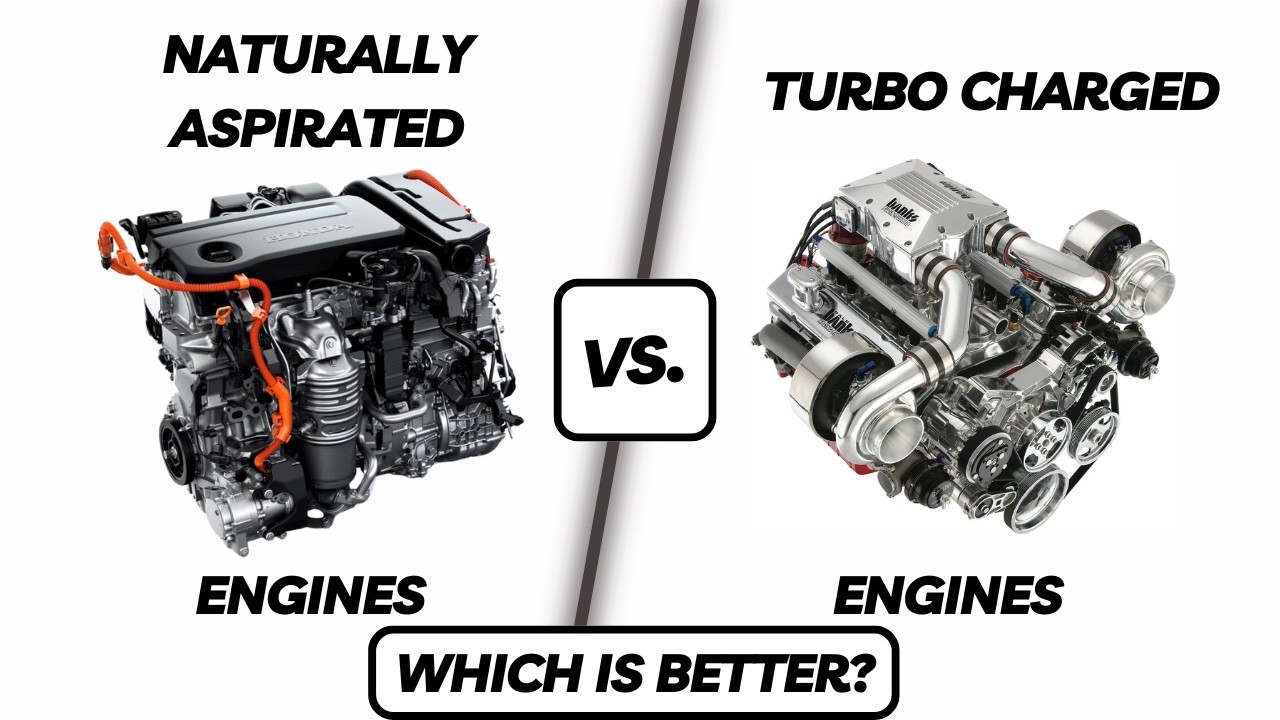
A naturally aspirated (NA) engine breathes on its own. Pistons move down, atmospheric pressure pushes air in through the intake, no assistance, no forced feeding. The amount of air the engine can pack into a cylinder is capped by displacement, cam timing, and how well the intake and exhaust are designed to flow. Want more power from an NA engine, you're generally looking at more displacement, higher RPM, better breathing (bigger valves, better ports, more aggressive cams), or some combination of the three. There's a hard ceiling and you get there by making the engine work harder to reach it.
A turbocharged engine cheats that ceiling by force. Exhaust gas spins a turbine, the turbine spins a compressor on the same shaft, and that compressor crams pressurized air into the cylinders, more air than the engine could ever pull in on its own. More air means more fuel can be burned per cycle, which means more power, from the same physical displacement. A turbo four-cylinder making 400 horsepower isn't some engineering fantasy anymore, it's a Tuesday.
Here's the part that actually explains the culture war though: how that power arrives is completely different.
- NA power builds linearly. Push the throttle, the engine responds instantly and proportionally, and power climbs steadily as RPM climbs, usually peaking somewhere near redline. There's no lag, no surprise, no delay between input and output. What your foot does, the car does, immediately.
- Turbo power arrives in a rush. Below a certain RPM (or below a certain boost threshold), there isn't much extra power on tap yet, the turbo hasn't spun up enough to force meaningful air in. Then it crosses that threshold and the power shows up all at once, a surge instead of a build. Modern turbo tuning has gotten dramatically better at smoothing this out, but the fundamental physics of "the turbo needs exhaust flow to spin up" hasn't gone anywhere.
That difference, instant linear response versus delayed nonlinear surge, is the entire seed of the culture split. It's not really about horsepower numbers. It's about how the car talks back to you.
🎻 The Sound Argument (And Why It's Not Just Nostalgia)
Ask an NA loyalist why they care and "the sound" comes up in the first sentence, every time. That's not just sentimentality, there's real acoustic physics behind it.
A naturally aspirated engine's exhaust note is a direct, mostly unfiltered signature of what's happening inside the cylinders. Higher RPM, more cylinders, more aggressive cam profiles, all of it translates almost one-to-one into a distinct, often screaming sound at the top of the rev range. A high-strung NA V8 or a screaming VTEC four-cylinder at 8,000 RPM has a sonic signature that's become genuinely iconic in car culture, the kind of sound people recognize from a YouTube clip before they even see the car.
A turbocharger, by design, is a muffler that also happens to make power. The turbine sits directly in the exhaust path and physically absorbs a huge amount of the sound energy that would otherwise escape as noise, that's literally part of how it extracts energy to spin the compressor. Turbo cars are inherently quieter and duller-sounding at the same RPM range, all else equal. That's not a flaw, it's just what happens when you put a spinning turbine in the exhaust stream. Manufacturers have spent real money trying to fake the difference back in with resonators, sound tubes, and (on the worst offenders) speaker-generated engine noise pumped through the audio system, which is its own can of worms car people love to hate.
So when someone says "turbo cars just don't sound as good," they're not being irrational or old-fashioned. They're describing a real, measurable acoustic tradeoff that comes baked into the fundamental design. The NA camp isn't imagining it. They're just weighting it differently than the turbo camp does, and that's a legitimate values disagreement, not a factual one.
⏱️ Throttle Response, Or: Why "Instant" Feels Different From "Fast"
Peak horsepower numbers get all the attention, but the number that actually shapes how a car feels to drive is throttle response, the delay between "I press the pedal" and "the car does the thing."
NA engines have essentially zero mechanical lag. Every input maps directly to output, which is why a well-tuned NA car, even a relatively low-power one, can feel more alive and more connected than a much more powerful turbo car with laggy delivery. This is the entire reason a stock Miata with 180 horsepower has a bigger cult following than plenty of 400-horsepower turbo cars. It's not about being fast. It's about the car responding to you the instant you ask it to.
Turbo lag, real physical lag caused by the time it takes exhaust flow to spool the turbine up to useful boost pressure, used to be a massive, obvious problem in older turbo cars from the 80s and 90s. You'd mash the throttle and genuinely wait, sometimes over a full second, for the power to arrive. Modern engineering has closed that gap dramatically: smaller, lighter turbos that spool faster, twin-scroll designs, electric-assist turbos that use a motor to pre-spin the turbine before exhaust flow even gets there, and better tuning that manages the transition. A well-engineered modern turbo car can feel nearly as immediate as an NA car in daily driving.
But "nearly as immediate" isn't the same as "identical," and car people notice the difference even when they can't always explain it. That tiny window between input and response is exactly the kind of thing enthusiasts are wired to obsess over, because it's the difference between feeling like you're driving the car and feeling like you're requesting something from it.
🏁 Where Turbo Just Wins, No Argument
None of this is meant to pretend turbocharging is worse. In most practical and even most performance categories, it isn't close.
- Power-to-weight. A turbo engine can hit the same power number as a much larger NA engine while weighing significantly less, which improves handling, braking, and acceleration everywhere else on the car, not just in a straight line.
- Efficiency. Turbocharging is a big part of how modern cars make more power on less fuel than their NA predecessors, which matters for everyday driving and for meeting emissions regulations that keep tightening.
- Tunability. This is the big one for the enthusiast crowd specifically. An NA engine's power ceiling is fundamentally mechanical, you're stuck unless you're willing to do serious internal work: bigger cams, ported heads, higher compression, more displacement, all expensive, all labor-intensive. A turbo engine's power ceiling is largely a boost number. Within reason, more boost, more fuel, a tune to match, and the power goes up. That's why the biggest horsepower numbers in the tuning world, the four-digit dyno queens, are almost always turbocharged. It's simply a shorter, cheaper path to huge power.
- Altitude and heat. Turbos actually help compensate for the power loss NA engines suffer at high altitude, since they can force in more air to make up for thinner atmosphere. NA cars lose noticeably more power the higher you climb.
If the entire argument were "which one makes it easier to go faster for less money," turbo wins and there's nothing left to discuss. That's exactly why the argument isn't actually about that.
💭 The Real Reason This Debate Won't Die
Car culture doesn't actually argue about horsepower per dollar. It argues about what the car makes you feel, and what building or owning that car says about you.
NA loyalists aren't clinging to an inferior technology out of ignorance. They're prioritizing a specific experience: linear response, unfiltered sound, an engine that has to be revved out and worked to give up its power, which for a lot of enthusiasts is the whole point of driving a performance car in the first place. There's also a mechanical-sympathy angle: NA engines are generally simpler, with fewer failure points (no turbo bearings, no wastegates, no intercooler plumbing, less heat soak to manage), which appeals to people who value reliability and want an engine they can push hard without babysitting boost levels.
Turbo enthusiasts, meanwhile, aren't chasing a shortcut, they're chasing ceiling. The appeal is the fact that a stock-bottom-end turbo engine can go from 300 horsepower to 500 with a tune and some supporting mods, no engine-out rebuild required. That's a legitimate and exciting kind of performance culture too, it's just built around modification headroom instead of factory character.
Neither side is wrong. They're optimizing for different things, and car culture has never been great at admitting two things can both be right at the same time. So the argument keeps going, not because anyone's actually confused about the physics, but because it's really a proxy war between "the drive should feel effortless and immediate" and "the ceiling should be as high as I'm willing to push it."
Spota tip: if you're the type who wants to settle this argument in person instead of in a comment section, that's exactly the kind of debate that gets loud (in a good way) at a real meet. Spota's Clubs make it easy to find the local crews already having it, NA purists and boost junkies parked ten feet apart, arguing the same argument they've been having online, except now you can actually hear the exhaust notes they're fighting about.
🔮 Where This Goes From Here
The honest answer is that pure NA performance engines are becoming rarer with every model year. Emissions regulations, fuel economy targets, and the simple math of turbocharging keep pushing manufacturers toward smaller, boosted engines across almost every segment, including in cars that used to be flagship NA performance icons. A handful of holdouts remain (certain Japanese and European high-revving engines, some American V8s that haven't been forced to downsize yet), but they're increasingly the exception, not the rule.
That scarcity is, ironically, part of what's fueling the current wave of NA nostalgia. The engines that used to be "just what a sports car had" are turning into something closer to a dying craft, which tends to make people appreciate them louder on the way out. Expect the debate to get more emotional, not less, as genuinely new NA performance engines become rarer and the remaining ones start commanding real premiums on the used market.
Turbo technology, meanwhile, keeps getting better at closing the gap that used to define the argument. Electric-assist turbos and smarter boost control are already erasing a lot of the lag that made older turbo cars feel disconnected. It's plausible that in another decade, the response-time argument mostly evaporates on its own, and whatever's left of the debate becomes almost entirely about sound and mechanical simplicity instead of feel.
Until then, don't expect anyone to actually change their mind in that forum thread. That's never really been the point.
If you want to keep reading about the engineering debates car culture can't let go of, check out why car guys hate CVTs and why rotary engines are so beloved despite being so unreliable, or browse the full under-the-hood archive for more.
Pick your side. Just don't expect the other guy to switch.