
🎢 The Sound Nobody Wants to Hear
You mash the throttle. The engine screams up to 6,000 RPM and just... stays there. The car is moving, technically accelerating, but it sounds like the engine is stuck in a pothole, revving its heart out while the speedometer creeps up like it's not even trying.
That's a CVT. And if you've spent any time in car forums, comment sections, or a Cars and Coffee parking lot, you already know: car people talk about continuously variable transmissions the way vegetarians talk about gas station hot dogs. Not exactly with enthusiasm.
Here's the thing though: CVTs aren't bad engineering. In a lot of ways they're smarter than what they replaced. So why does an entire subculture built around loving machines treat this one specific transmission like it personally wronged them?
Turns out there's real substance behind the hate, not just vibes. Let's get into it.
⚙️ What a CVT Actually Is (And Why It's Different)
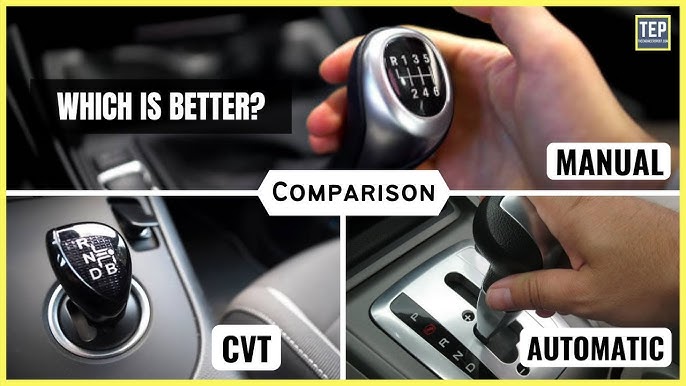
A traditional automatic transmission has a fixed number of gears, usually somewhere between 6 and 10 these days, each with its own gear ratio. A manual has the same idea, just with a clutch pedal and your own right arm doing the shifting. Both work the same basic way: discrete steps, one ratio at a time, a defined "click" from one gear to the next.
A CVT throws that whole concept out. Instead of gears, most CVTs use two variable-diameter pulleys connected by a steel belt or chain. As the pulleys change width, the effective "gear ratio" changes smoothly and continuously, with no fixed steps at all. There's no third gear. There's no shift point. There's just an infinite range of ratios the transmission slides through on its way from a stop to highway speed.
In theory, this is genuinely brilliant:
- The engine can sit at its single most efficient RPM (its power band sweet spot) and just stay there while the "gearing" adjusts around it
- There's no wasted energy from shift shock or torque interruption between gears
- Fuel economy goes up because the engine isn't constantly hunting for the right gear
- It's mechanically simpler in some ways: fewer gear sets, fewer clutch packs
Honda, Nissan, Subaru, Toyota. Half the economy and crossover market runs on some version of this tech. It's not a gimmick. It's the dominant transmission design in a huge chunk of cars sold in America right now.
So if it's this efficient and this common, why does the enthusiast world treat it like a punishment?
🔊 The "Rubber Band" Feel Is Real, Not Imagined
This is the number one complaint, and it's not car guys being dramatic. It's a genuine, measurable characteristic of how CVTs deliver power.
Because a CVT doesn't have discrete gears, it doesn't produce the stepped acceleration feel your brain associates with "going fast." Instead, under hard acceleration, the engine RPM jumps up almost immediately and just holds there, flat, while road speed climbs underneath it. There's no rise and fall. No shift bump. No sense of building momentum through gears.
What your brain expects from acceleration:
- RPM rises
- Shift happens (a brief pause or bump)
- RPM drops back down
- RPM rises again
- Repeat, faster each time, until you're at speed
What a CVT actually gives you:
- RPM jumps to a high, flat plateau
- It just... stays there
- Road speed increases while engine note stays constant
- No shifts, no rhythm, no punctuation
That mismatch between what you hear (a screaming, unchanging engine note) and what you feel (steady, undramatic acceleration) is where the "rubber band" nickname comes from. It genuinely feels like the drivetrain is stretching rather than shifting. Car people who grew up associating a rising-then-dropping RPM needle with speed find this deeply unsatisfying, even when the car is objectively getting to 60 mph just fine.
Automakers have tried to paper over this. A lot of modern CVTs now use "stepped" programming that simulates fake gear changes, artificially dropping and raising RPM to mimic a traditional automatic, purely so the car doesn't feel like it's droning. That fix existing at all tells you everything about how big a problem the drone was in the first place.
💀 The Reliability Reputation (And Where It Comes From)
Car culture has a long memory, and CVTs earned a black mark early that they've never fully shaken.
Nissan's early-2010s CVTs, especially in the Altima, Sentra, and Rogue, developed a well-documented reputation for premature failure. Overheating, shuddering, and outright transmission death well before 100,000 miles became common enough that it turned into class action lawsuit territory, not just internet complaints. Nissan extended warranties on several model years specifically because of it.
That reputation spread to the whole category, fairly or not. Once "CVT" and "grenade by 90k miles" got linked together in enthusiast conversation, it stuck, the same way "oil burner" stuck to certain Subaru engines or "rod knock" stuck to the Hyundai Theta II.
Why CVTs can be more failure-prone than a traditional automatic:
- Belt/chain wear: The steel belt or chain running between the pulleys is under constant, variable tension. Wear here isn't a sudden failure, it's a slow degradation that shows up as shuddering, especially under load or from a stop.
- Heat sensitivity: CVTs generate more heat under sustained high-load situations (think towing, mountain driving, aggressive acceleration) than a traditional automatic, and they're less tolerant of it.
- Fluid specificity: CVT fluid is not interchangeable with standard ATF. Using the wrong fluid, or skipping fluid changes because "CVTs are sealed for life" (a claim that's aged about as well as most "sealed for life" claims), accelerates wear dramatically.
- No forgiveness for abuse: A traditional automatic with a blown clutch pack often still limps along in one gear. A CVT with a damaged belt or worn pulley surface tends to fail more abruptly.
To be fair to the technology: later-generation CVTs (Subaru's Lineartronic, Toyota's Direct Shift-CVT, Honda's more recent units) have largely fixed the worst of this. Reliability data on newer CVT-equipped cars looks a lot better than the horror stories from a decade ago. But car culture doesn't update its priors that fast. Once a reputation sets in a forum thread that ranks on Google forever, it basically becomes permanent folklore, accurate or not.
🏁 The Bigger Issue: CVTs Kill the Thing Car People Actually Love
Reliability concerns and rubber-band droning explain part of the hate. But the deeper issue is philosophical.
Car culture, at its core, is obsessed with driver involvement. That's why manual transmissions get treated like a dying religion. That's why rev-matched downshifts get filmed and posted. That's why people will pay a premium for a car with a proper dual-clutch gearbox that bangs off crisp, controllable shifts instead of one that just smoothly slides between ratios with zero drama.
A CVT is, by design, the opposite of involvement. It's an appliance-grade solution built to optimize fuel economy and smoothness for a driver who doesn't want to think about the transmission at all. That's exactly what most drivers want. It is explicitly not what enthusiasts want.
What gets lost with a CVT:
- Manual control, even simulated "gears," rarely feels convincing
- Audible, physical feedback of a shift happening
- The sense of a car "working with you" through a gear change
- Predictable, repeatable behavior under hard driving (some CVTs will actually intentionally limit ratio range or add cooling delays under sustained hard use to protect themselves)
This is why you'll almost never see a CVT in anything marketed as a performance car. Subaru doesn't put a CVT in the WRX STI. Honda didn't put one in the Civic Type R. When a manufacturer actually wants a car to feel engaging, they reach for a manual, a torque-converter automatic tuned for quick, positive shifts, or a dual-clutch. CVTs get reserved for the Corolla, the Rogue, the Outback: cars built to be appliances, not cars built to be loved.
Car people notice that distinction instantly. And they resent seeing CVTs creep into cars that used to have real transmissions, because it reads as manufacturers optimizing for EPA test cycles and cost sheets over the driving experience.
🛠️ Living With a CVT (If You're Stuck With One)
Not every enthusiast gets to choose their daily. Plenty of car people are driving a CVT-equipped commuter right now out of necessity, not preference. If that's you, the hate doesn't have to translate into neglect.
A few things that actually matter for CVT longevity:
- Change the fluid on a real schedule. Ignore the "lifetime fluid" marketing. Somewhere around 30,000 to 60,000 miles depending on the manufacturer and how you drive is a far safer interval than never.
- Avoid sustained high-load situations when you can. Long uphill towing pulls or extended stop-and-go in extreme heat are where CVTs take the most abuse.
- Don't ignore shuddering. A CVT that shudders from a stop or under light acceleration is telling you something early. Catching belt wear before it worsens is a lot cheaper than a full unit replacement.
- Use manufacturer-spec fluid only. This one's non-negotiable. Generic ATF in a CVT that calls for CVT-specific fluid is a fast track to premature failure.
None of this makes a CVT fun. It just makes it survive.
🚗 Where This Leaves Car Culture
CVTs aren't going anywhere. They're too efficient, too cheap to manufacture at scale, and too well-suited to exactly what most car buyers actually want: smooth, quiet, economical transportation that doesn't ask anything of the driver. From a pure engineering-efficiency standpoint, they've mostly won.
But car culture was never built around pure efficiency. It's built around feel, sound, involvement, and the sense that the machine underneath you is doing something interesting. A CVT, by its very design, hides all of that. It optimizes the drama out of driving, and enthusiasts will keep calling it out for exactly that reason, reliability improvements or not.
If you're the type who notices this stuff, who can tell a CVT drone from an actual shift point without looking at the tach, you're exactly the kind of person who ends up deep in threads arguing about it at 1 AM. That instinct, caring this much about how a car actually behaves under you, is the whole reason communities like Spota exist. Somewhere between the tunnel-run debates and the "is my transmission normal" panic posts, that's real car culture happening in real time. Spota tip: next time you're at a meet and the CVT-versus-manual argument starts up again, snap it for your Garage. Half the fun of these debates is having the receipts.
For more on the culture wars car people never stop having, check out why manual transmissions refuse to die or browse more of under the hood.
Some technology wins on paper. It still has to earn a place in car culture. CVTs are still waiting.