
🥊 The Fight That Never Ends
Post a picture of a Supra next to a GT-R in any car group and watch what happens. Within ten comments someone's typing "RWD or it doesn't count" and someone else is typing "AWD will smoke that in the rain, in the snow, and off the line." Nobody's mind changes. Nobody expected it to.
This isn't a new argument. It's not even really about lap times anymore, though people will absolutely pull up Nürburgring numbers to back their side. It's older than that, weirder than that, and it's not going anywhere. Car people have been having this exact fight since Audi showed up to the World Rally Championship in 1980 with a turbocharged Quattro and made every rear-drive purist in the paddock look like they were driving with one hand tied behind their back.
So let's actually dig into it: what each layout does, why the "feel" argument is real and not just nostalgia, and why this debate survives every generation of car guy that tries to settle it once and for all.
⚙️ What's Actually Happening Under the Car
Strip away the tribalism for a second and it's just physics.
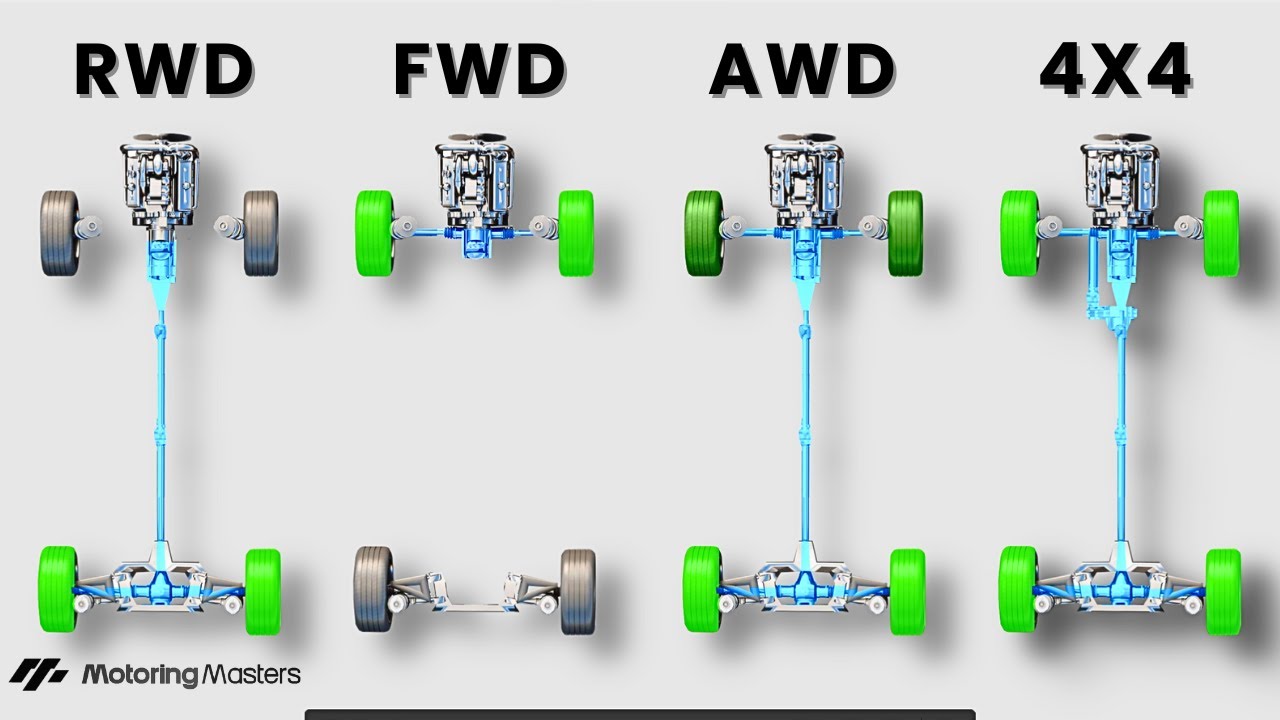
Rear-wheel drive sends power to the back wheels only. The front wheels' only job is steering. That separation of duties is the whole appeal: the front end stays light and responsive because it's not fighting to do two things at once, and the rear end can be provoked into rotating, which is the entire basis of drifting as a sport. RWD cars also tend to have better weight distribution out of the box, since you're not cramming a transfer case and extra differential up front.
All-wheel drive sends power to all four wheels, usually split by a center differential or an electronically managed clutch pack that shifts torque depending on which wheels have grip. Modern systems like the GT-R's ATTESA E-TS or the WRX's symmetrical AWD can send anywhere from 0 to 50% of torque to the front axle in real time, reacting faster than a human driver ever could.
The tradeoff is simple and it's the crux of the whole argument:
- RWD = lighter, more mechanically simple, more feedback, easier to slide on purpose, cheaper to build and maintain.
- AWD = more traction in basically every condition, faster off the line, more forgiving at the limit, heavier, more expensive, more parts to eventually replace.
Neither one is objectively "better." They're built for different jobs, and that's exactly why the fight never resolves. Both sides are right about their own priorities and wrong that the other guy's priorities don't matter.
🌧️ The Traction Argument (AWD's Best Case)
AWD's pitch is simple: more contact patches doing work means more grip, full stop. A stock WRX will out-accelerate a stock RWD car with similar horsepower in almost any condition that isn't a bone-dry drag strip, because it's putting power down through four tires instead of two. In rain, snow, or gravel, the gap widens fast. Rally has been an AWD sport since the Quattro era for exactly this reason: you cannot out-traction physics on loose surfaces with two driven wheels.
This is why AWD dominates in places where weather is a real factor. Ask anyone who's tried to leave a parking lot in a RWD car during the first snow of the year and got a masterclass in humility instead. AWD sedans (Subaru built an entire brand identity on this) sell because "it just goes" is a genuinely compelling pitch to someone who isn't optimizing for a track day, they're optimizing for getting to work on a Tuesday in February.
AWD also flatters average drivers. It hides mistakes. Get on the throttle too early coming out of a corner in a RWD car with the wrong tires and you're now facing the wrong direction. Do the same thing in an AWD car and the front axle often just pulls you through it. That safety margin is a real, legitimate selling point, not a cop-out.
🏁 The Purity Argument (RWD's Best Case)
Here's what the RWD crowd is actually defending, once you get past the "real drivers" posturing: feedback and controllability at the limit.
When only the rear wheels are doing the driving, the car talks to you. You feel the rear step out before it happens. You can catch a slide with steering input and throttle because the chassis is behaving in a way that's mechanically simple enough to predict. That predictability is why drifting exists almost exclusively as a RWD discipline, and why the entire JDM drift scene built its identity around cars like the AE86, the S13, and the RX-7.
RWD purists will also point to weight. AWD systems add anywhere from 150 to 300+ pounds depending on the platform: transfer case, front differential, extra driveshafts, more cooling. That weight has to go somewhere, and it usually ends up making the car feel duller in transitions even if it's objectively faster in a straight line. A lighter RWD car can feel more alive at 60% of its limit than a heavier AWD car feels at 90% of its own.
And there's the maintenance argument, which is less romantic but very real. More drivetrain components means more things that can fail, more fluid changes, more expensive repairs when something in that AWD system finally gives out at 120,000 miles. RWD is mechanically simpler, and simple tends to be cheaper to keep alive.
🧠 Why This Is Actually About Identity, Not Physics
Here's the part that explains why this argument never dies even though both sides have been correct this whole time: RWD vs AWD stopped being a spec sheet debate a long time ago. It became a personality test.
Pick RWD and you're signaling that you value feel over numbers, that you'd rather manage a car at its limit than have the car manage itself, that you're willing to trade some all-weather practicality for a purer connection to what the car is doing underneath you. It's the same instinct that makes people prefer manual transmissions even though a modern dual-clutch is objectively quicker.
Pick AWD and you're signaling that you care about what the car actually does, not what it feels like doing it. Fastest to 60, most usable in the widest range of conditions, least likely to embarrass you on a wet on-ramp. That's not a lesser philosophy, it's just a different set of priorities, usually from people who've actually had to drive a RWD car through a bad winter and don't romanticize the experience the way people who haven't tend to.
The GT-R versus Supra argument specifically has been running for three decades now because both cars are genuinely excellent representations of their philosophy. The R32 GT-R earned the "Godzilla" nickname by using AWD and computer-managed torque vectoring to embarrass much more powerful RWD cars in period touring car racing. The Supra earned its own legend as a RWD platform that could take absurd amounts of boost on a stock bottom end and stay controllable because the layout kept things simple. Neither side is wrong about their own car. That's exactly the problem.
Spota tip: if you're building out a Garage profile, this is worth listing. Drivetrain is one of the fastest ways other users get a read on your build's philosophy before they've even seen a single mod.
🏆 Where Motorsport Actually Lands on This
If you want a genuinely honest answer instead of a forum argument, look at where the money and the rulebooks actually push manufacturers.
Rally: AWD, no real debate, hasn't been close since the Group B era ended.
Drifting: RWD, by definition. AWD drift exists as a novelty (some Evo and GT-R drift builds convert to RWD-only specifically to be legal in competition) which tells you everything about which layout the sport actually requires.
Drag racing: it depends on the class, but AWD launches harder off the line almost every time, which is why AWD platforms like the GT-R and Evo have historically dominated all-motor and moderately-built drag classes before RWD cars with more power and better weight transfer take over at higher power levels.
Time attack and road racing: mostly RWD at the top end, though AWD platforms are closing the gap as torque vectoring software gets better every generation. The RWD advantage here isn't really about grip, it's about a lighter car being easier to rotate through a technical section without scrubbing speed.
The honest answer, if you actually needed one: AWD wins more often when traction is the limiting factor. RWD wins more often when weight and rotation matter more than outright grip. Neither one wins the argument in the group chat, because the group chat was never actually about lap times.
💸 The Money Nobody Talks About
There's a practical layer to this fight that rarely makes it into the internet arguments because it's less fun than talking about drift angles: cost of ownership.
An AWD system is, mechanically, a RWD or FWD drivetrain with an entire second drivetrain grafted on top of it. That means a front differential, a transfer case, extra driveshafts and CV joints, extra fluid capacities, and in performance applications, an electronically controlled clutch pack (like Nissan's ATTESA or Audi's Haldex-based systems) that needs its own fluid changes on a schedule most owners never actually follow until something starts whining.
Add it up over 100,000 miles and a AWD platform will typically cost more to maintain than the RWD equivalent, sometimes significantly more once a transfer case or center differential needs attention out of warranty. That's not a knock on AWD, it's genuinely the price of the extra traction and safety margin. But it's worth being honest about, because a lot of the "AWD is just better" argument quietly ignores the maintenance bill that shows up five years later.
RWD isn't free either. Tires wear differently (all the power going through two contact patches means faster rear tire wear if you're driving it hard), and RWD cars tend to attract owners who modify aggressively, which brings its own maintenance curve. But the baseline mechanical simplicity really does translate to fewer expensive surprises over time.
🌎 How Geography Quietly Decides the Argument For You
A lot of this debate looks purely philosophical until you actually account for where someone lives, and that's the part forum arguments almost always skip.
Someone in Phoenix or Miami genuinely has very little practical reason to prioritize AWD. Dry pavement year-round means the traction advantage rarely shows up, and they get to enjoy the lighter weight and better feel of RWD without ever paying the tax of driving it in bad conditions. It's not surprising that a lot of the loudest RWD-purist voices online come from warm-climate states where the tradeoff genuinely skews in RWD's favor almost every day of the year.
Someone in Minneapolis, Denver, or Buffalo is having a completely different experience. For six months of the year, RWD without the right winter tires isn't a fun mechanical purity statement, it's a genuine hazard. AWD in that context isn't a compromise, it's the only version of "fun car" that's actually usable most days. This is a huge part of why Subaru built an entire regional identity in the Pacific Northwest and Northeast specifically, while RWD sports cars sell disproportionately better in the Sun Belt.
So when the argument flares up online, half the disagreement isn't actually about engineering at all, it's two people from different climates assuming their daily reality is the universal default.
🔧 So Which One Should You Actually Buy
If you're chasing feel, want to learn car control, or you're building toward drifting or autocross: RWD is going to teach you more and reward you more per dollar spent, especially on a budget platform. Something like a used BRZ, Miata, or 350Z will humble you in a way that makes you a better driver.
If you live somewhere with real winters, want the most usable performance car for daily driving, or you just want maximum grip with minimum drama: AWD is the objectively smarter buy. A WRX or a GTI 4Motion isn't a lesser car for being AWD, it's just optimized for a different job than a Miata is.
The people who insist there's one right answer usually haven't owned both. The people who've actually daily-driven a RWD car through an ice storm and tracked an AWD car on a technical circuit tend to have a lot more nuance about this than the group chat lets on.
If you want to see how other builds land on this (RWD swap projects, AWD platforms pushed way past stock, everything in between) check the Garage writeups and the build-of-the-week archive for real examples instead of forum theorizing.
This argument is never getting settled, and honestly, that's the point. A car scene where everyone agreed on drivetrain philosophy would be a boring one. Keep arguing. Just know what you're actually arguing about.