
🛑 The Pedal That Suddenly Isn't There
Every track day has the same moment. Somewhere around lap three or four, a rookie in the group comes barreling into the braking zone for turn one, stands on the pedal like they've done a hundred times in a parking lot, and the car just... keeps going. The pedal goes soft, or worse, it goes almost all the way to the floor with nothing happening. For about half a second, every instinct they have says the brakes are broken.
They're not broken. They're cooked.
That moment has a name in performance driving: brake fade, and it is arguably the single most common "first scary thing" that happens to a new track day driver. Ask anyone who instructs at HPDE events which failure mode sends the most students into the paddock white-knuckled and shaking, and brake fade wins by a mile. It's not rare. It's not even unusual. It's basically a rite of passage, which is exactly why the track day community treats brake prep as gospel instead of a suggestion.
This one is worth understanding properly, because it's not really a "track thing." It's physics that applies every time you use your brakes hard, whether that's a canyon run, a mountain descent with a loaded trailer, or genuinely just riding your brakes down a long grade in traffic. Street driving rarely generates enough heat to expose it. The track does, every single time, which is why it ambushes people who've never seen it before.
🔥 What Brake Fade Actually Is
There isn't just one kind of brake fade. There are two, and they're caused by completely different things, even though they feel similar from the driver's seat.
Pad Fade (Mechanical Fade)
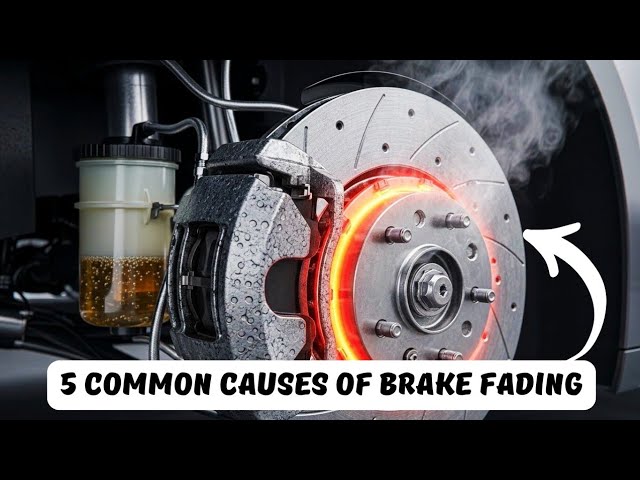
Every brake pad compound has an effective temperature window. Inside that window, the pad material transfers energy efficiently and the friction coefficient between pad and rotor stays high and predictable. Push the pad past the top of that window, and the compound starts to outgas: resins and binders in the pad material start breaking down and releasing gas at the friction surface.
That gas forms a thin cushion between the pad and the rotor, and a gas cushion doesn't grip anything. This is sometimes called the "green fade" or "gas fade" effect, and it's why a stock street pad that works flawlessly for years of daily driving can go almost completely useless after two or three hard laps. The compound simply wasn't engineered to survive rotor surface temperatures north of 500-600°F, and track braking zones routinely blow past that.
Fluid Fade (Vapor Lock)
The second kind is scarier because it can hit even when the pads themselves are fine. Brake fluid is hygroscopic, meaning it absorbs moisture from the atmosphere over time through the tiny amount of permeability in rubber brake lines and reservoir seals. Fresh, dry DOT 4 fluid might have a boiling point north of 480°F. The same fluid after a year or two of absorbing ambient moisture can have a wet boiling point as low as 300°F, sometimes lower.
Under hard, repeated braking, heat from the pads and rotors transfers into the calipers and, eventually, into the fluid itself. If that fluid hits its boiling point, it doesn't just get hot: it turns into compressible vapor bubbles inside a hydraulic system that is only supposed to move incompressible liquid. Press the pedal after that happens and you're compressing gas instead of pushing fluid, which is exactly what a soft, sinking-to-the-floor pedal feels like. This is why old fluid is one of the most dangerous, least visible things sitting in a car that otherwise looks track-ready.
Both failure modes can happen independently or stack on top of each other, and from behind the wheel they feel almost identical: less bite, a pedal that keeps sinking, and a car that suddenly needs way more distance to slow down than it did two laps ago.
🧠 Why It Always Hits the Rookie First
Experienced track drivers aren't immune to brake fade. Push any brake system hard enough for long enough and it will eventually protest. But it disproportionately catches new drivers, and it's not really about car ownership experience. It's about specific habits nobody teaches you until you've been burned once.
- They're using street pads and street fluid. Nobody tells a first-timer that the brakes their daily commute has never stressed past 40% of their capability are about to get asked for 100% of it, repeatedly, for 20-30 minutes straight.
- They're riding the brakes through the whole braking zone instead of trail-braking and releasing. A rookie tends to stay on the brake pedal longer and harder than necessary because they're not yet confident carrying speed into the corner, which pumps more total heat into the system per lap than a smoother, more committed brake application would.
- They're not managing cool-down laps. Experienced drivers use an out-lap and an in-lap specifically to let brake temps stabilize before and after a hard session. Rookies often go straight from the paddock to full attack mode and back, giving the system zero chance to recover.
- Nobody warned them the fade would build gradually, then all at once. The margin doesn't disappear instantly. It erodes over a few laps, each one requiring a little more pedal for the same result, until suddenly there isn't enough pedal travel left to hide it anymore. By the time it's obvious, the system's already deep into the failure curve.
This is exactly the kind of thing a good HPDE instructor watches for before it becomes a problem: pedal travel creeping longer lap over lap is one of the first tells that a car is heading toward fade, and it's something you can feel long before it becomes dangerous, if you know to pay attention to it.
🧯 What Actually Prevents It
The track day community's obsession with "fresh pads, fresh fluid" before every event isn't superstition. It's the two cheapest, highest-leverage fixes for both failure modes, and it's why you'll see it repeated in literally every HPDE prep checklist ever written.
Track-Rated Pad Compounds
Pads built for track use are formulated to hold a stable, high friction coefficient at temperatures well beyond where a street compound starts outgassing, often into the 800-1,000°F+ range depending on the compound. The tradeoff is real: many track compounds are noisier, dustier, and less effective cold, which is exactly why so many enthusiasts run a street pad for daily driving and swap in track pads the night before an event. It's annoying. It's also the single biggest lever against pad fade that exists.
High-Temp DOT 4/DOT 5.1 Fluid
A quality track-oriented fluid with a dry boiling point north of 500°F, and critically, a wet boiling point that's still respectable after moisture absorption, buys enormous margin against vapor lock. This is why the "flush your fluid before every track day, not just once a year" rule exists in serious track circles. Fluid that's a year old and has quietly absorbed moisture from humid garage air is a liability nobody can see just by looking at it.
Brake Cooling (Ducting and Airflow)
Getting fresh air onto the rotor and caliper matters more than most people expect. Brake ducting that routes air from the front bumper directly at the rotor hat is common on dedicated track cars for a reason: it directly lowers the steady-state temperature the whole system runs at, which raises the ceiling before either fade mode kicks in. Even something as simple as making sure a wheel's brake dust shield isn't blocking airflow can make a measurable difference.
Driving Technique
Smooth, committed braking that gets the deceleration done efficiently and gets off the pedal generates less cumulative heat than a longer, softer application covering the same braking zone. This is one of the reasons instructors push new drivers toward "brake later but harder, then get off it completely" rather than a long, drawn-out squeeze. Less total time on the pedal per lap means less total heat dumped into the system over a session.
Spota tip: if you're building toward your first real track day, the Garage is a good place to actually log what pads and fluid are in the car and when they were last changed, so "when did I last flush this" isn't a guess you're making in a paddock at 7am.
⚠️ What It Feels Like, and What to Do If It Happens
Recognizing brake fade in the moment is a skill, and it's one every track day novice should hear described before their first session rather than discovering cold.
- The pedal gets progressively longer. You're pushing further and further to get the same stopping power you had a lap or two earlier.
- The car needs more distance for the same braking zone. If you're missing your normal braking marker by a car length or two and it keeps getting worse, that's not you having an off day, that's the system telling you something.
- In severe cases, the pedal goes almost to the floor with minimal resistance. This is usually fluid vapor lock rather than pure pad fade, and it's the scarier of the two because pumping the pedal can sometimes restore partial function by moving fresh fluid past the vapor pocket, but it's not something to bank on.
If it happens, the standard advice from every instructor is the same: back off immediately, extend your braking zones dramatically, and come into the pits to let the system cool down before doing anything else. Pushing through it hoping it stabilizes is how a scary moment turns into an actual off-track excursion. There is no lap time worth finding out how much margin is actually left.
🏁 It's Not a Track-Only Problem
Brake fade gets talked about as a track phenomenon because that's where it's most reliably triggered, but the same physics apply anywhere brakes get worked hard for a sustained stretch: a loaded truck coming down a long mountain grade, a car with worn pads getting hammered in stop-and-go traffic on a hot day, or a driver riding the brakes the whole way down a canyon road instead of using engine braking. The track just makes the exposure guaranteed and repeatable, which is exactly why it's such a good teacher. Understanding what's actually happening at the pad and in the fluid, instead of just knowing "brakes can fade," is the difference between recognizing the warning signs early and finding out the hard way at 80 miles an hour into a braking zone.
That's really the whole story with brake fade. It's not a mysterious car problem. It's two well-understood, well-documented failure modes that street driving almost never exposes and track driving exposes almost immediately, and the fix has been the same for decades: respect the heat, prep the system before you ask more of it, and never assume the pedal that worked fine ten minutes ago is still telling you the truth.