

🛢️ The Ugliest Mod That Actually Matters
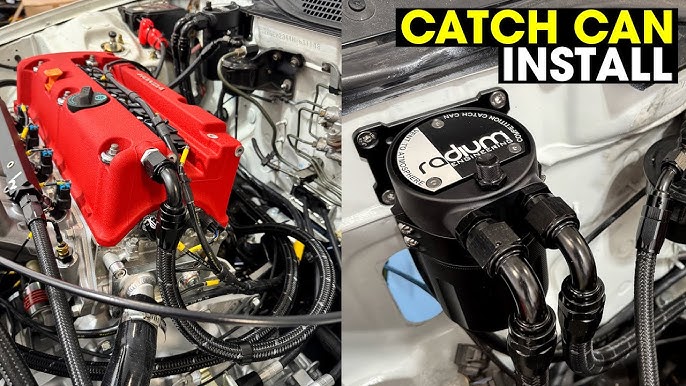
Pop the hood on a modded turbo car at any meet and somewhere in that engine bay, usually zip-tied to a strut tower or wedged behind the intercooler piping, you'll find a small aluminum can with two hoses coming out of it. It's not loud. It doesn't make horsepower numbers go up on a dyno sheet. It doesn't get a cool exhaust note or a badge on the trunk. And yet ask around any turbo forum, any GTI group chat, any Golf R or WRX Discord, and you'll find people treating an oil catch can like it's as mandatory as an oil change.
That's strange, on the surface. Most mods exist to make a car louder, faster, lower, or better-looking. A catch can does none of that. It just sits there catching oil vapor before it hits your intake. So why did an unglamorous little tank become one of the most recommended first mods for an entire generation of direct-injection turbo cars?
Because the alternative is genuinely ugly: an engine that slowly clogs its own airway from the inside, loses power over years without you noticing, and eventually needs a mechanic to physically scrub carbon off your intake valves with walnut shells. That's not an exaggeration. It's a documented, well-understood failure mode of modern engine design, and the catch can exists specifically because of it.
Let's get into the actual mechanism, why it only became a real problem in the last fifteen years, and why the debate over whether you need one is more settled than the forums make it sound.
🔧 Why This Wasn't a Problem on Old Engines
Port Injection Used to Clean the Valves For Free
For most of automotive history, fuel injectors sprayed gasoline into the intake port, right before the intake valve. That's called port fuel injection, and it had a side effect nobody had to think about: every time gasoline sprayed across the back of the intake valve, it acted like a solvent. Detergents in the fuel would wash the valve clean on every single intake stroke. Carbon simply couldn't build up in a meaningful way because it was getting power-washed thousands of times per drive.
Then automakers moved to direct injection (GDI, or gasoline direct injection) to chase better fuel economy and emissions numbers. Direct injection sprays fuel straight into the combustion chamber instead of the intake port, which is more efficient and lets engineers run higher compression ratios. It's a genuine engineering win for efficiency.
But it created a new problem: with no fuel spray hitting the back of the intake valve anymore, there's nothing washing it. And that valve still gets exposed to something else entirely.
The PCV System Is the Actual Culprit
Every internal combustion engine has some gas blow by the piston rings during combustion. That's normal, unavoidable, and been true since the first Model T. Those combustion gases, mixed with oil mist from the crankcase, need somewhere to go, so engines route them through a Positive Crankcase Ventilation (PCV) system back into the intake tract to be burned again rather than vented to the atmosphere.
On a port-injection engine, that oil mist got sprayed with fresh fuel and washed away before it could stick to anything. On a direct-injection engine, that same oil mist enters the intake tract, hits the back of the (now bone-dry) intake valves, and with no fuel spray to wash it off, it just sits there. Heat from the engine bakes it. Over thousands of miles, it hardens into a black, tar-like carbon deposit that builds up layer by layer, exactly like grease baking onto a stove burner that never gets cleaned.
Turbocharged engines make this worse for two reasons: they run more boost pressure through that same PCV pathway, and a lot of modern turbo engines lean on the PCV system harder because of how they manage crankcase pressure under boost. More vapor moving through the intake means more material available to cook onto the valves.
⚠️ What Carbon Buildup Actually Does to a Car
This isn't a hypothetical worst-case scenario. It's a documented pattern across an entire generation of GDI turbo engines: Volkswagen and Audi's EA888 family, BMW's N20/N54/B58 engines, Ford's EcoBoost lineup, Subaru's FA-series turbos, and plenty of others.
Here's the progression enthusiasts and mechanics report:
- Reduced airflow past the valves as carbon narrows the opening, which shows up as gradually lost power and throttle response over 30,000 to 60,000 miles, slow enough that most owners don't notice until it's significant
- Rough idle and misfires as buildup gets severe enough to disrupt proper valve sealing
- Hesitation and hard cold starts as the narrowed intake path affects airflow metering
- In extreme cases, valves that don't seat properly anymore, which can lead to real mechanical damage
- A repair that isn't cheap or quick: walnut shell media blasting, where a mechanic uses a specialized machine to physically blast crushed walnut shells at the valves to scrub carbon off without damaging the metal, typically an intake-manifold-off job that runs several hours of labor
That last point is exactly why this became such a big deal in enthusiast circles. It's not a $40 part replacement. It's a labor-intensive service that a lot of dealerships won't even proactively recommend, because manufacturers have been slow to publicly acknowledge how common the problem is on their own engines. Owners largely figured this out themselves, through forums, YouTube teardown videos, and mechanics who kept seeing the same wear pattern on the same engine families.
🧪 How a Catch Can Actually Fixes This
An oil catch can doesn't stop blow-by. It doesn't change how your PCV system works at a fundamental level. What it does is intercept the oil-laden vapor on its way from the crankcase to the intake, and force it through a baffled chamber (sometimes with a filter media, sometimes just baffle plates and a coalescing effect) that causes the oil droplets to condense out of the vapor stream and drop into the can instead of continuing on to your intake valves.
What actually gets separated out:
- Liquid oil droplets, which are the primary carbon-forming culprit
- Some of the heavier hydrocarbon vapor that would otherwise bake onto valve surfaces
- Water condensation in some designs, though this varies by can quality
What it doesn't do, and this matters because it's where a lot of the online arguing happens: it doesn't eliminate carbon buildup entirely, because some vapor and combustion byproducts still make it through no matter how good the can is. It just dramatically slows the rate at which carbon accumulates, buying years of extra life before a valve cleaning is needed, and in a lot of daily-driven applications, pushing that need out far enough that it may never come up during normal ownership.
The people who get the most value are turbo owners with tuned cars, since more boost generally means more crankcase pressure and more vapor moving through the PCV system, which means faster carbon accumulation on an uncatted engine.
🗣️ Why the Forums Still Argue About It Anyway
If the science is this well documented, why does "do I actually need a catch can" still generate hundred-reply threads on every forum for every direct-injection platform? A few real reasons:
- Warranty concerns. Some manufacturers have pushed back on aftermarket PCV modifications, and owners worry (sometimes correctly, sometimes overblown) about warranty claims being denied if a dealer spots a non-factory catch can during a service visit.
- Quality varies wildly. A cheap catch can with poor baffling barely outperforms doing nothing, while a well-engineered one with proper internal baffling and the right size for your engine's PCV flow makes a real measurable difference. That inconsistency means people compare notes with completely different actual products and reach different conclusions.
- It requires maintenance you have to remember. A catch can only works if you actually empty it. Forget to drain it every few thousand miles and it fills up, which in some designs can actually push oil back into the intake or trigger a check engine light from a full-can sensor. Owners who skip maintenance sometimes conclude "catch cans don't work" when the real issue is their own upkeep.
- Some platforms have less severe issues than others, so an EA888 or N54 owner staring down documented, widespread carbon problems has a very different calculus than someone on a platform where it's a smaller concern.
None of that actually contradicts the underlying mechanism. It just means the mod's real-world value depends heavily on which car you drive, how you drive it, and whether you'll actually maintain the thing.
🧰 What to Actually Look For If You're Buying One
A lot of the "catch cans don't work" backlash traces back to people buying the cheapest option on a parts site and expecting the same result as a properly engineered unit. Not all catch cans are built the same, and the differences aren't cosmetic.
Things that actually separate a good catch can from a paperweight:
- Baffling design. A can with internal baffle plates forces vapor to change direction repeatedly, which is what actually causes oil droplets to condense out and drop to the bottom. A can that's just an empty tube with hose barbs on it barely does anything.
- Filter media, if included. Some cans add a stainless steel or bronze mesh filter stage on top of baffling to catch finer vapor. This helps, but only if it's cleaned or replaced on schedule, since a clogged filter can restrict PCV flow and cause its own problems.
- Correct sizing for your PCV flow. A can designed for a small four-cylinder won't keep up with the vapor volume off a big turbo V8, and an undersized can fills too fast to be practical.
- A visible fill line or drain petcock. If you can't easily see how full it is or drain it without disconnecting hoses, you'll skip maintenance, and a catch can you don't maintain is worse than not running one at all.
- Application-specific kits over universal ones. A kit designed for your exact engine will route to the correct PCV lines with the correct fittings, instead of you improvising vacuum lines and hose barbs that may not seal properly under boost.
One more thing worth knowing before you buy: on some platforms, a catch can isn't strictly a bolt-on-and-forget part, since a poorly installed one can introduce a vacuum leak or throw a code if it interferes with factory PCV pressure regulation. Reading up on your specific platform's known-good setup before ordering the first thing that shows up in a search saves a comeback repair later.
🏁 The Bottom Line
Oil catch cans aren't a horsepower mod, and nobody's buying one to impress anyone at a meet. They exist because direct injection quietly created a maintenance problem that didn't exist on older engines, and because the actual fix (walnut blasting) is expensive enough that prevention makes obvious sense on paper. For turbo owners on known problem platforms, running one isn't really a debate anymore so much as cheap insurance against a five-figure-mile headache.
Spota tip: if you're logging mods to your Garage, a catch can install is exactly the kind of unsexy-but-important entry that separates a car that's actually built from one that's just modded for looks. Track it alongside your bigger builds so future-you (or a buyer) knows the maintenance side got handled too.
For more on what actually holds up under real ownership versus what's internet mythology, check out why every Hellcat owner is on borrowed time or browse more under-the-hood breakdowns.
Your engine bay doesn't care how good your car looks on Instagram. It cares whether you understood what was actually happening under the hood before it became an expensive lesson.