
🌀 The Sound Before You See It
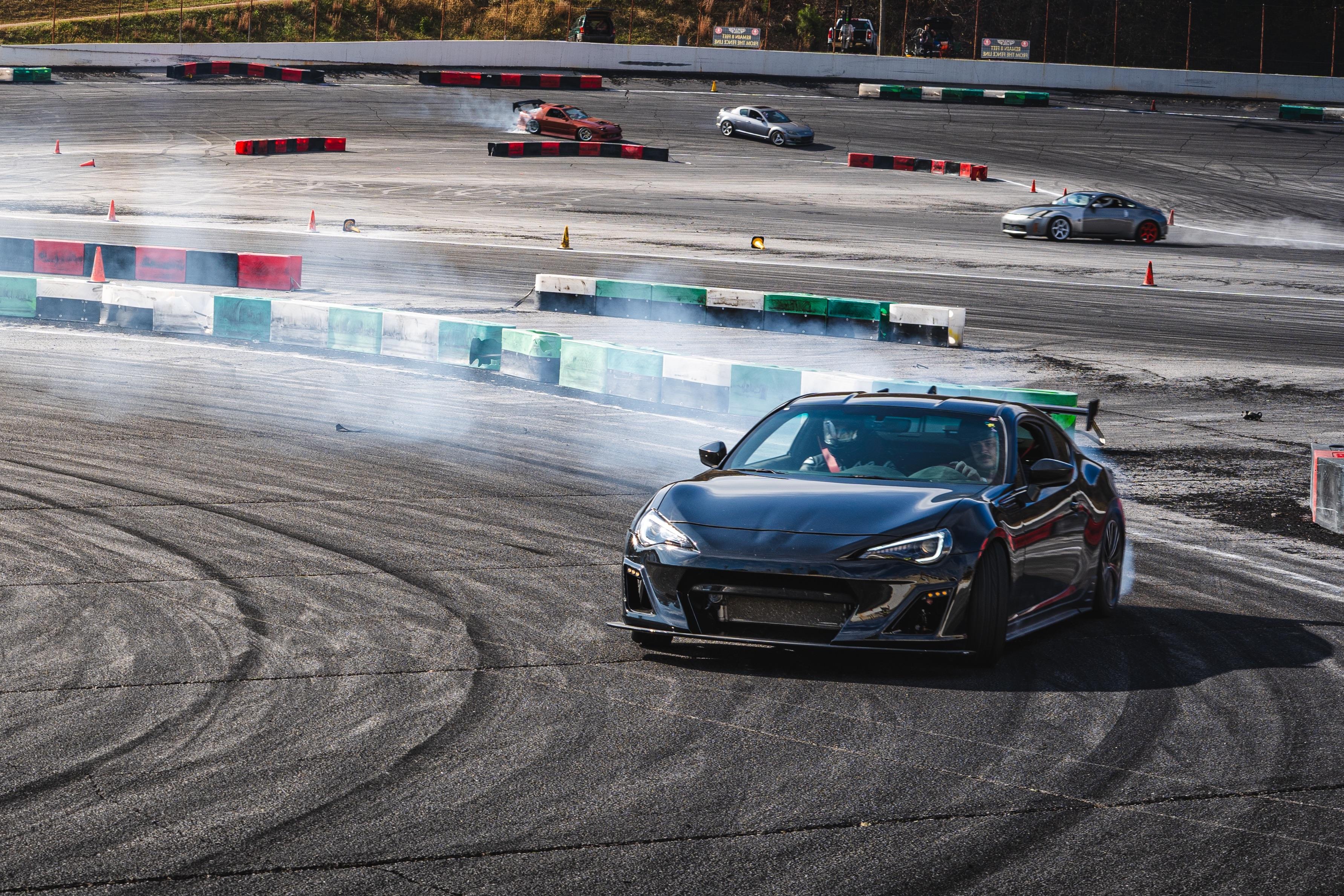
You hear it before you see it. That rising whine of an engine held at redline, then the bark of a clutch kick, then the sudden shriek of rubber giving up its grip on the asphalt. By the time the car actually comes into view, it's already sideways, smoke rolling off both rear tires, the driver's hands sawing at the wheel like the car owes them money.
Nobody taught you what that sound means. You just know. It means somebody's drifting, and every car person within earshot is about to stop what they're doing and go watch.
That's the strange power drifting has over car culture. It's not the fastest way around a track. It's not the most efficient way to drive a car. By almost every practical measure, it's the wrong way to drive. And yet it's become the single most obsessed-over skill in the entire hobby, the thing car people default to daydreaming about, the poster on the wall, the wallpaper on the phone, the reason half the builds in any given parking lot exist at all.
How did a technique that started as a way to lose less time through mountain corners turn into the defining aesthetic of an entire subculture? Let's actually trace it.
🏔️ It Started as a Way to Go Faster, Not Sideways
Here's the part that surprises people: drifting wasn't invented to look cool. It was invented to be fast.
On Japan's mountain touge roads, tight, narrow, blind-cornered roads carved into the hillsides, drivers in the 1970s and 80s discovered that carrying a controlled slide through certain corners let them maintain more speed than a clean, traditional racing line would allow on those specific roads. Legendary drivers like Kunimitsu Takahashi, and later the touge racers who inspired the Initial D manga, weren't drifting to entertain anyone. They were drifting because on a road with almost no runoff and corners you couldn't see the exit of, sliding the rear end out gave you information and control that a "correct" line didn't.
It was a regional, practical technique before it was ever a spectacle. That matters, because it means drifting has always had one foot in "this is genuinely difficult and technical" even after it became a show.
The shift from technique to spectacle happened fast once people started watching it on purpose:
- Touge battles became informal spectator events, with fans lining the mountain at night to watch
- Keiichi Tsuchiya, later nicknamed the "Drift King," started releasing videos in the late 80s specifically showcasing the technique
- Those videos made their way west on grainy VHS tapes years before YouTube existed, and they hit American and European car enthusiasts like nothing they'd seen
- By the mid-90s, drifting had its own dedicated competitions in Japan (D1 Grand Prix launched in 2000), turning an underground mountain habit into an actual judged sport
The technique didn't change much. What changed is that an entire generation of car people outside Japan got their first exposure to it as pure spectacle, stripped of the practical touge context, and it looked like the coolest thing they'd ever seen a car do.
🎬 Pop Culture Did the Heavy Lifting
No car culture phenomenon exists in a vacuum, and drifting's global explosion owes an enormous debt to a handful of very specific cultural moments.
Initial D deserves its own paragraph. The manga (1995) and later anime turned a Toyota AE86 hauling tofu down Mount Akina into one of the most recognizable car culture stories ever told, and it did it by making drifting the emotional core of the narrative. An entire generation of enthusiasts who'd never seen a real touge road became obsessed with AE86s, eurobeat music, and the idea that a stock, unassuming car could become a legend through driver skill alone.
Then The Fast and the Furious: Tokyo Drift (2006) did for mainstream American audiences what Initial D did for hardcore enthusiasts: it put drifting in front of millions of people who'd never heard the term. Say what you want about the movie's plot. The drift sequences sold tickets, sold posters, and sold a fantasy that plenty of teenagers in that theater turned into a lifelong obsession with cars.
And then video games closed the loop:
- Gran Turismo let players practice drift lines on virtual versions of real tracks
- Need for Speed: Underground built drift events directly into its core gameplay loop
- Arcade drift games in Japan let people who couldn't afford a car, or didn't have anywhere legal to drift one, feel the technique in miniature
By the mid-2000s, you didn't need to live near a mountain road or a race track to fall in love with drifting. You needed a screen. That's an enormous unlock for how fast a niche technique became a global obsession, and it's a big part of why drift culture skews toward people who discovered cars through media first and mechanics second.
🧠 The Psychology: Why Sideways Feels Like Freedom
Strip away the pop culture and the competitions for a second, and ask the more interesting question: why does watching (or doing) a car slide sideways feel so good?
Part of it is pure risk signaling. A car under normal grip is behaving exactly as designed, following the laws of physics in the boring, predictable way engineers intended. A car in a drift is deliberately operating past the edge of that design intent, and staying controlled anyway. Your brain reads that as skill, because it is skill. Holding a car sideways through a corner, modulating throttle and steering input in real time to keep it from either spinning out or straightening up too early, is a genuinely difficult motor skill that takes years to develop.
There's also the theater of it. Drifting is one of the only motorsport disciplines where the car is turned sideways to the direction of travel, which means spectators actually get to see the whole side profile of the car, the wheel angle, the smoke, the driver's hands working, in a way a car driving straight past you never shows off. It's inherently more watchable than lap-time racing for anyone who isn't deep into the data.
And there's a deeper thing going on that connects to why car culture exists at all:
- Drifting rewards commitment over caution, which appeals to a hobby that already prizes going all-in on a build rather than playing it safe
- It's one of the few motorsports where a cheap, imperfect car (a rusty AE86, a tired 240SX) can be genuinely competitive against something far more expensive, because car control matters more than horsepower up to a point
- It photographs and films unbelievably well, which matters enormously in an era where a build's reputation is built as much on Instagram and YouTube as on the actual driving
That last point is worth sitting with. Drifting is, in a very real sense, one of the first motorsport disciplines that was built to be content even before content was the word anyone used for it. A perfectly executed clean lap is hard to appreciate without a stopwatch. A perfectly executed drift is obvious the instant you see it, smoke and all.
🔧 What a Drift Build Actually Requires (And Why That Builds Community)
Part of why drifting became such a magnet for the DIY car culture crowd is that a competent drift car isn't necessarily an expensive one. It's a specifically-modified one, and that distinction created an entire ecosystem of shared knowledge.
The core mods that separate a drift car from a stock car:
- Angle kit - Modified steering knuckles and tie rods that let the front wheels turn far past the factory-limited steering angle, which is what allows the extreme, sustained slide angles you see in competition
- Limited-slip differential - A stock open differential sends power to whichever rear wheel has the least grip, which is exactly wrong for drifting. An LSD forces both rear wheels to spin together, which is what lets a driver initiate and hold a slide predictably
- Hydraulic handbrake - A separate, more responsive handbrake setup used to instantly break rear traction for tighter transitions and entries
- Suspension geometry changes - Camber, caster, and ride height adjustments tuned specifically for slide control rather than grip-focused cornering
- A rear-wheel-drive platform, almost always - This is why certain chassis codes (the Nissan Silvia/240SX S-chassis, the Toyota AE86 and Supra, the BMW E36/E46, the Mazda RX-7 and RX-8) became legendary specifically within drift culture, while front-wheel-drive and most all-wheel-drive cars never developed the same following for this discipline
None of that is exotic engineering. It's accessible enough that a determined enthusiast with a welder, a parts forum, and a willingness to learn can build a genuinely competent drift car in a home garage. That accessibility is precisely why drift culture built such a strong DIY, community-taught ethos, with forums and now Discord servers full of people trading angle kit part numbers and diff setups instead of gatekeeping the knowledge.
It's also why drift meets tend to have a different social texture than a typical car show. Nobody's standing around admiring paint from a distance. People are leaning over engine bays asking about steering angle, trading contact info to swap parts, and offering to help with the next install. If you're chasing that same kind of build-and-share energy, a Garage profile that tracks the actual mod progression, angle kit installed, LSD swapped, suspension re-tuned, does more justice to that story than a single glamour shot ever could.
🏁 From Underground to Stadiums, Without Losing the Underground
What makes drifting unusual among motorsports is that it successfully scaled up into professional, stadium-filling competition (Formula Drift in the US, D1GP in Japan, and regional series worldwide) without killing off the grassroots, parking-lot version of the culture that birthed it.
Formula Drift events routinely sell out arenas, with professional drivers running six-figure builds putting on choreographed, judged battles for a paying crowd. That's a legitimate sport with sponsors, points championships, and television coverage. And at the exact same time, on any given weekend, there's a parking lot somewhere with a group of enthusiasts running their own informal "drift day," in cars worth a fraction of a pro build, chasing the same feeling on a much smaller budget.
That dual existence, pro spectacle at the top and accessible grassroots practice at the bottom, is rare in motorsport. Most disciplines either stay niche and underground or professionalize to the point where amateur participation basically disappears. Drifting somehow kept both lanes open, and that's a huge part of why the culture around it stayed as strong as the sport itself. You don't need a pro license to feel like part of the same community that fills those stadiums. You need a rear-wheel-drive car, some open pavement, and someone to teach you the clutch kick.
Spota tip: if you're chasing down local drift days or the touge-style meets that still happen in plenty of cities, a city Playlist built around known cruising routes and meet spots beats scrolling five different group chats trying to figure out where everyone's actually going this weekend.
🌍 Why It Never Became Just "Another Motorsport"
Plenty of niche motorsports have loyal followings without becoming a broader cultural touchstone. Autocross has a passionate community. Time attack has one too. Neither has anything close to drifting's reach into mainstream car aesthetics, movies, video games, and even fashion.
The difference comes down to what drifting represents symbolically, not just athletically. A drift is visually legible as rebellion against a car's intended behavior, and that reads as something bigger than motorsport to people who aren't even into cars. It's why drifting imagery shows up in sneaker collabs, streetwear graphics, and music videos that have nothing to do with racing. The smoke and the sideways silhouette became shorthand for a certain kind of controlled chaos, and that symbol traveled far beyond the people who could tell you what an angle kit does.
Inside the hobby, that crossover cuts both ways. It brought in a wave of enthusiasts who came for the aesthetic and stayed for the mechanics, which is a genuinely good on-ramp into deeper car knowledge. It also means drift culture occasionally gets treated as a costume by people chasing the look without the driving skill or the mechanical understanding underneath it, which is a real source of tension between old-school touge purists and newer fans who found the culture through a movie or a game rather than a mountain road.
Both things can be true. Drifting is a legitimate, technically demanding motorsport discipline with fifty years of history behind it, and it's also the single most effective piece of car culture marketing that was never actually designed as marketing. That combination is rare, and it's a big part of why it's not going anywhere.
🗺️ Drift Culture Looks Different Everywhere, But the Roots Show
Drop into a drift scene anywhere in the world and you'll recognize the bones of it instantly, even if the details are completely local.
Japan is still the spiritual home, and it's the one place where you can trace a direct, unbroken line from the original touge battles to today's D1GP grids. Mountain passes like Hakone and Mount Haruna (the real-world basis for Initial D's fictional Akina) still draw drivers and spectators, even as the legal landscape around unsanctioned touge runs has tightened considerably since the genre's peak.
The United States built its own version around Formula Drift, but the grassroots side leans heavily on regional car culture. The 240SX and E36 3 Series became the default entry-level platforms largely because parts and knowledge were already abundant in American forums, and the sheer size of the country meant drift days spread out into dozens of regional scenes rather than one centralized hub.
Europe developed a hybrid identity, blending drift technique with the continent's existing hillclimb and rally heritage. You'll see BMWs and Volvos built for drift alongside JDM imports, and European drift events often lean into a rougher, more improvised aesthetic than the polished American pro circuit.
Southeast Asia, Eastern Europe, and Latin America have all built fast-growing scenes of their own over the last decade, frequently using cheaper, locally available platforms (old Toyota Corollas, Ladas, whatever rear-wheel-drive chassis is actually affordable) proving again that the technique matters more than the specific car.
What's consistent everywhere is the social structure underneath it: a small core of technically skilled builders who understand angle kits and diff setups, a wider circle of enthusiasts who show up to watch and eventually get pulled into building their own car, and almost always a specific stretch of road or lot that becomes "the spot" for that region's scene. Car culture in general runs on exactly that pattern, a hub, a core group, and a slow pipeline of newcomers, but drifting seems to generate it faster and stickier than almost anything else in the hobby.
❌ Myths That Still Follow Drift Culture Around
A few misconceptions have hung around drifting for decades, and they're worth clearing up because they shape how outsiders (and sometimes insiders) misjudge the discipline.
- "It's just about going sideways as much as possible." Competitive drift judging actually rewards line, angle, speed, and proximity to clipping points and other cars simultaneously. A driver who slides wildly with no control loses to one holding a tighter, faster, more precise angle. Style matters, but precision wins.
- "You need a fast car to drift." Slide angle and control matter more than raw horsepower up to a point. Plenty of legendary drift builds run modest, naturally aspirated engines. What separates a good drift car from a bad one is chassis balance, steering angle, and a driver who's put in the seat time, not a dyno sheet.
- "It's reckless street racing." Organized drifting, from grassroots track days to Formula Drift, happens on closed courses specifically because the discipline is dangerous enough to demand a controlled environment. The street drifting that shows up in movies and viral clips is a real and genuinely reckless problem, but it's a separate (and widely condemned within the community) thing from the sport itself.
- "It's a young person's fad that'll fade." The technique is now over fifty years old, has a professional international circuit, and is currently being adapted into electric platforms by manufacturers who see long-term commercial value in it. That's not what a fad's lifecycle looks like.
🔮 The Obsession Isn't Fading
Every few years someone predicts drifting is about to peak and decline, and every few years the sport finds a new way to expand instead: electric drift cars are now a real, developing category, Formula Drift continues to grow its viewership, and a new generation is discovering Initial D and touge culture through re-releases and clips the exact same way an earlier generation discovered it on bootleg VHS.
The core appeal hasn't changed because the core appeal was never really about the smoke. It's about watching someone hold a car at the edge of control and make it look effortless, and about the fact that with enough time in a garage and enough patience learning car control, that skill is genuinely learnable by regular people in regular cars. That combination of spectacle and accessibility is why drifting became car culture's ultimate obsession, and why it's going to stay that way for a long time.
Some skills in this hobby you admire from a distance. Drifting is one you're always quietly convinced you could learn if you just had the right car and an empty parking lot. That's the whole hook, and it's never let go.