
🗻 A Tofu Delivery Route That Changed Car Culture Forever
Ask a car guy under 45 why he wants a beat-up, underpowered, rear-wheel-drive Toyota Corolla from the 1980s and there's a decent chance the answer traces back to the same place: a cartoon about a kid delivering tofu down a mountain at 4 a.m.
That's not an exaggeration. Initial D, a Japanese manga that started in 1995 and became an anime in 1998, is arguably the single most influential piece of car media of the last three decades, and it didn't come from a car magazine, a racing league, or a Hollywood studio. It came from a story about Takumi Fujiwara, a bored, sleep-deprived high schooler who spends his nights hauling tofu for his dad's shop in a hand-me-down Toyota Sprinter Trueno AE86, unknowingly turning himself into the fastest, most terrifying driver on Mount Akina's touge without ever meaning to.
Decades later, that fictional mountain pass has real-world consequences you can measure in dollars. AE86s that sold for a few thousand bucks in the early 2000s now regularly clear five figures, and pristine or celebrity-owned examples have sold north of $100,000. An entire generation of car people learned the word "touge," discovered drifting before drifting had a mainstream name in the West, and decided their dream car was a cheap, gutless Corolla instead of anything with real horsepower. None of that happens without Initial D. This is how one story about a tofu run rewired car culture worldwide.
🚙 What Even Is an AE86, and Why That Car Specifically
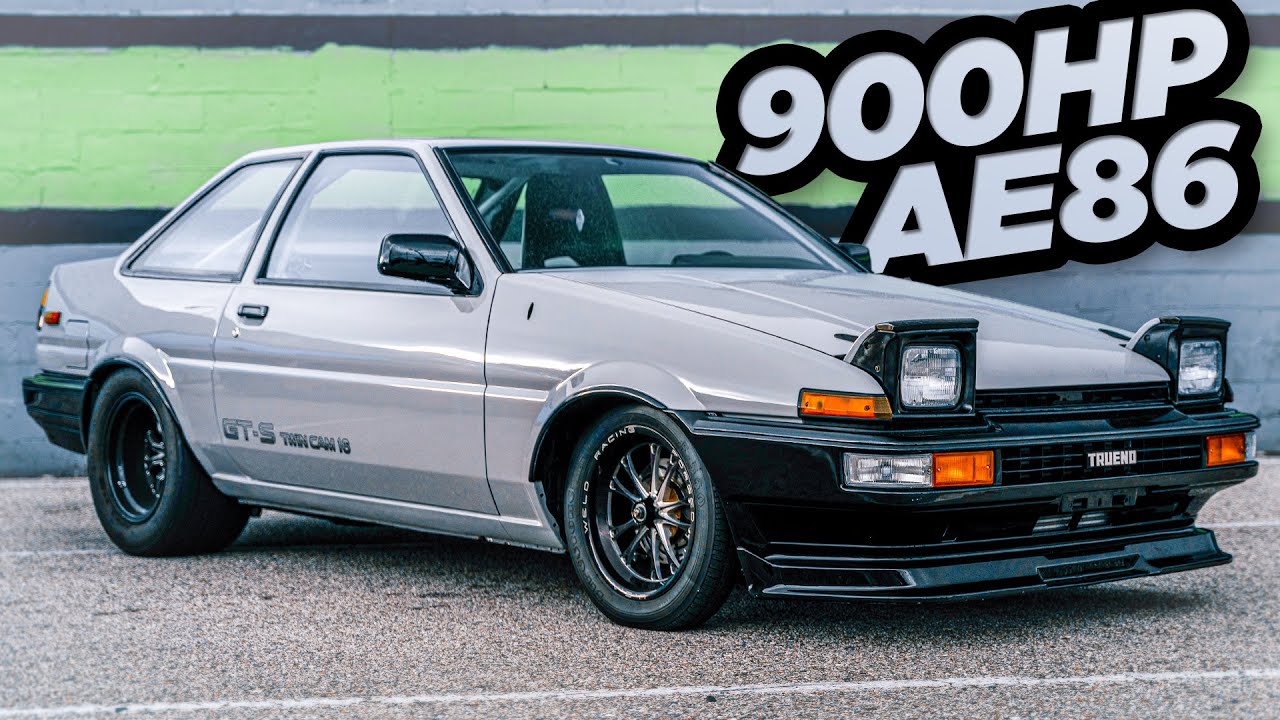
The AE86 isn't a nickname Toyota gave the car. It's the chassis code, and it stuck so hard that "hachi-roku" (Japanese for "eight-six") became the car's actual name in enthusiast circles. Sold in Japan as the Toyota Sprinter Trueno and Corolla Levin, and in North America mostly as the Corolla GT-S, it's fundamentally a small, cheap, front-engine, rear-wheel-drive coupe from 1983 to 1987 with a 1.6-liter four-cylinder making somewhere around 110 to 130 horsepower depending on market and trim.
On paper, that's nothing. A modern economy hatchback outguns it without trying. But horsepower was never the point:
- Rear-wheel drive in an era when the entire industry, Toyota included, was rapidly shifting compact cars to front-wheel drive for cost and packaging reasons. RWD is what makes a car rotate, slide, and drift. FWD compacts largely can't.
- Light curb weight, somewhere around 2,100 to 2,300 pounds depending on spec, which meant that modest power still translated into a genuinely responsive, chuckable little car.
- A near-perfect front-to-rear weight distribution for its class, thanks to the 4A-GE twin-cam engine sitting low and far back in the engine bay.
- A live rear axle and a chassis simple enough to understand, fix, and modify with basic tools and a limited budget, which mattered enormously to teenagers and young adults with no money.
Put simply, the AE86 was one of the last cheap, mass-produced, rear-wheel-drive Japanese coupes before the industry moved on. By the time Initial D picked it as its hero car in the mid-90s, it was already an obscure, unfashionable used car in Japan, the kind of thing a broke high schooler's dad might hand down because nobody else wanted it. That obscurity is exactly why it worked as a story. Takumi wasn't driving a supercar. He was driving what everyone else considered a beater, and beating GT-Rs and RX-7s with it anyway.
📖 The Story That Made Underdog Engineering Cool
Initial D's plot is simple on the surface: street racing on Japan's mountain touge roads, told through the lens of a kid who doesn't even realize how good he is because he's been unconsciously training every single night hauling tofu, carrying a full glass of water on the passenger seat so he learns to drive smooth enough not to spill it.
What made it different from every other car media property up to that point was its obsession with the mechanics of why a car goes fast on a mountain road, not just that it does. Chapters and episodes spend real time on tire choice, suspension setup, weight transfer, racing lines, and the specific reasons a lighter, well-balanced car can beat a more powerful one on a tight, technical course. It wasn't dumbed down. It assumed its audience wanted to understand the physics, and that assumption turned out to be correct.
That's also what separated the AE86's on-screen legend from pure horsepower fantasy. Takumi wins races against a Mazda RX-7 FC, a Mitsubishi Lancer Evolution, a Nissan Skyline GT-R, cars with two to three times his power, by out-driving them on a road he's memorized down to the centimeter, in a car that rewards precision over brute force. For a huge chunk of car-obsessed teenagers who couldn't afford a real sports car, let alone insurance on one, that was the most relatable fantasy imaginable: you don't need the fastest car, you need to actually be good.
🌏 How a Japanese Manga Became a Global Car Culture Event
Initial D's reach outside Japan wasn't instant. Early scanlated manga chapters and fansubbed VHS and DVD rips circulated through car forums and anime communities in the late 90s and early 2000s, well before streaming made anything easy to find legally. That grassroots, word-of-mouth spread mattered. Kids weren't discovering Initial D through an ad campaign. They were discovering it because a friend at the car meet burned them a disc, and that kind of organic discovery tends to build far more obsessive fandoms than anything a marketing budget can buy.
The timing also lined up with a broader JDM explosion in the West. The Fast and the Furious franchise was introducing American audiences to import tuning culture starting in 2001, video games like Gran Turismo and later the Initial D arcade racing cabinets were putting these exact cars into millions of hands, and eBay Motors and early import brokers were making it possible, for the first time, for someone outside Japan to actually chase down the cars they'd only seen on screen. Initial D didn't create JDM culture's Western boom by itself, but it gave it a specific mythology, a specific mountain, and a specific car to obsess over in a way that a generic "import tuning is cool" vibe never could.
Spota tip: if your city playlist has a canyon or mountain-adjacent Photo Op waiting to be found, that's basically the closest thing to touge tourism most of us are ever going to get, minus the actual racing. Screenshot-worthy, zero risk, still counts as a car culture pilgrimage.
💰 The Real-World Price Explosion
This is where Initial D's influence stopped being a vibe and started showing up in actual market data. AE86s were genuinely cheap for most of the 2000s, the kind of car a broke college kid could pick up for a few grand and immediately start modifying. That window has closed hard.
A few things collided to drive prices up:
- The 25-year import rule. U.S. federal law lets vehicles become eligible for import once they turn 25 years old, and the last AE86s built in 1987 crossed that threshold years ago, unlocking a wave of American demand that previously had to be satisfied with gray-market cars or domestic Corolla GT-S survivors.
- A shrinking, non-renewable supply. Toyota stopped building the AE86 in 1987. Every car that gets crashed, rusted out, or parted for a drift build is gone permanently. There's no factory making more.
- A generation with actual purchasing power now chasing a childhood want. The kids who watched Initial D on bootleg DVDs in 2003 are now adults in their 30s and 40s with careers and disposable income, and a lot of them never stopped wanting the car from the show.
- Drift culture's own growth turning clean, unmolested examples into a genuinely scarce category, since so many AE86s got sacrificed to grassroots drifting over the decades specifically because the car was cheap and available.
The result: rough project cars that used to sell for a few thousand dollars now routinely list in the $20,000 to $40,000 range, and exceptional, low-mileage, or documented examples have crossed six figures at auction. A car Toyota built as basic, disposable transportation is now, in the right condition, worth more than a new Toyota Supra.
🌀 The Accidental Birth of Western Drift Culture
Drifting existed in Japan long before Initial D, built by touge racers and pioneers like Keiichi Tsuchiya through the 70s and 80s. But drifting as something the rest of the world actually knew about, cared about, and wanted to try themselves is a much more recent phenomenon, and Initial D's timing put it directly in front of an entire generation right as it was discovering car culture for the first time.
Watching a story built entirely around a driving technique makes that technique the point, not a stunt in the background of a chase scene. Every major rival in Initial D has their own drift style, their own philosophy about it, their own reason it works. That framing planted the idea that drift wasn't just a flashy trick, it was a skill worth actually learning. Combine that with the AE86 being cheap, RWD, and genuinely well suited to learning car control at low speed in an empty lot, and you get a straight line from "I watched this show" to "I want to try this myself," which is a much shorter jump than most car media ever manages to create.
Formula Drift launched in the U.S. in 2004, right in the thick of Initial D's Western spread, and plenty of the sport's early competitors and fans point to the show as part of what got them interested in the first place. Drift culture would have grown regardless. Initial D just handed it a massive, ready-made, already-obsessed audience years before it would have otherwise existed.
If you want the deeper mechanics of how drifting itself became car culture's defining obsession, we've written about that separately.
🎮 The Arcade Cabinet That Trained a Generation
Sega's Initial D Arcade Stage cabinets deserve their own mention here, because for a huge number of Western fans, the arcade game was the actual entry point, not the anime. Launched in Japan in 2002 and eventually spreading to arcades worldwide, the cabinets put you in a real seat with a real wheel and shifter, racing the exact touge courses from the show, unlocking the exact cars, complete with the show's soundtrack of Eurobeat music blasting the whole time.
Eurobeat itself became its own inseparable piece of the culture. High-BPM, hyper-produced Italian dance music had basically nothing to do with Japanese car culture on paper, but Initial D's soundtrack choices made it the unofficial anthem of drift culture worldwide, to the point that "Deja Vu" and "Around the World" are still instantly recognizable to anyone who spent time in this scene, regardless of whether they can name a single other Eurobeat track.
Between the arcade cabinets and the soundtrack, Initial D built something most car media never manages: a multi-sensory, repeatable experience people kept coming back to, not just a story they watched once.
🏎 The Legacy Everyone Still Feels Today
Initial D's fingerprints are everywhere in modern car culture, often in places people don't consciously connect back to the source anymore.
- Toyota and Subaru's 86/BRZ project, launched in 2012, was explicitly built as a modern homage to the AE86 formula: cheap, light, rear-wheel drive, driver-focused over powerful. Toyota's own marketing leaned directly into the "hachi-roku" name and legacy.
- The panda two-tone paint scheme, white over black, is instantly recognizable as Trueno livery to anyone in the scene, and it still shows up on wraps and builds that have nothing to do with an actual AE86.
- Touge driving as an aspirational concept spread into video games, YouTube canyon-run content, and even track day culture, well beyond anyone who's actually watched the show.
- A whole generation's baseline assumption that a good, light, well-balanced chassis beats raw power on a technical road, a genuinely useful piece of driving philosophy that traces directly back to a cartoon's argument, repeated over hundreds of chapters, that skill and setup matter more than the number on the spec sheet.
That last point might be the most underrated part of the legacy. Initial D didn't just sell a car. It sold a way of thinking about cars that a lot of enthusiasts still carry around without necessarily remembering where it came from.
🚗 Why This Still Matters in 2026
Initial D wrapped its manga run back in 2013 and the anime adaptations ended not long after, but the AE86 obsession hasn't faded, and if anything the market data says it's accelerating. Every year the surviving cars get older, rarer, and more expensive, and every year a new wave of people discovers the show for the first time through streaming reissues, clips, and a drift and JDM scene that's never really let the AE86's legend cool off.
There's something almost poetic about it. A story about an unremarkable car being secretly, quietly better than anyone expected turned into an unremarkable car actually becoming exactly that in the real world. Takumi never set out to make the AE86 a legend. He just drove it the way he knew how, every single night, until people couldn't ignore how good it was. The car culture around it followed the same path: nobody planned this outcome, it just accumulated, one convert at a time, until a cheap 80s Corolla became one of the most desired collector cars of its era.
If you're chasing your own AE86 in 2026, budget accordingly and expect competition. The tofu shop economy might not exist anymore, but the demand it created absolutely does.
For more on the JDM legends finally landing stateside, check out the 25-year import rule explained, or browse the full under-the-hood archive for more of the culture behind the cars you actually want.