
🏁 12.9 Miles That Run the Entire Industry
Ask a car guy what "the Ring" means and watch their face change. Not "which ring." Not "a ring." The Ring. Capital T, capital R. There's only one track in the world that gets referred to like it's a person you should be afraid of.
The Nürburgring Nordschleife sits in the Eifel mountains of Germany: 12.9 miles, 73 corners, over 1,000 feet of elevation change, and a nickname earned in blood: the Green Hell. Jackie Stewart coined that name in the 1960s and nobody's ever felt the need to update it.
Here's the part that should be strange but isn't: a public toll road in rural Germany, one that regular people can drive on any Tuesday evening for about 30 euros a lap, became the single most trusted performance benchmark in the entire automotive industry. Not the quarter mile. Not 0-60. The Ring.
This didn't happen by accident, and it didn't happen because a marketing team decided it should. It happened because the Nürburgring does something no other number in car culture does: it can't really be faked.
📊 Why a Dyno Sheet Doesn't Mean What You Think It Means
Car guys are naturally suspicious people, and for good reason. The industry has given them plenty of reasons to be.
Horsepower numbers get inflated. Automakers round up, use best-case dyno conditions, or quote "SAE certified" figures that mysteriously always land higher than independent dyno pulls. 0-60 times get cherry-picked from a perfect car, on a perfect surface, with launch control, rollout subtracted, and a professional driver at the wheel, then advertised like your dealership example will match it.
A Nürburgring lap time is different, and here's why:
- You can't hide bad handling. A car with a huge horsepower number and mediocre chassis tuning gets exposed instantly on 73 corners of changing camber, blind crests, and off-camber sweepers.
- The track punishes everything at once. Braking stability, tire wear, cooling under sustained load, suspension geometry, driver visibility. A one-dimensional car (all power, no balance) simply cannot post a fast time.
- It's a public road. Anyone with a car, a helmet, and an entry fee can go verify it themselves, or at least go feel the corners the pros were driving. That's not true of a manufacturer's private proving ground.
- Third parties film it. Independent outlets, YouTubers, and rival manufacturers show up with their own cameras and GPS data loggers specifically to catch inflated claims.
That last point matters more than people realize. The Ring has a built-in fact-checking community that no other benchmark has. If a manufacturer's claimed time doesn't match onboard footage, tire choice, or ambient conditions, the internet will absolutely find out and drag it into every comment section for years.
Spota tip: if you're building out your Garage with performance mods, treat lap-time claims (yours or anyone else's) the same way the Ring community does: trust footage and data, not marketing copy.
🇩🇪 A Brief History of the Green Hell's Rise to Power
Built for a Different Era
The Nordschleife opened in 1927, designed as a long, brutal test loop for German manufacturers before purpose-built proving grounds existed. It was genuinely dangerous by design: minimal runoff, blind crests, elevation changes that put your stomach in your throat, and corners with names that read like a horror movie: Fuchsröhre (Fox Hole), Flugplatz (Airfield, because cars used to actually go airborne there), and the infamous Karussell, a banked concrete bowl corner unlike anything else in racing.
The Niki Lauda Turning Point
Formula 1 raced at the Nordschleife until 1976, when Niki Lauda's horrific crash and fire (he survived, barely, and raced again six weeks later) effectively ended top-level racing there. F1 moved to the shorter, safer GP-Strecke built alongside it. That should have been the end of the Nordschleife's relevance.
Instead, it became something bigger: the world's benchmark for road car development.
Manufacturers Move In
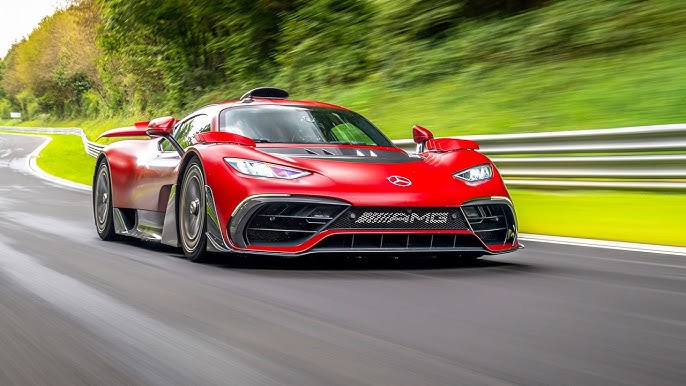
Starting in the 1990s and accelerating hard through the 2000s, automakers began building semi-permanent test facilities near the track. Porsche, BMW, and Mercedes-AMG all developed a reputation for essentially living there during final development phases. "Nürburgring-tuned suspension" became a marketing phrase strong enough to sell cars on its own, whether or not the buyer would ever see the track in person.
By the 2010s, a fast Ring time had become the industry's version of a report card. Miss the benchmark your segment expects and reviewers will say so in the first paragraph.
🚗 The Lap Time Arms Race, Explained
Once a handful of manufacturers started publishing times, it turned into something close to a public rivalry, and rivalries are what car culture runs on.
The general trajectory looked something like this:
- Early 2000s: Sub-8-minute laps were the mark of a serious performance car.
- Mid-2000s to 2010s: The "7-minute club" became the target for genuine supercars.
- Late 2010s: The Nordschleife lap record chase turned into a full-blown production-car war, with manufacturers stripping weight, adding aero, and running specific tire compounds specifically to claim the crown.
- Modern era: Hypercars and hybrid hypercars pushed times down into territory that would have seemed like fantasy 20 years ago, with EVs entering the conversation and posting numbers that shocked the combustion-only crowd.
The record has bounced between manufacturers repeatedly, and every single handoff generates the same predictable cycle online: the new record holder gets celebrated, then someone points out the tire compound wasn't street-legal, or the car wasn't in production spec, or the "Nürburgring lap" was actually run on the shorter GP circuit and not the full Nordschleife loop everyone assumes. That controversy is, honestly, part of the appeal. Car people love an asterisk they get to argue about.
🎥 Why YouTube Made the Ring Even Bigger
Here's the thing that took the Nürburgring from "thing enthusiasts read about in magazines" to "thing every car guy has strong opinions on": onboard camera culture.
Channels dedicated entirely to Nürburgring lap footage exploded once dash cams and GoPros got good enough to mount cleanly and cheap enough for regular track-day drivers to run every session. Suddenly you weren't just reading a claimed time in a press release. You were watching a Golf R get passed by a guy on a modified motorcycle, or a taxi service (yes, that's a real thing there, the Ring Taxi) hauling terrified passengers through the Karussell at speeds that shouldn't be legal.
This did two things to car culture:
- It democratized the track. You didn't need a press credential to see what the Ring actually looks like at speed. Anyone with an internet connection could watch hundreds of laps from dozens of cars and start forming their own opinions about what a "real" fast lap looks like.
- It created accountability. Public footage means public scrutiny. A sketchy claimed time gets torn apart frame by frame by people who've watched thousands of hours of Ring footage and know exactly what a clean lap through Flugplatz should look like.
Regular enthusiasts started making the pilgrimage themselves, renting a car or bringing their own to run Touristenfahrten (public tourist sessions), just to say they'd driven it. That's a huge part of why the Ring occupies a different space than a private proving ground ever could: it's simultaneously the industry's most serious engineering benchmark and something an average car guy on vacation can go experience firsthand.
⚠️ The Limits of a Lap Time (Because It's Not Perfect Either)
Car people who've actually paid attention to this stuff will tell you the Nürburgring number isn't flawless, and it's worth being honest about that.
- Conditions vary wildly. Temperature, track surface changes from ongoing construction, and even which direction traffic is running that session can shift a time by seconds.
- Driver skill matters enormously. A factory test driver who's run thousands of laps will beat a talented amateur by a wide margin in the identical car.
- Tires do a lot of the work. A time set on semi-slick, road-illegal rubber tells you very little about how the car will actually feel on the street tires it ships with.
- It's one track. A car tuned specifically to be fast at the Nordschleife's unique combination of corners isn't automatically the best-handling car everywhere else. Some manufacturers have been accused of tuning specifically for Ring lap times at the expense of real-world ride quality.
None of that has slowed the obsession down even a little. If anything, arguing about why a time doesn't tell the whole story has become its own subgenre of car culture content.
🏆 Why It's Still the Number That Matters Most
At the end of the day, the Nürburgring earned its status the hard way: by being hard to fake, hard to sandbag, and impossible to fully control the narrative around. In an industry full of adjusted numbers, best-case scenarios, and marketing spin, car people gravitated toward the one benchmark that still has to survive contact with 73 corners of unforgiving German asphalt and a community that will absolutely check your work.
That's the whole appeal. Not the number itself, but what it takes to earn it.
Whether you'll ever actually turn a lap there or not, that's the same instinct that drives everything else in car culture: chasing something real, something that can't just be claimed, something you have to go earn. If you're documenting your own build's journey (mods, progress, the actual work) rather than just the highlight reel, that's exactly what a Garage profile on Spota is built for.
The Ring doesn't care about your press release. Neither does the car scene.