
🎯 The Sound That Separates Drivers From Passengers
You've heard it before you ever knew what it was. A car comes off a highway ramp, downshifts into a corner, and instead of the usual clunk and lurch, there's this quick, clean throttle blip right before the clutch drops. No jerk. No head bob. Just a smooth transition like the car and the driver are one thing.
That's rev-matching. And somewhere over the last decade it turned into the single most reliable way to tell who actually knows how to drive a manual and who's just rowing gears and hoping for the best.
It's not about lap times for most people doing it on public roads. It's a flex. A quiet one, but a flex all the same, because everyone in the car (and half the people at the light next to you) can hear the difference between someone who learned the technique and someone who's grinding their transmission into an early grave.
⚙️ What's Actually Happening Mechanically
Here's the problem rev-matching solves. Every gear in a manual transmission spins its internal shafts at a different speed relative to engine RPM. When you're cruising in fourth gear and you downshift to second to set up for a corner, your engine is spinning at, say, 2,500 RPM. But second gear, at your current road speed, wants the engine spinning closer to 4,500 RPM.
That gap has to get closed somehow. If you just dump the clutch without doing anything about it, the clutch disc has to violently force the engine's RPM up to match what the gear demands. That's the lurch. That's the jerk that throws your head forward. And that's also serious wear on your clutch, your engine mounts, and your drivetrain, because you're using the clutch as a brake to spin up the engine instead of doing it with the throttle.
Rev-matching means you blip the throttle yourself during the downshift, bringing the engine RPM up to roughly where the lower gear needs it to be before the clutch fully re-engages. When you get the blip right, the clutch just... connects. No fight. No shock load. The car settles into the lower gear like it was always there.
Heel-toe downshifting is the full technique: brake with the ball of your right foot, roll the heel (or the edge of the foot, depending on pedal spacing) over to blip the throttle, all while your left foot works the clutch, and you're doing all three at once while also steering into a corner. It sounds like a lot because it is. That's exactly why it's a flex.
🏁 Where It Actually Came From
This isn't a car-meet invention. Heel-toe downshifting comes straight out of racing, credited most often to French driver and engineer Pierre Levegh in the 1920s and popularized through decades of road racing where every tenth of a second and every ounce of clutch life mattered. Race cars downshift constantly under braking, and a driver who's fighting wheel hop and lurching gear changes into every corner is going to lose time and eventually break something expensive.
Racing schools have taught it for generations because it's not optional at that level. Smooth weight transfer under braking is the difference between a car that stays planted and one that's skipping around on its suspension right when you need the most grip. Rev-matching keeps the rear wheels from momentarily locking or lurching when you drop the clutch mid-corner, which keeps the chassis balanced.
It filtered down into street car culture the same way most performance driving technique does: through track days, through YouTube channels breaking down what pro drivers are doing with their feet, and through forums where people obsessed over doing it right on their daily. Once it became something you could learn and practice instead of something locked behind a racing license, it became a badge you could earn.
🔥 Why It Became a Status Symbol
A few things stacked on top of each other to turn rev-matching into the flex it is today.
- It's audible proof of skill. You can't fake the sound. Either the RPMs match and the shift is smooth, or they don't and everyone hears the mismatch.
- It requires actual coordination. Three pedals, three separate inputs, all timed within a fraction of a second. Most people who drive stick never bother to learn it properly, which makes the ones who do stand out immediately.
- Modern cars made it rare to need. With automatics dominating the market and even manuals getting less common by the year, doing something this deliberate with a stick shift already signals you went out of your way to drive one. Doing it well signals you went further than that.
- It's self-policing in car culture. Miss a rev-match at a meet or on a canyon run and someone's going to notice, even if nobody says anything out loud. Car people clock this stuff. It's part of the unspoken hierarchy the same way knowing your torque curve or being able to identify an engine by sound is.
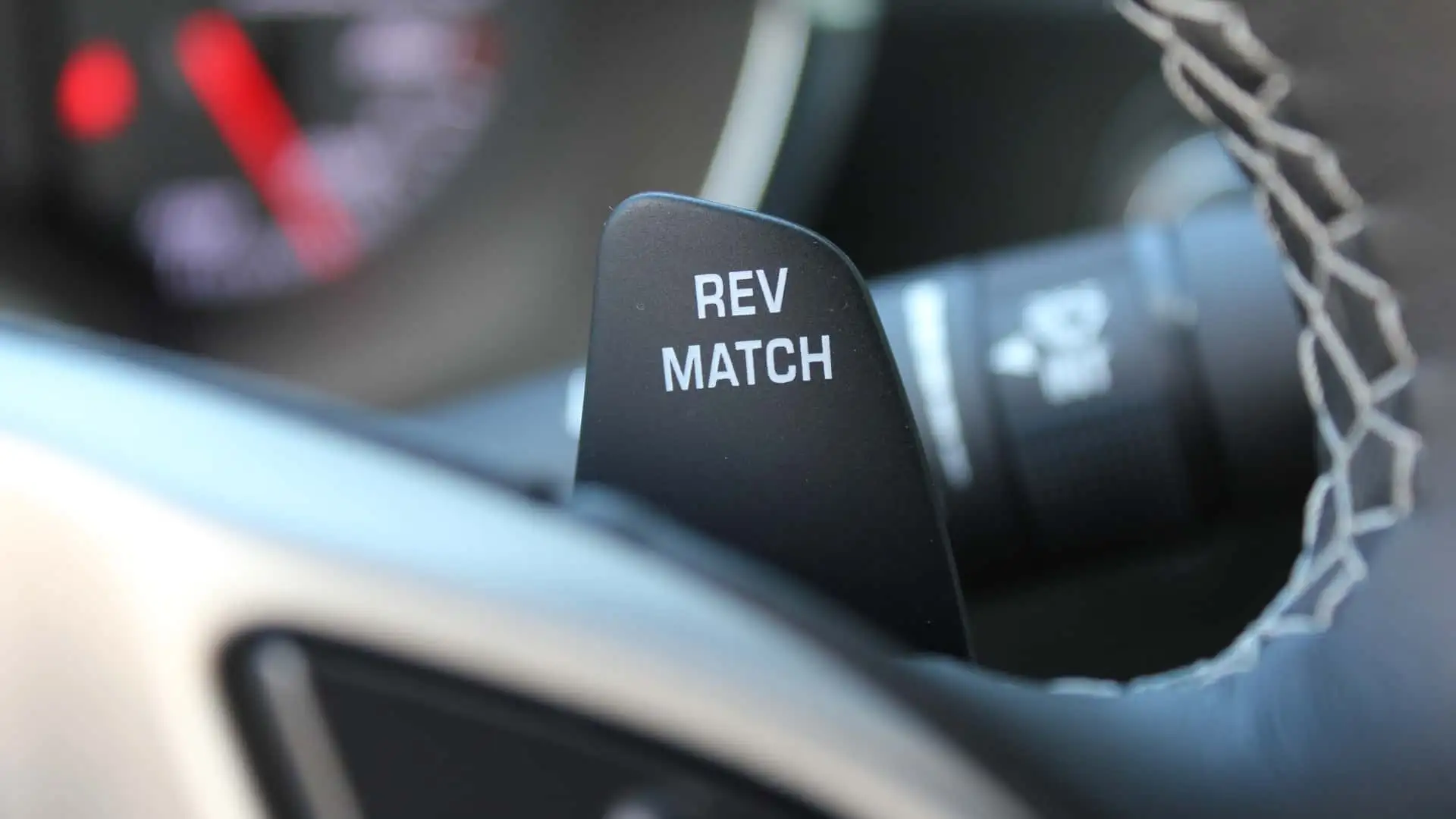
- Automakers started building it in. A lot of modern performance manuals, from certain Porsches to the Chevy Camaro SS to some Hyundai/Genesis performance trims, added rev-matching throttle blip systems that do it automatically. That split the community: purists who think auto rev-match defeats the point of driving stick at all, and people who just want the smoothest downshift possible and don't care how it happens. That argument alone keeps forums busy.
🧊 The Practical Case, Not Just the Flex Case
It's easy to write this off as pure showing off, but there's a real mechanical argument underneath it. A clutch that's constantly absorbing the shock of unmatched downshifts wears out faster. The syncros inside the transmission that are supposed to smooth gear engagement take extra abuse when the RPM gap is large and repetitive. Drivetrain components, motor mounts, even tires under hard cornering, all benefit from a smoother, more controlled transition between gears.
So the driver who's rev-matching every downshift on their commute isn't just performing for an audience. They're also probably going to get more life out of their clutch and drivetrain than the person dumping the clutch and letting the car sort it out. The flex and the function point the same direction, which is part of why the culture around it is so strong. It's not style over substance. It's style because of substance.
🌀 Different Disciplines, Same Fundamentals
Rev-matching shows up differently depending on what you're actually doing behind the wheel, but the physics underneath never changes.
Track days and time attack. This is where the technique matters most in a measurable way. A driver braking hard into a corner while downshifting two or three gears at once (say, sixth to third) has to blip the throttle multiple times in quick succession, all while modulating brake pressure so the car doesn't dive or upset the balance. Get it wrong under those conditions and you can lock a rear wheel momentarily, which on a car already at the edge of grip can be the difference between a clean apex and a spin.
Drifting. Drift culture leans on rev-matching constantly, though it gets less credit for it than the flashier stuff like clutch kicks and angle changes. Every transition, every gear change mid-slide, needs the RPM matched or the car will upset itself at exactly the wrong moment. Watch slow-motion footage of a skilled drifter's feet during a transition and it's a blur of heel-toe work most people never notice because they're watching the smoke instead.
Canyon runs and spirited street driving. This is where the flex element is loudest, because there's an audience. A group run through a canyon or mountain road, everyone downshifting into hairpins, is basically a rolling audition. The people who've put the work in sound noticeably different from the people who haven't, and in a group of enthusiasts, that gets noticed fast.
Daily driving. Plenty of manual owners rev-match every single downshift on their commute, corner or no corner, purely out of habit and mechanical sympathy. It stops being a conscious technique at some point and just becomes how they drive. That's usually the tell of someone who's been doing it a long time.
⚠️ Common Mistakes That Give You Away
Just as easily as good rev-matching signals skill, bad rev-matching signals the opposite, and car people notice both.
- Blipping too much or too little. Overshoot the RPM and you get a small lurch in the other direction as the clutch engages into an engine spinning faster than the gear needs. Undershoot it and you're back to the original problem, just softer.
- Timing the blip too early or too late. The blip needs to land while the clutch is disengaged, not before you've pushed it in and not after you've started letting it back out. Miss that window and the technique doesn't do anything for you.
- Riding the clutch to compensate. Some drivers who haven't nailed the timing will slip the clutch longer to smooth things out instead of getting the RPM right. It hides the problem from the passengers, but it's still eating the clutch, just a different way.
- Ignoring it entirely on aggressive downshifts. The bigger the gear drop and the harder the braking, the more a bad rev-match shows up. Someone can get away with sloppy technique on a gentle single-gear downshift in traffic and completely fall apart doing a double downshift into a tight corner.
None of these are embarrassing to have at some point. Almost everyone who drives stick has clunked a downshift. The culture isn't really about punishing beginners, it's about respecting the people who've put in the reps to make it look effortless.
🤖 The Automatic Rev-Match Debate
Once manufacturers started building throttle-blip rev-matching into performance manuals, the community split roughly into two camps, and neither side is fully wrong.
The purist argument: driving a manual is supposed to be a full-body, full-attention skill. Letting the car's computer handle the blip removes the exact thing that made rev-matching a flex in the first place. If the ECU is doing the hard part, you're not proving anything by downshifting smoothly, the car is.
The practical argument: a factory rev-match system does the job perfectly every single time, protects the drivetrain just as well as a skilled human, and still requires the driver to work a clutch pedal and shift gears manually, which most cars on the road today don't even ask of you anymore. For a lot of owners, that's plenty of manual-transmission authenticity without needing to master a technique that takes real time to build.
Most of these systems can be switched off, which is telling. Manufacturers built in an option specifically so drivers who want to do it themselves still can. That compromise hasn't ended the argument on forums and at meets, and it probably never will, but it does mean the debate is really about what "counts" as driving skill rather than about which approach is mechanically better.
🚗 Learning It Without Destroying Your Clutch
If you're trying to pick this up, most people recommend starting in an empty parking lot at low speed before ever attempting it in traffic or at a meet. Get a feel for how much throttle input it takes to bring RPM up for each gear in your specific car, since that number is different depending on the engine, the flywheel weight, and the gearing.
A lightweight flywheel, common on modified cars, makes rev-matching both easier and less forgiving. RPM rises and falls faster with a light flywheel, so the timing window to nail the blip gets tighter, but the payoff (quicker engine response) is part of why people swap flywheels in the first place.
Spota tip: if you're documenting a manual swap, a lightweight flywheel install, or just want proof you've got the technique down, drop the clip in your Garage. Progress pics and mod timelines are exactly what the Garage was built for, and "before and after" rev-match footage is the kind of thing that actually gets noticed on a build page.
🏆 The Bottom Line
Rev-matching isn't complicated in theory. Match the RPM, ease the clutch in, don't lurch the car. But doing it consistently, under braking, into a corner, without thinking about it, takes real seat time and real intent. That's exactly why it carries weight in car culture. It's a skill you can't buy, can't fake, and can't shortcut. Every clean downshift is a small, quiet proof that you actually learned to drive the thing instead of just owning it.
Related reading: check out why manual transmissions refuse to die and browse more under-the-hood breakdowns of the stuff car people argue about.