
🧾 The Piece of Paper That's Worth More Than the Radio Ever Was
Somewhere in a filing cabinet, a glovebox, or a manila envelope taped under a workbench, there's a piece of paper that a lot of car people would trade a set of wheels for.
Not a title. Not a registration. A window sticker. The thing the dealer peeled off the glass and threw away decades ago, back when nobody thought a Malibu or a Camaro would ever matter to anyone.
Now there are entire corners of the internet built around finding these things. People pay a research service $50 to pull a reproduction from GM's archives. They post a blurry photo of a build sheet found wedged behind a fuel tank like they just uncovered a lost Dead Sea Scroll. They argue for pages about whether an "M21" code on a door tag means what everyone assumes it means.
It looks insane from the outside. A sticker. Who cares?
Car people care. A lot. And once you understand what that sticker actually proves, the obsession stops looking crazy and starts looking like the most logical thing in the world.
🕵️ What a Window Sticker Actually Is (And Why It Became Sacred)
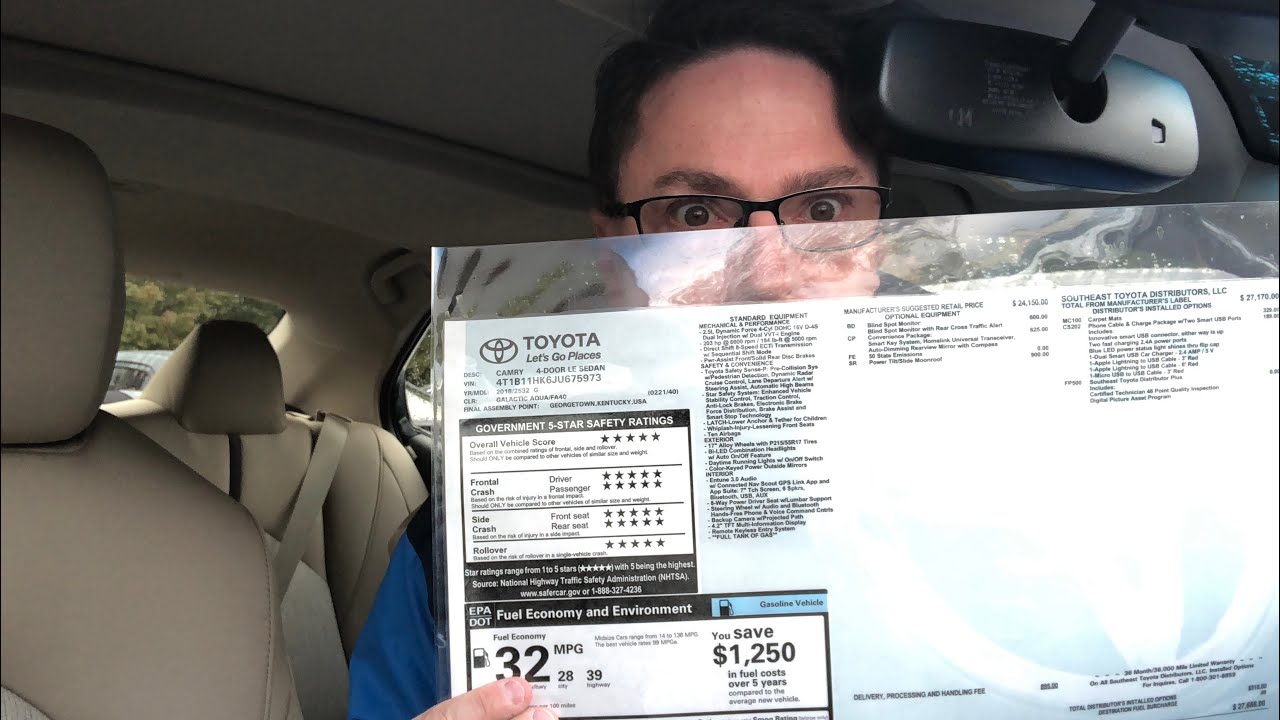
The window sticker, officially called a Monroney label (named after the senator who mandated it in 1958), is the factory-printed sheet that used to sit taped to a new car's window at the dealership. It lists:
- The base price and every factory option, with individual pricing
- The exact trim, engine, and transmission as built
- Fuel economy figures
- The build plant and sometimes the build date
- A full accessory and options breakdown, often down to floor mats and stripe packages
For a brand-new car, it's paperwork nobody thinks twice about. It gets tossed in the trash within a week, sometimes literally with the trash the dealer used to prep the car.
For a car that's now 20, 30, or 50 years old, it becomes something else entirely: the only surviving, unbiased, factory-generated proof of exactly how that specific car left the assembly line.
That distinction is everything. A seller can say a car is a numbers-matching, factory-optioned, rare-color example all day long. A window sticker doesn't say anything. It just states, in black and white, from 1969 or 1987 or 2003, what was actually ordered and built. No modern seller wrote it, no modern seller can convincingly fake the aging, the paper stock, the exact period-correct formatting, or the pricing structure of that specific model year. That's what makes it worth chasing.
📋 The Build Sheet: The Window Sticker's Rougher, Rarer Cousin
If the window sticker is the public-facing proof, the build sheet (also called a broadcast sheet, tank sticker, or invoice copy depending on the manufacturer and era) is the internal one. These were the factory floor documents used to tell line workers what to actually install on that specific car: which options, which trim codes, which colors, which drivetrain.
Here's the part that turns grown adults into treasure hunters: build sheets weren't meant to survive. They were shop-floor paperwork, and workers famously used to stuff them into seat springs, behind interior panels, above the gas tank, wherever there was a gap, mostly just to get rid of them once the car was assembled. Nobody planned for anyone to find these decades later.
But people do find them. All the time. A guy pulls a back seat for an upholstery job and there's a yellowed piece of paper folded up inside the springs. A restoration shop drops a fuel tank and something flutters out. Forums like the Chevelle, Nova, and Mustang restoration communities are full of "found the build sheet today!" posts with photos held up next to the VIN tag like a court exhibit.
It's not really about the paper. It's about the fact that the car itself just confessed something nobody could have faked.
🔍 The VIN Decoder Rabbit Hole
Before anyone even gets to a window sticker or build sheet, the obsession usually starts smaller: decoding the VIN, or on older cars, the door tag and trim tag codes.
A modern VIN alone can tell you the plant, the model year, the engine, and sometimes the trim. Older American cars used separate cowl tags, fender tags, or data plates with strings of letters and numbers that map to a specific color, interior, engine, and options package, if you know how to read them (or more realistically, if you know which forum thread has the decoder key someone spent a decade compiling).
This is where a huge amount of car-culture energy quietly goes:
- Model-specific forums maintain crowd-sourced VIN and trim-tag decoder threads, often unofficial, sometimes more accurate than the manufacturer's own records
- Facebook groups exist purely to help people decode a tag photo in real time
- Entire hobbyist businesses exist just to pull archived factory records (GM Heritage Center, Ford's own archive services, Chrysler's historical services) for a fee, specifically so someone can get an official reproduction of a document that would otherwise be gone forever
- People will post a single blurry photo of a tag and get fifteen replies within the hour, each one cross-referencing a different code table
None of this is casual. This is closer to genealogy research than car ownership. And that's not an accident, because it's solving the same emotional problem: where did this thing actually come from, and is the story I've been told about it actually true?
💰 Why It's Not Just Nostalgia: The Money Side
There's a very practical reason this obsession runs so deep, and it's not sentimental at all: documentation changes what a car is worth.
A numbers-matching, factory-documented, rare-option car can be worth multiples of an otherwise-identical car with no paperwork and a story nobody can verify. Auction houses like Barrett-Jackson and Mecum specifically call out lots that come with the original window sticker, build sheet, or Protect-O-Plate, because buyers pay a real premium for it. It's not uncommon to see a listing where the documentation gets its own bullet point above the engine specs.
Why? Because the used and collector car market runs entirely on trust, and trust is exactly the thing that's hardest to verify secondhand. Anyone can say "it's numbers matching." Anyone can say "it was optioned with the rare package." A build sheet or window sticker is the one thing that doesn't care what the seller says. It's a paper trail from the actual factory, from the actual day the car was built, and it can't be argued with the way a verbal claim can.
This is also why fakes and forgeries are a real, ongoing problem. Reproduction window stickers, made to fool buyers into paying collector prices for a car that was never actually optioned that way, are common enough that entire guides exist just on how to spot a fake one: wrong font, wrong paper weight, pricing that doesn't match period records, a layout that's subtly off for that model year. The forgery arms race is its own proof of how much the real thing is worth.
🧠 The Deeper Reason: A Car's Spec Sheet Is Its Identity Card
Strip away the money angle and there's something more personal going on. Enthusiasts don't just want to know what a car is. They want to know who it was when it was born.
A car that's been modified, repainted, swapped, and passed through six owners over forty years accumulates a completely different identity than the one it rolled off the line with. Maybe it started as a base six-cylinder car and someone dropped a V8 in decades later. Maybe the "factory" color everyone assumes is original is actually a repaint from 1994. A window sticker or build sheet cuts through all of that guesswork and answers the one question every enthusiast eventually asks about a car with real history: is this actually what it claims to be?
That instinct, the sense that a car's real history is part of what you own and not just its current spec, is the same instinct that drives a lot of the collector world's obsession with matching numbers and factory originality. It's the reason people will pay a premium for a documented survivor over a nicer-looking clone. The paper doesn't just prove value. It proves identity.
For a daily-driven build instead of a garage-kept collector car, the same instinct shows up differently: people want a running record of what's actually been done to their car over time, not just what it looked like on day one. That's a big part of why a Garage that tracks a car's real history, mods, milestones, and progress pics has become such a natural habit for people building something they actually care about keeping track of. It's the same paper trail instinct, just pointed forward instead of backward.
🏭 It's Not the Same Hunt at Every Brand
Part of what makes this obsession so deep is that every manufacturer did it differently, which means every fanbase has developed its own specialized folklore around finding and reading the paperwork.
- GM used broadcast sheets (often called "tank stickers" because they frequently turn up taped or wedged near the fuel tank) alongside the more formal window sticker. The GM Heritage Center is the gold standard for official reproduction requests, and it's common enough that Corvette and Camaro forums have entire pinned threads just walking people through the request process.
- Ford used a build sheet system too, but the coding conventions differ enough by era that Mustang and Bronco owners rely on entirely separate decoder resources than GM owners do. Ford's own archive services can pull data for many VINs, but coverage for older or lower-production models is spottier.
- Mopar (Chrysler, Dodge, Plymouth) owners talk about the fender tag, a small metal plate riveted to the firewall or inner fender that encodes trim, color, engine, and options in a dense string of letters and numbers. Decoding a Mopar fender tag correctly is basically a rite of passage in that community, and getting it wrong in a public forum post is a fast way to get corrected by five people at once.
- Import and JDM culture runs a parallel version of the same obsession, just with different documents: shaken (Japanese vehicle inspection) records, factory option sheets, and chassis codes that get cross-referenced with the same intensity as a Camaro fender tag, especially now that the 25-year import window keeps pulling more JDM legends into the US market with murkier paper trails than their American counterparts.
None of these systems talk to each other. A GM guy walking into a Mopar forum asking about a "build sheet" the way GM people mean it will get politely redirected to fender tag terminology within minutes. Every brand's community guards its own version of this knowledge like it's proprietary, because in a very real sense, it is: it's decades of crowd-sourced expertise that no manufacturer ever bothered to document for the public in the first place.
📱 Does Any of This Still Matter for a Car Bought Yesterday?
It's a fair question. Modern cars are logged digitally from the moment they're built. Every option, every build date, every service visit lives somewhere in a manufacturer database, accessible (in theory) with a VIN lookup and a Carfax or manufacturer app pull.
But the paper-chasing instinct hasn't gone away. It's just moved targets:
- People still screenshot and archive their own build sheet or order confirmation the day it's issued, specifically because they've read enough forum horror stories about dealers losing records or manufacturers purging old data after a database migration
- Manufacturer apps and portals get shut down, redesigned, or discontinued, and when they do, that "permanent" digital record can vanish the same way a paper one used to get thrown in the trash
- Enthusiasts building a modern car with a genuinely rare factory package (a manual transmission on a car that mostly sold with automatics, a discontinued color, a low-production special edition) are already thinking about how they'll prove originality to a buyer in 2050, the same way a '69 Camaro owner is proving it today
The format changed. The underlying anxiety, that documentation is fragile and institutions eventually stop caring about your specific car, hasn't changed at all. If anything, digital records feel less permanent to a lot of enthusiasts than a piece of paper that's already survived fifty years by accident.
🗂 Where People Actually Look
If you've never gone down this rabbit hole, here's roughly how the hunt actually plays out, whether it's for a personal project or someone flipping through a listing trying to verify a seller's claims:
- Check the car itself first. Door jambs, glovebox liners, under seat springs, above the fuel tank, inside spare tire wells. A shocking number of build sheets get found by accident during routine work, not deliberate searching.
- Ask the manufacturer's own archive service. GM Heritage Center, Ford, and Chrysler's historical services can produce an official reproduction window sticker or build record for a fee if the VIN is in their surviving archives, though coverage gaps exist for older or lower-volume models.
- Model-specific forums and registries. Marque-specific clubs (Corvette, Mustang, Chevelle, Camaro, and dozens of others) often maintain their own VIN registries built entirely by volunteers cross-referencing owner-submitted documentation.
- Private research services. A cottage industry of independent researchers exists specifically to track down archival documentation for a fee, often faster and cheaper than going through the manufacturer directly.
- Previous owners. Tracking down the second or third owner of a car through old registration records or forum posts and simply asking "did you happen to keep the paperwork" solves more of these mysteries than any archive does.
🚩 The Red Flags Every Buyer Learns the Hard Way
Anyone who's spent time in this world eventually learns to be suspicious of a few specific things:
- A window sticker that's suspiciously crisp for its age. Fifty-year-old paper looks like fifty-year-old paper. If it looks like it printed yesterday, ask questions.
- Pricing that doesn't match the model year. Every option had a documented price in that specific year's order guide. A mismatch is a hard tell.
- A seller who has the sticker but won't let you inspect it closely, or only shows a photo. Legitimate owners with real documentation are generally proud to show it off in person.
- A build sheet with handwriting or codes that don't match known factory formatting for that plant and year. This is exactly the kind of detail the forum decoder threads exist to catch.
🔧 Spota Tip
If you're building or buying into something you actually want a real history for, whether that's chasing down a car's original documentation or just making sure your own build has a real record going forward, it's worth treating your car's paper trail the same way the collector world does: like it's part of what you actually own. Log the mods, the milestones, the finds, in your Garage, so ten years from now nobody has to reverse-engineer your car's story from a scrap of paper wedged behind a seat spring.
Car culture loves a good detective story, and this one's been running for decades with no signs of slowing down. Every scrap of factory paper that survives is proof that somewhere out there, someone cared enough to keep it. That's the whole hobby in one sentence.