
🔥 The Sound Before You See Anything
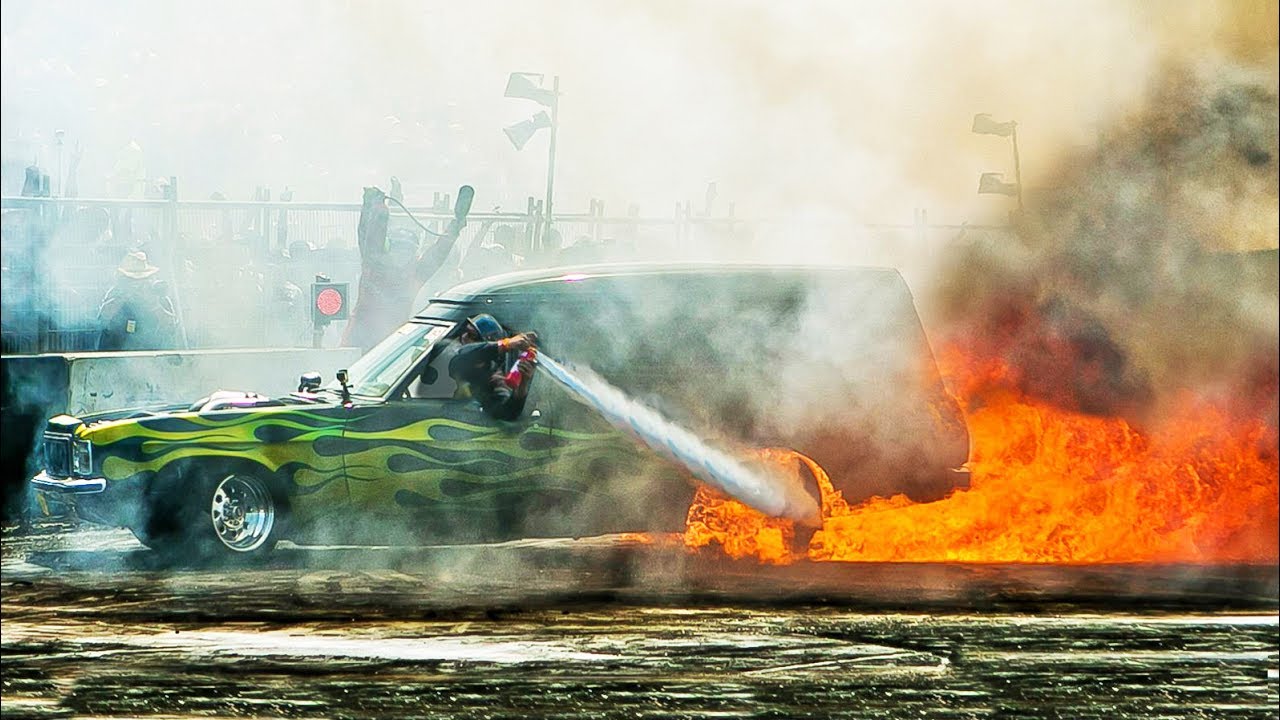
You hear it before you see it. A rising engine note, then a bark as the tires break loose, then that unmistakable hiss of rubber turning to smoke. By the time you turn your head, the car's already disappeared behind a wall of white haze, and everyone within fifty feet is either cheering or filming.
Nobody taught you what a burnout means. You just knew. It's a flex, a goodbye, a "watch this," a release valve for a car that's been sitting quiet all week. It costs money, it wrecks tires, and in most places it's flatly illegal. Car guys do it anyway, constantly, and have for seventy years.
That's the part worth actually unpacking. Burnouts serve no mechanical purpose in daily driving. They don't make the car faster, they don't fix anything, and they actively shorten the life of some of the most expensive parts on the vehicle. And yet they've become one of the most universally recognized rituals in car culture, instantly readable across every scene from muscle cars to JDM builds to lifted trucks. Something that pointless doesn't survive seven decades by accident.
⚙️ The Physics: What's Actually Happening Under the Tire
A burnout is, mechanically, very simple: you're feeding the drive wheels more torque than the available traction can handle, so instead of the tire gripping and rotating the car forward, the tire spins in place against the pavement.
What's happening at the contact patch:
- Friction converts to heat almost instantly. The tire surface can spike past 400°F in seconds, well past the rubber compound's design range.
- The rubber softens and shears. Once it's hot enough, the tire literally can't hold its molecular structure together at the surface, and thin layers peel and vaporize.
- That vapor is the smoke. It's not just friction dust, it's partially combusted rubber compound, oil, and volatilized additives, which is also why it smells the way it does and why breathing a lot of it isn't great for you.
- Traction drops as heat rises, which is the paradox: the harder you spin, the less grip you have, which is exactly what lets the spin continue instead of the car launching forward.
This is also why a burnout and a proper drag-strip launch are opposites, even though they look similar to a casual observer. At the strip, a "burnout box" is used to heat the tire just enough to soften the outer layer for maximum grip on launch, then the driver rolls forward into clean pavement and puts the power down before the tire overheats. A street burnout skips the second half entirely. The whole point is staying in the smoke, not leaving it. That's the fundamental split between a functional burnout (drag prep) and a performative one (everything you see at a meet), and it explains a lot about why the car community treats the two so differently.
Front-wheel-drive, rear-wheel-drive, and all-wheel-drive burnouts:
- RWD is the classic burnout platform. Weight transfers backward under power, loading the rear tires with grip right when you don't want it, which is why serious burnout cars often use a line lock or the parking brake to hold the front wheels while the rears light up.
- FWD burnouts are harder to sustain because the drive wheels are also doing the steering, and lifting the rear tires off the ground (a "one-wheel peel," when it happens on one side due to an open differential) is common and honestly more entertaining than dangerous in most cases.
- AWD burnouts are the hardest to pull off and the most expensive when they happen, because you're heating up drivetrain components (transfer cases, viscous couplings, center differentials) that were never designed for sustained wheel slip, which is part of why AWD platforms rarely show up doing burnouts at meets.
🏁 Where the Ritual Actually Came From
Burnouts didn't start as a party trick. They started as a necessity.
Drag racing in the 1950s and 60s ran on bias-ply tires that had almost nothing in common with modern radials. Bias-ply rubber needed real heat to get sticky enough to hook up on launch, and there was no traction compound painted on most staging lanes yet. Drivers would back into their own puddle of water (later, dedicated burnout boxes) and spin the tires hard before every run, purely to get enough temperature into the tread to survive the launch without just spinning through the whole quarter mile.
That functional habit bled into spectacle almost immediately, because a car doing a controlled, violent tire spin in front of a crowd is inherently a show. By the muscle car era of the late 60s and early 70s, burnouts at the strip were already half performance, half prep, and street cars started copying the look even when there was no functional reason to do it outside the burnout box.
A few cultural checkpoints that pushed it further into mainstream car identity:
- Muscle car culture made the burnout a statement of raw power. A car that could light up the tires from a dead stop was, by definition, taken seriously.
- Drift culture, which is technically a cousin of the burnout rather than the same thing, normalized sustained tire smoke as an aesthetic in its own right rather than just a byproduct.
- Burnout competitions turned it into a sanctioned spectator sport. Sturgis and Daytona both run dedicated burnout pits during their motorcycle rallies that draw car crowds too, and organized burnout contests exist at drag strips nationwide, complete with judged categories for smoke volume, control, and duration.
- Social media turned the burnout into content. A ten-second clip of a car disappearing into white smoke is close to perfectly engineered for short-form video: instant visual payoff, no context needed, works with the sound on or off.
None of this happened because burnouts are efficient or smart. It happened because a burnout is legible. Anyone, car person or not, immediately understands "this car is powerful and this driver doesn't care about the tire bill." That's a rare kind of communication in a hobby that's otherwise dense with jargon, spec sheets, and inside references.
🚔 Why It's Illegal (Almost) Everywhere
Here's the part that surprises newer enthusiasts: there is no state where an unsanctioned public burnout is simply legal. It's typically prosecuted under one or more of a small set of charges, and the specifics vary by state, but the pattern is consistent.
Common charges tied to street burnouts:
- Exhibition of speed / "exhibition driving" : the most direct charge, explicitly covering tire-spinning, rapid acceleration, and similar displays on public roads. This is the go-to charge in states like California and Texas.
- Reckless driving: a broader charge that a burnout easily qualifies for, especially with bystanders nearby, and it usually carries steeper penalties than exhibition charges alone.
- Disturbing the peace / noise ordinance violations: tire smoke aside, the sound alone is often enough for a citation, particularly at late-night meets in residential areas.
- Vehicle impoundment: a growing number of jurisdictions now impound the car on the spot for exhibition driving, not just the driver's license, which is a much bigger deterrent than a fine.
The consequences scale fast. A first offense is often a fine in the low hundreds of dollars, but repeat offenses, especially tied to organized "takeovers" or sideshows where dozens of cars block an intersection to run burnouts and donuts in the middle, are increasingly charged as felonies in some states, with real jail time attached. Street takeovers specifically have drawn a wave of new legislation over the past few years as cities try to get ahead of a problem that spreads fast on social media: one viral clip of an intersection shut down for a burnout show, and the next weekend three more cities have copycat gatherings.
This is exactly why organized, sanctioned venues (drag strips running burnout contests, car shows with a designated burnout pit, closed private lots) matter so much to the community. It's the difference between a legitimate car culture moment and a legal liability that gets an entire scene a bad reputation with local police and city councils. It's also a big part of why so many car meets have gotten stricter about "no burnouts, no donuts" rules in their posted etiquette. One person doing a burnout in a parking lot full of parked cars is how an entire meet gets shut down and the venue gets blacklisted for next year.
💸 The Real Cost of a Ten-Second Flex
Car people love to joke about it, but the math behind a burnout is genuinely brutal.
What you're burning through:
- Tires. A hard, sustained burnout can strip visible tread off a tire in seconds. On a performance tire that costs $300-$500+ each, that's not a cheap party trick, and doing it regularly means budgeting for tires the way some people budget for gas.
- Clutch (manual cars). Holding the clutch at the friction point while modulating a burnout cooks it. Repeated burnouts are one of the fastest ways to turn a healthy clutch into a warranty claim, or an out-of-pocket replacement on anything out of warranty.
- Differential and axles. Sudden, extreme torque spikes on a spinning wheel with almost zero resistance stress components that expect load, not violent unloaded spin.
- Transmission, especially automatics using a line lock or brake torque. Sustained stall-speed RPM against the brakes generates heat the transmission cooler wasn't built to dump that fast.
- Insurance risk. A citation for exhibition driving or reckless driving on your record is a fast way to see your premium jump, and a caught-on-camera burnout that ends in a crash (hitting a bystander, a parked car, a light pole) is a liability nightmare that can follow you for years.
None of that stops anyone. If anything, the cost is part of the appeal. A burnout is conspicuous consumption in its purest form: you're taking something expensive and visibly destroying a piece of it, on purpose, for no reason other than showing you can afford to.
🧠 The Psychology: Why It Still Feels Necessary
Strip away the physics and the legal risk, and what's left is a pretty simple human impulse: burnouts are one of the only socially legible ways a driver can announce "I built this" or "I earned this" in real time, in public, without saying a word.
A few things burnouts communicate that a static photo can't:
- Confidence in the build. A car that can hold a controlled burnout without something breaking is, implicitly, a car that's been maintained and set up right.
- A goodbye. Rolling out of a meet with a burnout is such a common closing ritual that at some meets it's practically expected, a loud punctuation mark on the night.
- A challenge or a greeting, depending on context. Between friends, it can be pure showmanship. Between rivals, it can read as a dare.
- Emotional release. There's a reason people describe it in almost cathartic terms. It's loud, it's physical, and it's over fast, which is a pretty accurate description of what a lot of people are chasing when they get into cars in the first place.
That last point is probably the real answer to why burnouts refuse to die despite every rational reason they should have faded out by now. Car culture, at its core, isn't really about transportation. It's about identity, and a burnout is one of the most efficient identity statements available: ten seconds, a cloud of smoke, and everyone watching immediately understands who you are as a car person, or at least who you're trying to be. What is a car enthusiast? gets into this same identity-first framing from a different angle.
🏆 Sanctioned vs. Street: The Line That Actually Matters
The car community's real disagreement about burnouts usually isn't "burnouts are bad." It's "where and how."
A burnout at a sanctioned event (a strip's burnout contest, a closed car show pit, a private track day) is celebrated. It's skill, it's spectacle, judges score it, crowds cheer, and nobody's property or safety is at risk. The same burnout in a public intersection with a crowd of onlookers standing inches from the smoke, blocking traffic, is a completely different thing, and it's the version that keeps making local news for the wrong reasons and getting entire scenes lumped in with reckless behavior they didn't sign up for. Why car meets get shut down by cops covers exactly how fast one bad stunt spreads into a citywide crackdown on an entire community.
That distinction, sanctioned spectacle versus street liability, is basically the same fault line running through most of car culture's more divisive rituals: drifting, tunnel revving, exhibition driving in general. The move is loud and the move is fun, but where you do it decides whether it builds the scene's reputation or torches it.
Spota tip: if the goal is capturing that kind of moment (the smoke, the crowd, the reaction) without the legal exposure of a street stunt, a Photo Op at a legal, parked location gets you a shot that still reads as pure car culture, minus the citation.
🛑 The Bottom Line
A burnout doesn't make a car faster, doesn't fix anything, and costs real money every time it happens. It's illegal nearly everywhere it's actually fun to do, and it's genuinely rough on some of the most expensive parts of the car. None of that has ever been the point.
Car people do it because for ten loud seconds, in a cloud of white smoke that everyone can see and smell and hear from a block away, it says something no spec sheet ever could. Do it at the strip, do it in a closed lot, do it somewhere sanctioned where the only thing at risk is a tire. The scene doesn't need another viral street-takeover clip. It needs more people who know the difference.