
🔊 There Was a Time Every Parking Lot Had One Car You Could Hear Before You Saw It
Remember that. A car rolls into the lot, windows already down, and the bass hits you in the chest before the headlights even clear the entrance. Somebody's trunk is doing more talking than their exhaust ever could.
That was normal once. Not a niche thing, not a "sub-culture" in the ironic sense. Boom cars were mainstream car culture. Every big-box electronics store had an install bay. Every mall had a car audio shop wedged between the food court and the arcade. Dual 12s in a ported box was a starter kit, not a flex.
Now? Ask a 19-year-old car guy what an SPL competition is and you'll get a blank stare. The scene didn't get replaced by something louder. It just quietly went away.
Here's what actually killed boom car culture, and why the pieces are starting to come back together.
📈 How Big This Actually Got
It's easy to forget how mainstream car audio was because nothing about today's car culture reflects it. But at its peak in the late 90s and 2000s, competitive car audio had real money in it.
What the scene looked like at its height:
- National SPL (Sound Pressure Level) competitions with sanctioned bodies like IASCA, MECA, and dB Drag Racing
- Purpose-built "demo cars" gutted of interior and rear glass just to survive the pressure of the system inside
- Amp manufacturers (Rockford Fosgate, Kicker, MTX, Orion, Alpine) sponsoring teams the way tuner shops sponsor drift cars today
- Magazine culture: Car Audio and Electronics, Bassin', entire publications dedicated to install photos and SPL leaderboard results
- Recorded SPL scores well north of 170-180 dB in the extreme "trunk" and "wall" classes, loud enough to be genuinely dangerous to unprotected hearing at close range
That last number is worth sitting with. A jet engine at takeoff is roughly 140 dB. The most extreme competition builds were pushing sound pressure that made a jet engine look quiet, all generated from a box in a trunk.
This wasn't a handful of obsessives either. Local car audio shops were a real, profitable retail category. Best Buy had a car audio department with trained installers. That's how normalized it was.
💸 Reason One: The Money Dried Up
The simplest explanation is usually the right one, and here it's simple: car audio got expensive at the exact moment disposable income for car mods got squeezed everywhere else.
A serious SPL build in the 2000s wasn't a $500 hobby. Real competition-grade setups ran:
- $3,000-$8,000+ in subwoofers alone for a multi-sub wall build
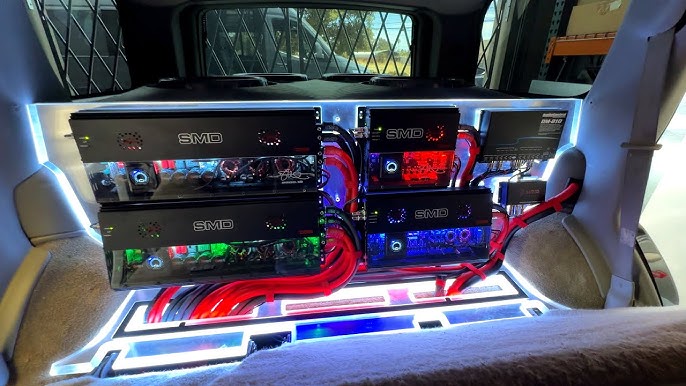
- $1,500-$4,000 in amplifiers to actually push that kind of power
- Custom fiberglass or MDF enclosure work, often $500-$1,500 in materials and labor if you weren't building it yourself
- A second battery, or a full electrical upgrade with big alternators and capacitors just to keep the system from dimming your headlights every time the bass hit
- Structural reinforcement to the trunk and rear deck so the car itself didn't fall apart around the system
That's a $6,000-$15,000+ investment for a car that, functionally, drives exactly the same as before you started. Compare that to spending the same money on a turbo kit, coilovers, or wheels: mods that change how the car performs, handles, or looks. As disposable income for car culture tightened up after the 2008 recession, the return on investment for a boom system just didn't compete anymore.
📱 Reason Two: Phones Made the Whole Format Obsolete
This one gets underrated. Boom car culture was built on a specific piece of hardware logic that phones quietly deleted.
The old logic:
- You needed a head unit with real processing power and a strong amp built in, because your source was a CD or cassette with no other outlet
- Bluetooth streaming from a phone barely existed until well into the 2010s, and early implementations sounded compressed and thin
- If you wanted your music loud and good, the car stereo was the speaker system. There was no alternative.
What changed:
- Phones became genuinely good personal audio devices with AirPods, Bluetooth earbuds, and portable speakers that deliver a personal listening experience without needing a car at all
- Streaming services normalized casual listening at low volume through built-in factory systems that got dramatically better at baseline
- The "loud car stereo" stopped being the only way to have a serious listening experience on the move
When your phone and a pair of $200 earbuds can outperform a 2003-era factory deck for personal listening, the motivation to drop thousands into a car-specific system for the same basic function (hearing music you like) mostly evaporates. The people who kept building loud systems anyway weren't doing it for personal listening. They were doing it as a public statement, which brings up the next problem.
🚔 Reason Three: The Legal Environment Turned Against It
Boom cars didn't die from a single law. They died from a slow accumulation of noise ordinances and enforcement priorities that made the whole hobby a liability.
What tightened up over the 2000s and 2010s:
- Municipal noise ordinances specifically targeting "plainly audible from X feet" car stereo volume, with fines that scaled up for repeat offenses in a lot of cities
- Increased police discretion to pull over and cite a car for excessive stereo volume, sometimes as a pretext stop, which quietly discouraged people from running loud systems even when technically legal
- Insurance friction: some insurers started asking about aftermarket electrical modifications, and a car visibly built around a massive stereo system read as a target for both theft and scrutiny
- HOA and apartment complex rules explicitly banning loud car stereos in shared parking, which mattered more as more young car guys lived in denser housing than the suburban driveway setup boom car culture assumed
None of these individually killed the hobby. Together, they made "build the loudest possible system and drive it around" a genuinely risky way to spend your car budget, both financially and legally, in a way that turbo kits and wheels never were.
🏆 Reason Four: The Competitive Scene Lost Its Infrastructure
Every enthusiast subculture needs somewhere to actually compete and be seen, or it withers. SPL competitions had that infrastructure, and it collapsed slower but more completely than people realize.
Sanctioning bodies need event organizers, judges, calibrated equipment, insurance, and a venue willing to host a parking lot full of cars trying to set off car alarms three blocks away. That's a lot of overhead for a niche hobby once the broader participant base shrank. As fewer new competitors entered (because of the cost and legal pressure above), events got smaller, sponsorship dollars followed the audience elsewhere, and the whole ecosystem that made competitive car audio feel like a real scene, not just a personal hobby, thinned out.
Compare that to drift, which had the exact opposite trajectory: it built out a real competitive infrastructure (Formula Drift, regional series, dedicated tracks) right as boom car infrastructure was disappearing. Car culture attention and sponsorship dollars are finite. One scene's collapse is often another scene's growth.
🔧 Reason Five: The Aesthetic Fell Out of Fashion
Car culture runs in aesthetic cycles as much as anything mechanical, and the boom car look (deep-tinted windows, visible subs through the rear glass, a trunk that's more speaker box than trunk) became coded as a specific era rather than a timeless build style. The same thing happened to underglow, a mod trend that got legislated and mocked out of existence in about a decade flat.
Modern build culture skews toward stance, wheel fitment, and performance mods that read as intentional and technical. A trunk full of visible subwoofers started reading as dated rather than aggressive, the same way a certain era of body kit reads dated now even though the cars underneath are still great.
🩺 Reason Six: Nobody Talks About the Hearing Damage, But It Was Real
This one almost never comes up in the nostalgia version of the story, but it mattered more than people admit.
Sustained exposure above 120-130 dB causes measurable hearing damage in minutes, not hours. Competition-class boom car builds were regularly hitting 150+ dB inside the cabin, sometimes north of 170 dB in extreme trunk classes. That's not "loud music." That's an exposure level that shows up in occupational hearing-loss studies for jackhammer operators and jet mechanics.
What that meant in practice:
- Serious SPL competitors wore hearing protection just to sit in their own car during a run
- A non-trivial number of daily boom car drivers developed tinnitus or measurable hearing loss from years of casual exposure, well below competition levels
- Repeated exposure at high volume for hours at a time (which is exactly how a lot of people drove with these systems) causes cumulative damage that doesn't reverse
As car culture got a little more safety-conscious across the board (better data on track day risk, more awareness around modified car insurance, more scrutiny on stuff like nitrous and rolling coal) the "how loud can we get this" arms race stopped looking like a fun flex and started looking like a hobby with a real physical cost attached. That shift in attitude didn't kill boom car culture on its own, but it took away some of the bragging rights that used to come with the loudest build in the lot.
🎧 What's Actually Left of the Scene Today
Boom car culture isn't fully dead. It's smaller, older, and more concentrated than it used to be.
Where it survives:
- Diesel truck audio and "bass head" builds in specific regional scenes, especially the Southern US, where big trunk and wall builds are still a genuine subculture
- A dedicated competitive core still running dB Drag Racing and MECA events, smaller than the 2000s peak but not gone
- A resurgence of interest in vintage systems, driven partly by nostalgia and partly by the same JDM-adjacent retro wave that's brought back other 90s and 2000s car culture staples
- YouTube demo culture, where "loudest car stereo" builds get filmed for views rather than trophies, which is arguably the modern replacement for the old magazine spread
The infrastructure that made it mainstream is gone, but the underlying appeal (a car that announces itself before you see it) hasn't disappeared. It just found smaller, more dedicated pockets instead of a mass-market hobby.
Spota tip: if you're one of the people keeping this alive, your Garage is the right place to actually document a build like this the way the old magazine spreads used to: the enclosure work, the electrical upgrade, the before-and-after of what it took to get there.
🚗 The Bigger Pattern
Boom car culture is a clean case study in how a car mod trend actually dies. It's rarely one thing. It's cost pressure, a technology shift that made the original use case obsolete, legal friction that turned a hobby into a liability, and a competitive scene that couldn't sustain its own infrastructure once the base shrank, all landing in the same decade.
The same forces are worth watching in whatever's currently mainstream. Underglow got banned into a shadow of itself. Loud exhaust is under increasing legal pressure in a lot of states right now. Nothing in car culture is permanent, it just runs on longer cycles than people notice while they're inside them.
If you were around for the boom car era, you watched a real scene rise and fall in real time. If you weren't, just know that the quiet factory stereo in your daily driver used to be the exception, not the rule.
The bass dropped. Nobody agreed on when it would come back up.