
🅿️ The Walk Nobody Complains About
You pull into a packed lot. There's a wide-open spot four cars from the entrance. Your passenger points at it. You keep driving.
Two minutes later you're parking in the back corner, next to a light pole, three empty spots on every side, and a five-minute walk back to the store.
Nobody in the car argues. Everyone just accepts it. That's the part non-car-people never understand: this isn't laziness or indecision. It's a decision, made instantly, every single time, by people who've done the math without ever writing it down.
Ask a car guy why he does it and you'll usually get a shrug and "because I don't want my doors dinged." That's true, but it's only the headline. The actual reasoning runs deeper, and once you understand it, you'll never look at an empty back row the same way again.
🚪 The Door-Ding Math
This is the obvious one, but it's worth breaking down because most people underestimate how real the risk actually is.
Every parking spot near an entrance sees dramatically more traffic:
- More cars cycling through the same spots per hour
- More people getting in and out in a hurry
- More kids swinging doors open without looking
- More shopping carts rolling loose in the wind
- More strangers parking inches from your paint because it's the only spot left
A spot at the back of the lot might sit empty for an hour. A spot by the entrance turns over every ten minutes, and every turnover is another chance for someone's door edge to find your quarter panel.
The math isn't paranoia, it's exposure. If a door-ding is roughly a fixed probability per parked-next-to-you event, then the entrance spot with twenty turnovers a day carries twenty times the risk of the back row spot with one. Car guys aren't calculating percentages consciously, but years of finding new dings on cars that were "parked safely" has trained the instinct anyway.
And dings aren't cheap to fix right. A proper paintless dent repair on a modern high-strength panel, or a respray if the paint cracked, runs real money for damage that took someone half a second and zero thought to cause.
🛒 The Shopping Cart Problem
Ask anyone who's ever come back to find a fresh scrape down their door and they'll tell you: it usually wasn't another car. It was a cart.
Loose shopping carts are one of the most common sources of parking lot damage, and they're almost entirely a function of proximity to the store:
- Carts get pushed to the nearest empty spot instead of the corral
- Wind rolls unsecured carts across a lot with zero warning
- Cart corrals near entrances overflow first and fastest
- A rolling cart doesn't stop for anyone's paint job
Park at the back and you've functionally opted out of this entirely. There's no cart traffic four rows past the corral. That's not an accident. It's the whole point.
🧍 Fewer People, Fewer Variables
It's not just cars and carts. It's people.
Entrance spots put your car in the highest foot-traffic zone in the entire lot:
- Kids running ahead of parents, bikes leaning, skateboards rolling
- Distracted phone-in-hand pedestrians cutting between bumpers
- Strollers, dollies, and carts navigating tight rows
- Someone leaning a bag, a cooler, or a keychain against your fender while they dig for their phone
Every one of those is a low-probability, high-annoyance event on any single car, but stack up enough passersby over enough visits and it adds up. The back of the lot has maybe one person walking through it every twenty minutes. That's the actual product being purchased with the extra fifty yards of walking: fewer strangers within arm's reach of your car, full stop.
🧠 The Real Reason: It's Not About the Car, It's About the Investment
Here's the part that separates a car guy's back-row habit from a rideshare driver's or a rental car's. It was never really about the car as an object. It's about what's tied up in it.
Think about what actually sits under that paint on a built car:
- Hundreds or thousands of hours of research, wrenching, and troubleshooting
- Money that could have gone somewhere else, spent instead on parts, tune time, and finish work
- A build that's still, in some sense, never actually finished
- Identity. Ask any enthusiast and the car isn't just transportation, it's a project with their name attached to it
Loss aversion is a documented, well-studied bias: people feel the pain of losing something roughly twice as intensely as they feel the pleasure of gaining something equivalent. A car guy isn't protecting four doors and a hood. He's protecting a few hundred hours of Saturdays and a bank account's worth of parts invoices he doesn't want to think about too hard. Parking at the back isn't overkill against that backdrop. It's proportionate.
This is also why the habit sticks around even on cars that are objectively pretty stock. Once you've internalized "protect the car," it doesn't turn off just because this particular car hasn't been modded yet. The instinct outlives the specific justification.
🚶 The Walking Isn't a Cost, It's a Feature
Ask a car guy if the extra walking bothers him and you'll usually get a genuinely confused look. For a lot of enthusiasts, the walk is close to free, and sometimes it's a small bonus.
- It's a few extra minutes of exercise nobody complains about
- It's a last look back at the car before walking away, and a first look coming back
- On a clean day, it's basically a mini photo op: good light, an empty background, no other cars cluttering the shot
- It buys a beat of separation from a rushed errand, which plenty of people quietly like more than they admit
None of that outweighs the door-ding math on its own, but it's part of why the tradeoff feels so easy. There's essentially no real cost being paid for the extra protection, just a walk most people would take anyway if you framed it as a lap around the block.
🎯 Reading the Geometry of a Lot Like a Local
Enthusiasts who've been doing this for years aren't just aiming for "far away." They're reading the actual layout.
What an experienced car guy is scanning for:
- End caps and islands: a spot at the end of a row only has one neighbor instead of two
- Curbed medians: a spot against a planter or curb means nobody's parking flush next to that side at all
- Light poles: an island around a light pole creates a natural buffer with fewer real spots around it
- Angle and orientation: an easy straight-forward exit beats a spot boxed in on three sides, regardless of distance
- Sightlines: enough ambient light and visibility from the store or street, since an empty back row that's also poorly lit is a tradeoff in the other direction
That last point matters and gets skipped a lot in the "just park far away" version of this advice. A genuinely empty, dark, camera-free corner isn't automatically safer. It trades door-ding risk for a different kind of risk: theft, vandalism, or just a car sitting somewhere nobody would notice if something happened to it. The smartest version of this habit isn't "as far as possible," it's "as isolated as possible while staying visible, lit, and within sight of foot traffic or cameras." A back corner near a light pole and a sightline to the entrance beats a pitch-black row against the back fence every time.
💰 The Insurance Angle Nobody Talks About
There's a quieter financial reason behind the habit that most car guys have never said out loud, but every insurance adjuster knows well.
Parking lot incidents are one of the most common sources of comprehensive and collision claims, and a huge share of them are exactly the low-speed, low-drama kind that back-row parking is designed to avoid:
- A door swung open too fast into your panel
- A driver clipping your mirror while pulling out at an angle
- A cart or cargo strap left loose that rolls into a bumper
- A hit-and-run scrape where nobody ever comes forward
Filing a claim for a $600 door ding usually isn't worth it once a deductible and a potential premium bump are factored in, so most of this damage just gets absorbed as an out-of-pocket cost or, worse, left unfixed and staring back at you every time you walk up to the car. Modified cars complicate this further, since aftermarket parts and custom paint can be harder to match and more expensive to source than factory replacements. A cracked OEM bumper is an annoyance. A cracked bumper wearing a hand-applied wrap or a hard-to-match custom color is a genuinely bigger headache.
None of this shows up on a spreadsheet a car guy keeps, but it's baked into the instinct anyway. Every dollar not spent on a repair is a dollar that stays in the parts budget.
🕰️ Where the Habit Actually Came From
This isn't a habit that started with modified cars. It's inherited from a much older, more formal tradition: valet and show-car parking.
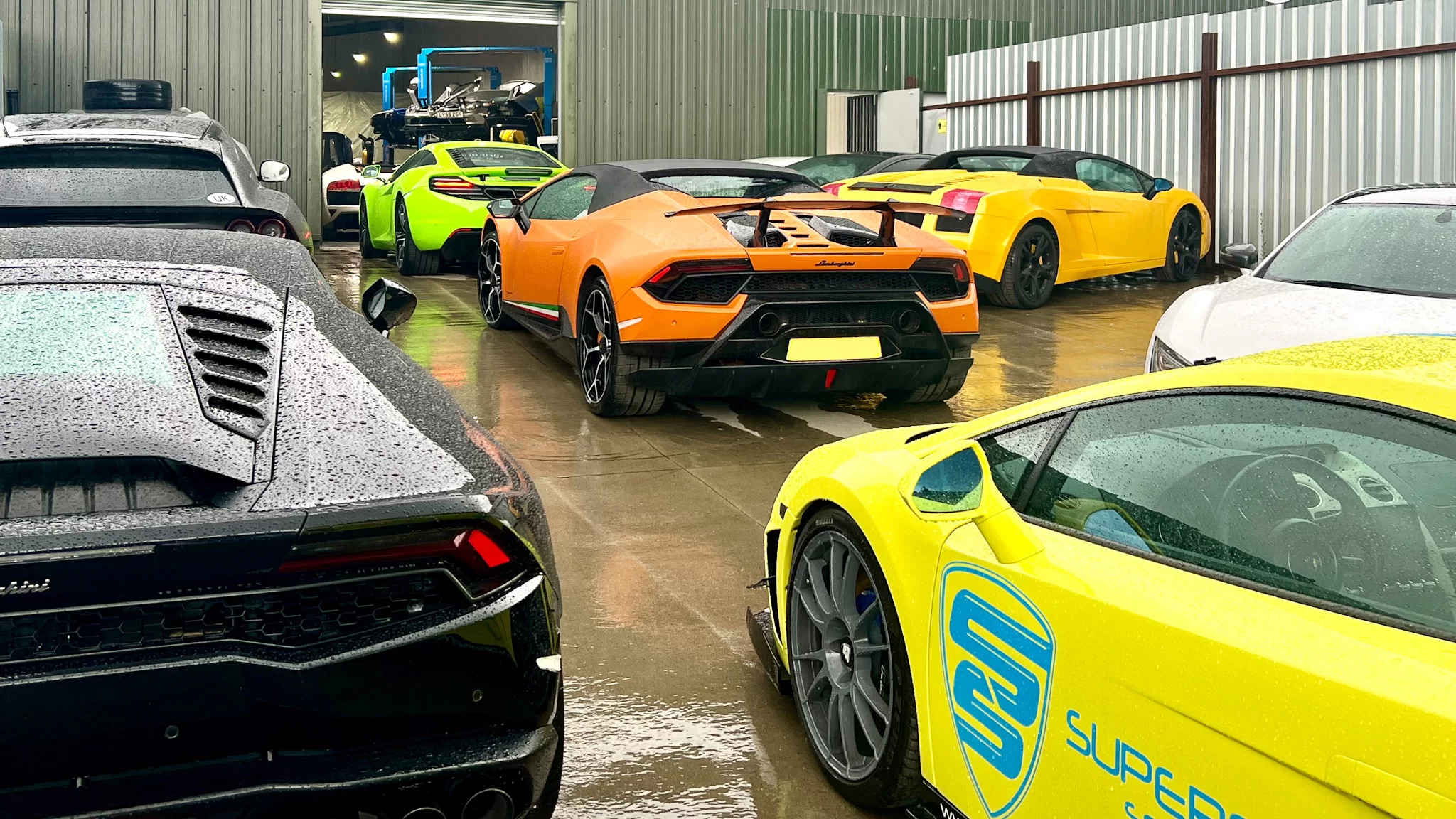
At concours events, car shows, and high-end valet stands, staff have parked exotic and classic cars away from general traffic for decades, specifically to avoid the exact risks described above. Nobody questions a $2 million classic getting parked in its own roped-off corner instead of squeezed between two minivans. That instinct, put the valuable thing somewhere it won't get touched by accident, is exactly the same logic a car guy applies to his own daily in a grocery store lot. He's just doing it himself instead of handing the keys to someone in a vest.
Car meets reinforced the same pattern from a different angle. Show up to any organized meet and you'll see cars deliberately spaced out, nose-out, with real gaps between them, because everyone there understands the unspoken rule: respect the space around someone else's build the way you'd want yours respected. That etiquette doesn't switch off the moment the meet ends and everyone drives to grab food afterward. It just quietly follows the car home.
🗣️ The Pushback: When Parking Far Away Is Actually the Wrong Move
Not every car guy does this every time, and the ones who've thought about it the most know when to break the habit.
- Bad weather: nobody's walking a quarter mile through a downpour or across an icy lot to save a fender from a hypothetical ding
- Late at night in an unfamiliar area: personal safety wins over paint every time, full stop
- Loading and unloading: moving groceries, tools, or gear repeatedly favors proximity over protection
- Accessibility needs: this entire habit is a luxury of mobility, and it's not universal, nor should anyone pretend it is
- Legitimately full lots: sometimes there is no back row, and the choice isn't "close vs. far," it's "spot vs. no spot"
The habit is a heuristic, not a religion. The car guys who get genuinely annoyed at other car guys for backing themselves into a bad situation just to avoid a theoretical ding are usually the ones who've actually had something happen in a dark, empty corner once and learned the hard way.
📸 Where This Overlaps With the Rest of Car Culture
The instinct to find the emptiest, cleanest spot in a lot isn't just defensive. It quietly doubles as content strategy for a lot of enthusiasts, whether they admit it or not.
An isolated spot with clean pavement and no clutter in the frame is a genuinely better backdrop than a packed row of minivans. It's why plenty of "quick garage pic" style shots on Instagram and in car Discords are clearly taken in some half-empty back row of a Target or a gym parking lot: good light, nothing distracting, car by itself.
Spota tip: if you're already scouting a lot's back corner for the extra space, that same instinct for finding a clean, uncluttered spot is exactly what a good Photo Op location looks for, parked, legal, and safe, with nothing else competing for the frame. Plenty of Spota's Photo Op missions live in exactly the kind of overlooked lot corner a car guy already knows to aim for out of habit.
If you want to see how enthusiasts are turning ordinary parking lots and city corners into actual content and progress instead of just empty space, the Garage system is worth a look. It's the same instinct that puts a car in the back row: protect it, then show it off on your own terms.
🏁 The Bottom Line
It looks irrational from the outside. Ten open spots up front, and the guy in the clean coupe drives past every one of them for a spot nobody else wanted.
It's not irrational. It's a small, repeated act of protecting something that took real time and real money to build, weighed against a walk that costs basically nothing. Fewer doors near you means fewer dings. Fewer carts near you means fewer scrapes. Fewer people near you means fewer chances for someone else's bad five seconds to become your $400 repair bill.
The back row isn't about being precious. It's about doing the math once, internalizing it, and never having to think about it again.
Next time you see a nice car parked alone at the far end of an otherwise packed lot, you're not looking at someone being difficult. You're looking at someone who already did the math you haven't thought about yet.
❓ FAQs
Why do car guys park so far away from the store?
Mainly to reduce exposure to door dings and shopping cart damage. Spots near an entrance see far more car and cart turnover, and each turnover is another chance for someone else's carelessness to damage your paint. Parking farther away trades a short walk for meaningfully less risk.
Is parking far away actually safer for your car?
Generally yes for door dings and cart strikes, since fewer cars and pedestrians pass close to your doors. It can be less safe in poorly lit, low-visibility corners, though, so experienced enthusiasts look for an isolated spot that's still well-lit and within sight of the entrance or cameras, not just the emptiest spot available.
Does parking far away actually prevent all damage?
No. It reduces risk, it doesn't eliminate it. A car parked far from other vehicles can still get hit by another car pulling in badly, hail, falling branches, or a runaway cart caught by the wind. It's risk reduction, not a guarantee.
Why do car guys care so much about minor door dings?
Because a lot of what's under the paint on a built car represents real time, money, and effort that isn't easily replaced. Proper dent repair or a respray also isn't cheap, so avoiding damage in the first place is usually far less expensive than fixing it later.
Is this just a car guy thing, or does everyone benefit from parking farther away?
Anyone can use the same logic. Fewer neighboring cars means less risk of dings and scrapes for any vehicle, not just modified ones. Car enthusiasts just tend to be more deliberate about it because the stakes, at least to them, feel higher.
When does it make sense to just park close instead?
Bad weather, unloading heavy items repeatedly, personal safety in an unfamiliar or poorly lit area, accessibility needs, or a lot that's simply too full to have a real "back row" at all. The habit is a general rule of thumb, not an absolute.
It's not about the walk. It's about what's waiting at the end of it.