
🔥 The Car That Makes Every Head at the Gas Station Turn
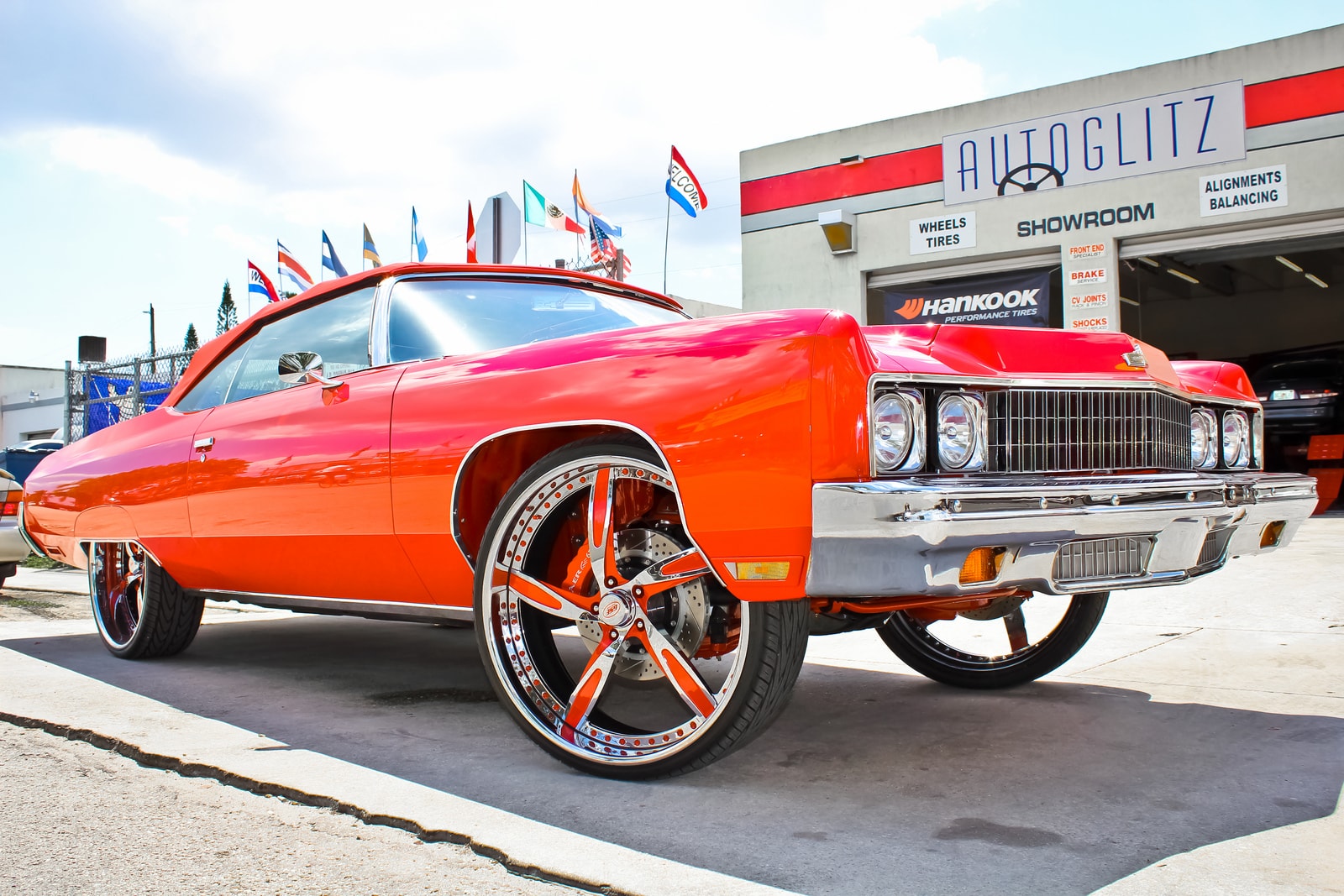
Picture a 1974 Caprice, candy-orange paint deep enough to look wet, sitting on wheels so big the fenders look like they're wearing someone else's shoes. It rolls into a gas station and every single person there stops what they're doing. Not because it's fast. Not because it's subtle. Because nothing else on the road looks anything like it.
That's a donk. And depending on who you ask, it's either one of the boldest, most skill-intensive builds in car culture, or a rolling punchline about why anyone would put 30-inch chrome under a 50-year-old Chevy.
Car culture has been predicting donk culture's death for two decades now. It hasn't happened. If anything, the scene has gotten more organized, with its own drag racing series, its own dedicated shows, and a new generation of builders keeping 1970s and 1990s Chevys alive specifically to put them on wheels the factory never imagined. So before writing it off as a phase, it's worth understanding what donk culture actually is, where it came from, and why it's stuck around this long.
📜 Donk, Box, and Bubble: The Terminology That Actually Matters
"Donk" gets used as a catch-all for "old car, huge wheels," and that drives purists up the wall, because inside the culture the term is specific. It refers to one narrow window of cars: the 1971 to 1976 Chevrolet Impala and Caprice, full-size body-on-frame sedans with enough real estate in the wheel wells to swallow genuinely massive rims.
The rest of the family tree has its own names:
- Donk: 1971-1976 Impala or Caprice. The original, and the only cars purists will call a true donk.
- Box: 1977-1990 Impala or Caprice, named for the squared-off, boxy body style Chevy ran through the malaise era.
- Bubble: 1991-1996 Caprice, named for the rounded, aerodynamic "bubble" body that replaced the box.
Call a box-body Caprice a donk in the wrong crowd and someone will correct you within about ten seconds. The distinction isn't pedantry for its own sake. It's the same instinct that makes a JDM guy correct you on hatch versus fastback, or a muscle car guy insist a Chevelle isn't a Malibu. Getting the vocabulary right is part of showing you actually know the culture instead of just gawking at it.
Where the term "donk" itself comes from is genuinely debated, and even longtime builders don't fully agree. The most common explanation ties it to the Impala's leaping-deer hood emblem, which early owners nicknamed a "donkey," shortened to "donk." Others point to the way these cars sit once they're raised and wheeled, with a stance some compare to a donkey squaring up. Either way, the name stuck decades before anyone was Googling its origin.
🌴 Where It Started: South Florida, the 90s, and a Culture Built From Scratch
Donk culture didn't come out of a magazine spread or a factory tuner program. It came out of South Florida in the early 1990s, grown inside Miami's Black car scene and tangled up tightly with the Dirty South hip-hop movement that was exploding out of the same neighborhoods at the same time.
These weren't cars people were buying new and building up. The '71-'76 Impalas and Caprices that became donks were cheap, plentiful used cars in the early 90s: big, comfortable, full-frame sedans that were easy to find and easy to work on. Owners started swapping in progressively bigger wheels, first as a status move, then as a genuine craft, with candy paint, elaborate interiors, and sound systems joining the wheels as the build matured. Miami rapper Trick Daddy, out of Liberty City, is widely credited with helping push the term and the imagery into wider culture through his music and videos, and from there it spread through the South and eventually nationwide, with strong scenes taking root in cities like Indianapolis and St. Louis alongside Florida.
By the 2000s, the culture had its own logic, its own hierarchy of respect, and its own annual gatherings. FL2K, Florida's massive spring car meet week, became one of the biggest stages for donk builds anywhere, drawing rows of Impalas and Caprices on chrome that dwarfed anything else in the parking lot. It's not a fringe scene borrowing legitimacy from mainstream car culture. It built its own lane from the ground up.
⚙️ The Case Against Donks: What the Function Crowd Gets Right
Ask a performance-first car guy what's wrong with a donk and you'll get a list, and most of it holds up under actual scrutiny.
- Wheel size versus tire sidewall. Stretching a low-profile tire over a 26-, 28-, or 30-inch wheel leaves almost no sidewall to absorb impacts. Potholes and bad pavement transfer straight into the wheel and suspension instead of getting cushioned.
- Suspension geometry pushed way outside its design range. Fitting wheels that size usually means raising the car and reworking control arms, spindles, and sometimes the whole front clip, which stacks up stress on parts never engineered for that geometry.
- Weight and balance problems. A set of 30-inch wheels and tires is dramatically heavier than stock, which changes unsprung weight, rotational inertia, and how the car responds to braking and steering input, almost never for the better.
- Not built for daily-driving distance or speed. Most serious donk builds are show cars or slow-cruise cars by design. Push one hard through a corner or a long highway stretch and the tradeoffs show up fast.
If the standard for a "good" car mod is faster, safer, more capable, a donk fails that test about as hard as a mod can fail it. That's a fair, technically accurate critique. It's also answering a question the builder was never asking.
🎨 The Case for Donks: Craft, Culture, and a Scene That Built Its Own Rules
Ask a donk builder why they do it and performance never comes up, the same way it never comes up when you ask a lowrider builder or a custom painter why they do what they do. The answer is craft, presence, and belonging to something with real roots.
- The fabrication work is genuinely hard. Getting a 50-year-old body-on-frame Chevy to safely carry 28s or 30s without the fenders getting chewed up or the suspension collapsing takes real skill: custom control arms, reworked spindles, careful ride height tuning. Bad execution gets clowned inside the culture just as fast as outside it.
- It's preservation with a twist. Every donk build starts by saving a car that would otherwise be scrapped or forgotten. A stock, unmolested '74 Caprice isn't collectible in the way a Chevelle SS is. Donk culture gave an entire generation of overlooked full-size Chevys a reason to survive, get restored, and get loved.
- It's rooted in a specific community, not a trend that got borrowed. Donk culture grew directly out of Miami and the broader Dirty South scene, tied to music, to specific neighborhoods, to a specific moment. Building one connects an owner to that history the same way building a lowrider connects an owner to Chicano car culture in Southern California. It's not costume; it's lineage.
- The events are real infrastructure, not just internet hype. FL2K, regional donk shows, and the National Donk Racing Association's drag events give the scene a structure most "phase" trends never build: competition classes, community standards, a reason to keep showing up year after year.
Nobody's building a 30-inch-wheeled Caprice because they think it'll out-corner a track car. They're building it because presence, history, and craft are their own reward, and car culture has always had room for that lane right alongside the performance one.
🏁 The Same Fight, a Different Wheel Size
Strip away the specifics and donk culture is arguing about the exact same thing stance culture, lowrider culture, and show-car culture have always argued about: is a car's value measured by what it does, or by what it says?
Function-first car culture measures a build against a stopwatch. Form-first car culture measures it against craft, history, and how hard it hits when it rolls up. Neither answer is wrong, and neither one is the whole story. A drift car and a donk are both "impractical" by a pure-performance standard, and both are built by people who know exactly what tradeoffs they're making and don't care, because the tradeoff was never the point.
Spota tip: if you're restoring and building out a car with real history behind it, whether that's a donk, a lowrider, or a restomod, the Garage is where that story belongs: the before-and-after progress pics, the parts list, the reasoning behind each decision. A finished build photo tells people what you ended up with. A documented build tells people what it took to get there, and that's the part that actually earns respect in a culture built on craft.
🧭 Why It's Not Going Anywhere
Car culture loves declaring things dead. Stance was supposed to be a fad. Drift was supposed to fade once video games moved on. Donks have been getting the same prediction since the early 2000s, and the scene keeps proving it wrong, because it was never a trend riding on hype. It's a community with its own history, its own shows, its own competition circuit, and a genuine craft tradition passed down from builder to builder.
You don't have to want 28s under your own car to respect what it takes to build one right. That's true of most of the lanes inside car culture that look nothing alike on the surface but are all chasing the same thing underneath: something nobody else on the road has, built by hand, on purpose, tradeoffs and all.
For more on how these different corners of car culture stack up against each other, check out Why Stance Culture Divides the Car Scene: Form vs. Function, or browse more culture deep-dives over in Under the Hood.