
📉 The Number That Ends Every Argument (And Starts Ten More)
Somebody pulls up a dyno sheet on their phone. 487 whp. The group goes quiet for a second, then the questions start. What dyno was that. Was it corrected. Was it a cold morning. Who tuned it. Because everybody in that parking lot already knows the uncomfortable truth: a dyno number by itself means almost nothing.
Car people treat dyno sheets like courtroom evidence. Print it out, post it, settle the debate. But the same exact car can roll onto two different dynos in the same city and print two numbers 40 horsepower apart, with nothing mechanical changed in between. That's not fraud. That's just how dynos work, and almost nobody explains it before you're standing there arguing about it.
This is the part of car culture that gets glossed over constantly: a dyno doesn't measure "horsepower" the way a speed trap measures speed. It measures a pull, on a specific day, on a specific machine, under a specific set of assumptions, and then does math to turn that into a number you can compare to other numbers. Every one of those variables can move the needle. Let's actually break down why the number lies, and how to read one like you know what you're looking at.
🔧 There's No Such Thing as "The" Dyno Number
The first thing that trips people up: there isn't one type of dyno, and the type matters as much as the car.
Chassis dyno vs. engine dyno. An engine dyno measures the engine alone, disconnected from the car, direct off the crank. A chassis dyno measures power at the wheels, with the car sitting on rollers, power flowing through the transmission, driveshaft, differential, and tires before it ever gets measured. Every one of those parts eats power through friction and drag. That's why "crank horsepower" and "wheel horsepower" are never the same number for the same car, and why comparing a manufacturer's crank rating to your buddy's dyno sheet is comparing two different measurements pretending to be one.
Drivetrain loss isn't a fixed percentage, either, even though forum math treats it like one. The classic rule of thumb is roughly 15 to 20 percent loss for a manual RWD car and 20 to 25 percent for AWD, because AWD systems run power through more gearsets and transfer cases. But that's a rough band, not a law of physics. A worn clutch, a tight new differential, cold gear oil, tire pressure, even how hard the car is strapped to the rollers all change how much power gets eaten before the dyno reads it. Two identical cars with different mileage, different fluids, and different tie-down tension can post different numbers with zero difference in the actual engine.
Brands of dyno behave differently too. A Dynojet, a Mustang dyno, and a Dynapack all load the engine differently and calculate power differently. Dynojet dynos are known in tuning circles for reading a bit generous compared to a Mustang dyno, which is part of why shops that run Dynojets tend to post the flashier numbers online. None of this means one is "lying" and one is "honest." It means you can't compare a number from one brand of dyno to a number from another and expect it to mean the same thing.
🌡️ The Weather Is Part of the Math
Here's the part that surprises people who haven't spent time around tuners: the air itself changes how much power an engine makes, pull to pull, day to day.
Denser air means more oxygen molecules packed into every cylinder fill, which means more fuel can burn, which means more power. Denser air shows up on cold days, at low altitude, with low humidity, and high barometric pressure. Thin air, the opposite, on a hot humid day at elevation, chokes the engine down. The same car with the same tune can genuinely make less real power on a muggy August afternoon than it did on a crisp October morning, with nothing touched under the hood.
That's why dyno software applies a correction factor, most commonly SAE J1349 or the older STD correction, which mathematically adjusts the raw pull up or down to estimate what the car "would have" made under a standardized reference condition. It's a real, useful, industry-standard tool. It's also a lever. A shop chasing a headline number can run an uncorrected pull on a cold, dry, low-altitude day and post a number that's flattering but not apples-to-apples with a corrected pull somewhere else. Neither pull is fake. They're just answering different questions, and the sheet rarely tells you which question it answered unless you know to look for the correction standard printed in the corner.
🎯 Dyno Queens and the Tune-For-The-Number Problem
Car culture has a name for a build that's optimized to print a big dyno number and nothing else: a dyno queen. It's not always an insult, sometimes it's just an accurate description of a tuning philosophy.
A tune can be built two different ways. One version is tuned for a fat, drivable powerband, safe margins, and consistency across a full pull, a full tank, and a hot day in traffic. The other is tuned to hit peak power at one specific RPM under one specific set of dyno-day conditions, timing pulled tight to the edge of knock, fuel trimmed lean where it's safe on that particular day, cooling systems that are fine for a 15-second pull but would cook the engine in stop-and-go traffic. That second tune can post a bigger number and be a genuinely worse tune to actually drive and own.
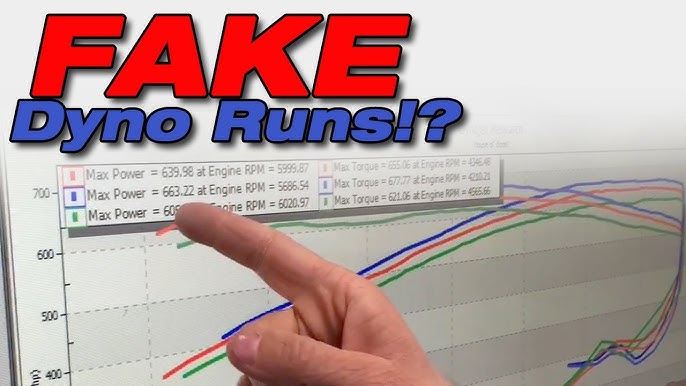
This is why experienced tuners care less about a single peak number and more about the shape of the curve. A wide, flat torque curve that holds power across a broad RPM range usually makes a car faster and more fun in the real world than a spiky curve with one impressive peak and a cliff on either side of it. But peak numbers are what get posted, screenshotted, and argued about, so peak numbers are what get chased.
🏁 Why Manufacturer Numbers and Dyno Numbers Never Match
This is the argument that starts every time somebody's "500 horsepower" car dynos at 420 whp and someone in the comments calls it underpowered.
Manufacturer horsepower ratings are crank numbers, measured on an engine dyno, under controlled lab conditions, often on an engine that hasn't accumulated any drivetrain wear or accessory load. Your car, sitting on a chassis dyno, is losing power to the transmission, the alternator, the power steering pump, the AC compressor, the exhaust backpressure, and the tires flexing against the rollers. A car rated at 500 crank horsepower posting somewhere around 400 to 425 wheel horsepower on a chassis dyno isn't underperforming. That's roughly the expected drivetrain loss doing exactly what drivetrain loss does. The manufacturer number was never a promise about what a dyno would read at the wheels, even though that's exactly how car people use it in every parking lot debate.
📋 How to Actually Read a Dyno Sheet
If you want the number to mean something, here's what to actually check before you compare it to anyone else's:
- Corrected or uncorrected, and which correction standard (SAE, STD, EEC). If it's not labeled, ask, because an uncorrected pull on a great-weather day can be meaningfully inflated.
- Which dyno brand ran the pull. A Dynojet number and a Mustang dyno number from the same car are two different data points, not one.
- Wheel or crank. Never compare a wheel number to a crank rating and call it apples-to-apples.
- Ambient conditions on the sheet, temperature, humidity, elevation, if they're listed. Consistency between runs on the same dyno matters more than the raw peak.
- The shape of the curve, not just the peak. A flat, wide curve is a better real-world indicator than a single spike.
- Same car, same dyno, before and after is the only truly fair comparison. A tune change measured on the same dyno, same day, same conditions, before and after, is about as close to a controlled test as this hobby gets.
None of this means dyno numbers are useless. It means a dyno sheet is a data point from one specific test, not a universal truth. Once you know how to read one, you stop getting into pointless arguments about whose 400-whp car is "really" faster and start asking the questions that actually matter: same dyno, same conditions, same day. Everything else is noise dressed up as a fact.
Spota tip: when you're logging mods and dyno pulls in your Garage, keep the dyno brand and correction standard in the notes right alongside the number. Future you, and anyone you're showing the build to, will actually be able to compare it to the next pull instead of arguing about it blind.
If you're deep enough into this stuff to care about correction factors, you'll probably also want why 0-60 times became car culture's favorite flex, and why they're lying to you, same problem, different number.
The dyno's not lying to you. It's just answering a more specific question than the one you thought you asked.