
🔊 The Sound That Ruins a Perfectly Good Highway Drive
You just dropped real money on a cat-back exhaust. The idle sounds mean, the cold start crackles, and for the first fifteen minutes of ownership you're rolling down every window just to hear it. Then you hit the highway, settle into fourth gear at 2,200 RPM, and it happens: a low, pulsing hum fills the cabin and doesn't stop. Not loud exactly, just relentless. A frequency that seems to vibrate the door panels, rattle a loose bolt somewhere in the trunk, and make your ears feel pressurized after twenty minutes.
That's drone, and it has ruined more good exhaust setups than any other single mod-related problem in car culture. Forums are full of threads titled some version of "is this normal" and "how do I fix drone without losing sound," and the honest answer is more complicated than most people want to hear. Drone isn't just "too loud." It's a specific, predictable acoustic phenomenon, and once you understand what's actually happening inside that pipe, you understand why some setups get it brutally and others barely at all.
This is the real explanation, not the forum folklore.
📐 What Drone Actually Is (It's Not Just Volume)
Drone gets blamed on "loudness" constantly, and that's the wrong diagnosis almost every time. A straight-piped car can be earsplitting and still not drone. A quiet cat-back can drone like a jet engine idling in your trunk. Volume and drone are different problems with different causes.
Drone is resonance. Every exhaust system, engine, and cabin has natural frequencies it wants to vibrate at, the same way a wine glass has a frequency that makes it shatter if you hit the right note. An engine firing at a specific RPM produces exhaust pulses at a specific frequency (this is directly tied to RPM and cylinder count: a four-cylinder fires twice per revolution, a V8 four times, and so on). When that pulse frequency lines up with a natural resonant frequency of the exhaust system, or with a resonant frequency of the cabin itself, the sound waves stack instead of canceling out. The result is a frequency that gets amplified far beyond what the engine is actually producing acoustically.
That's why drone is almost always described the same way by everyone who's experienced it: a narrow RPM band, usually somewhere between 1,800 and 2,800 RPM depending on the car, where the sound goes from "fine" to "unbearable" and then back to "fine" once you're past it. Below the resonant RPM, the pulses aren't matched up right. Above it, same thing. Right in that window, they line up perfectly and the cabin turns into a speaker box.
Spota tip: if you're logging a car's specs in your Garage, this is worth noting in your mod log: the exact RPM where drone kicks in is genuinely useful diagnostic info, both for yourself and for anyone else running the same setup who searches for it later.
🎺 Why Removing the Resonator Is the Usual Culprit
The single most common cause of new drone is deleting the resonator, and it's also the single most common regret in exhaust modding.
A resonator isn't a muffler. A muffler's job is to reduce overall volume through baffling and absorption. A resonator's job is narrower and more specific: it's tuned to cancel out particular problem frequencies before they ever reach the cabin, using internal chambers sized to create destructive interference at those wavelengths. Delete it, and you haven't just made the car louder. You've removed the one component that was specifically countering the resonance that causes drone.
This is why so many "I deleted my resonator and now it drones like crazy" threads exist, and why so many of the "fixes" people try afterward don't actually work. Wrapping the exhaust in sound-deadening material, adding cabin insulation, cranking the radio: none of that touches the root cause, because the resonance is happening in the metal pipe and the air column inside it, not in the cabin. You're treating a symptom while the actual mechanism keeps running.
Piping diameter matters too, and it's a less obvious cause. A pipe that's too large for the engine's exhaust volume creates more room for standing waves to form and reinforce each other. This is part of why going from a factory 2.25-inch system straight to a 3-inch catback on a modest four-cylinder often drones worse than the same upgrade on a big V8 that actually needs the extra flow. The pipe diameter has to be matched to the engine's real exhaust volume, not just sized for maximum theoretical flow.
🚗 Why Some Cars Drone Brutally and Others Barely Notice
Drone isn't random, and it isn't purely about the exhaust system either. Two identical cat-back setups on two different chassis can produce wildly different amounts of drone, and the reason comes down to the cabin itself.
Every car's interior is also a resonant chamber, shaped by its volume, its glass, its trim material, and where the rear subframe and exhaust hangers physically connect to the body. A sedan with a large trunk cavity and thin rear deck sheet metal will often amplify drone frequencies far more than a coupe with a smaller, stiffer trunk area. Cars with solid rear subframe bushings (common on stiffer, more track-focused platforms) transmit resonant vibration directly into the chassis instead of letting rubber bushings absorb some of it, which is part of why lowering a car on stiffer mounts sometimes makes an existing drone problem noticeably worse, not just louder.
This is also why the exact same header-back exhaust gets rave reviews from one owner and drone complaints from another owner of the same model. Aftermarket exhaust hangers, differences in factory sound deadening trim levels, even something as small as whether the rear seats fold down (changing the cabin's effective air volume) can shift a car from "acceptable rumble" to "headache by the time you get home."
🔧 What Actually Fixes Drone (And What Doesn't)
What doesn't work, despite being the internet's favorite advice:
- Sound deadening mats. They reduce road noise and rattles. They do almost nothing for resonance, because the problem is a standing wave in the exhaust and cabin air, not vibration transmitted through sheet metal.
- "Just get used to it." Drone fatigue is real, documented, and unpleasant on long drives. It doesn't go away with time, it just gets tuned out mentally, which isn't the same as it not affecting you.
- Aftermarket exhaust tips. Purely cosmetic. Zero acoustic effect on internal resonance.
What actually works:
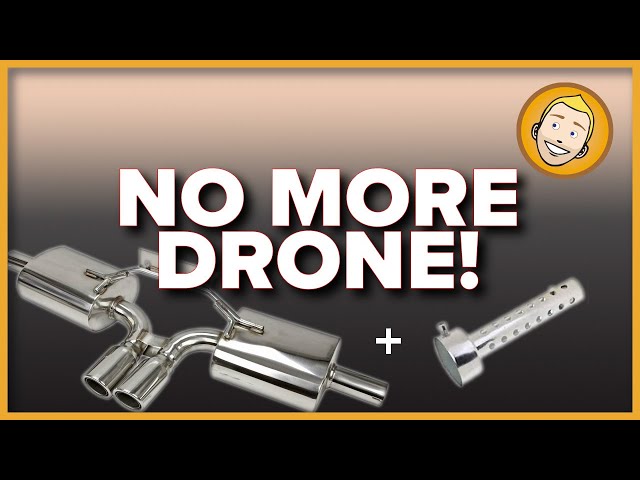
- Reinstalling or adding a resonator. The single most reliable fix. A properly sized resonator, even an aftermarket universal one welded in at the right spot, restores the destructive interference that cancels the problem frequency. Most reputable exhaust shops can tune resonator placement specifically to kill a known drone RPM.
- Changing pipe diameter. Downsizing slightly, or switching to a mandrel-bent design instead of crush-bent, changes the internal standing wave pattern enough to shift or reduce resonance.
- Adjustable exhaust cutouts or valves. Popular on higher-end builds specifically because they let you route exhaust through a quieter path at cruising RPM and open up for sound under load, sidestepping the resonant band entirely instead of trying to eliminate it.
- Rubber isolator hangers instead of solid mounts. If a lowering setup or subframe brace introduced new drone by transmitting more vibration into the chassis, softer isolators at the exhaust hanger points can meaningfully cut how much of that resonance reaches the cabin.
The honest, unsatisfying truth is that fully custom-tuned exhaust work, the kind where a shop actually measures your specific drone frequency and builds a resonator to counter it, is usually the only fix that works every time. Universal parts and forum guesses get you partway there. A shop with a way to actually diagnose the resonant frequency gets you the rest of the way.
🧪 How to Actually Diagnose Your Drone (Instead of Guessing)
Most people go straight to buying parts when they should start with a five-minute diagnostic, because "fix drone" and "fix a specific known frequency" are very different jobs, and throwing parts at the wrong one wastes money.
Find the exact RPM range first. Take the car on a quiet stretch of road, hold steady speeds, and note precisely where the drone starts and stops. Most cars have a window somewhere between 200 and 400 RPM wide. Write it down. This is the single most useful piece of information for anyone helping you diagnose it, whether that's a shop or a forum thread.
Test in gear versus in neutral at the same RPM. If drone shows up in both, the resonance is purely about engine RPM and exhaust pulse frequency. If it only shows up under load in a specific gear at road speed, driveline vibration or a resonant frequency in the chassis itself (not just the exhaust) may be compounding the problem, which changes what actually needs fixing.
Check whether it's worse with the windows up or down. Counterintuitively, drone is sometimes worse with windows up, because the sealed cabin becomes a more effective resonant chamber. If cracking a window meaningfully helps, that's a strong signal the cabin itself is amplifying the frequency, not just the exhaust pipe.
Feel for it in the seat and steering wheel, not just your ears. Resonance transmits through the chassis as vibration as much as it does through the air as sound. If you can feel the hum in the seat base or the wheel at the exact RPM where you hear it, that's confirmation you're dealing with true resonance and not just raw exhaust volume, which matters for picking the right fix.
Do this before calling a shop. A tuner who already knows "drones hard from 2,100 to 2,450 RPM, worse in third gear, feels it through the seat" can go straight to a fix. A tuner who just hears "it's loud on the highway" is starting from zero.
🚙 Which Platforms Are Notorious for It (And Why)
Certain cars have become infamous in their respective forums specifically for drone, and the reasons line up exactly with the physics above.
Late-model Mustangs with axle-back or cat-back exhausts are a constant topic on Mustang forums, largely because the factory rear subframe design and trunk cavity size create a cabin resonance that lines up almost perfectly with common highway cruising RPM in top gear. Subaru WRX and STI owners running popular aftermarket cat-backs report a similarly well-documented drone band, made worse by the boxer engine's distinct firing pulse characteristics interacting with typical piping choices. German sport sedans, BMW 3-series and similar cars in particular, tend to drone hard specifically when owners delete the factory resonator assembly, since German OEM exhaust design leans heavily on resonator tuning rather than muffler baffling to keep cabin noise low at cruise.
None of this means those cars are flawed. It means their factory engineers spent real time solving a problem that aftermarket parts makers often don't bother tuning for, because a universal cat-back has to fit dozens of different chassis and can't be acoustically customized to each one. The factory system was quietly doing more work than it got credit for.
🧠 Why Car Guys Put Up With It Anyway
Here's the part that doesn't show up in the technical explanations: plenty of people who've dealt with brutal drone don't actually fix it, even when they know how. There's a specific kind of pride in owning a car that announces itself, and a resonator delete is often as much a statement as it is an acoustic decision. The trade-off between a mean-sounding car and a livable daily driver is a real one, and different people land in different places on it depending on whether the car is a daily, a weekend toy, or something in between.
It's the same logic that shows up everywhere else in car culture: comfort and practicality lose to character more often than most non-car-people would guess. A car with zero personality is easy to live with and forgettable. A car that hums at 2,400 RPM every single commute is annoying and also, somehow, exactly what a lot of people signed up for.
If you're chasing that sound for content, a good drone note actually reads great on camera. It's part of why a lot of the loudest rev clips and pull videos circulating in car culture right now come from cars that would be genuinely unpleasant to drive every day. Worth keeping in mind before you delete that resonator: know what you're trading, and decide on purpose instead of by accident.
For more on the mods that shape how a car sounds and feels, check out why exhaust pops and crackles became car culture's most divisive mod and browse more explainers over in under the hood.
Know the frequency. Know the trade-off. Then decide if you're keeping the drone or killing it.