

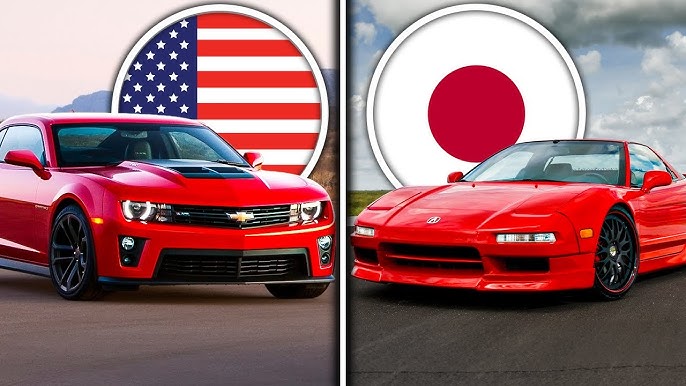
🥊 Two Cars, One Parking Lot, Zero Chill
Park a clean Nissan Skyline next to a clean '69 Camaro and watch what happens. Within about ninety seconds, somebody's leaning against a bumper saying "yeah but it's got no soul," and somebody else is saying "yeah but it's stuck in 1975." Nobody asked either of them. It just happens. It's basically a law of physics at this point.
That's import vs. domestic. It's the oldest, dumbest, most enduring argument in car culture, and it has survived every single trend that was supposed to kill it: the tuner boom, the muscle car revival, drifting, stance, EVs, all of it. Other rivalries in this hobby come and go. This one's been running for decades and shows zero signs of quitting.
So where did it actually start, why does it still have this much juice, and is anybody actually right? Let's get into it.
🏭 It Didn't Start as a Car Argument. It Started as an Economic One.
Here's the part a lot of younger enthusiasts miss: import vs. domestic wasn't born on a drag strip. It was born in a factory town.
Through the 1970s and into the 80s, Japanese automakers started eating serious market share from American manufacturers, and they did it with something Detroit wasn't prioritizing at the time: reliability, fuel efficiency, and tight build quality on smaller, cheaper cars. The 1973 oil crisis made fuel-sipping Japanese compacts suddenly very appealing to American buyers who'd been driving big V8 land yachts. Then the second oil shock in 1979 accelerated it further.
American automakers, understandably, did not love this. Neither did American autoworkers watching plants close while imports climbed. This wasn't subtle, either:
- Congress held hearings about Japanese imports and threatened quotas
- The "Voluntary Export Restraint" agreement in 1981 actually capped how many cars Japan could ship to the US
- Buy American campaigns ran hard through the 80s, explicitly framing import ownership as a betrayal of domestic jobs
- There were genuinely ugly incidents, including anti-Japanese-car sentiment that spilled into real hostility toward Asian-American communities, which is a dark chapter that's worth remembering isn't just car culture trivia
So the rivalry's actual origin isn't "which car is cooler." It's "an entire domestic industry felt threatened, and that anxiety trickled all the way down to backyard mechanics and dealership lots." By the time it became a car enthusiast argument instead of a labor and trade argument, the tribal lines were already drawn. Car culture just inherited them.
🏎️ Then the Tuner Scene Turned It Into a Culture War
If the 70s and 80s planted the seed, the 90s and early 2000s are when import vs. domestic became the specific flavor of rivalry car people argue about today.
A new generation of enthusiasts, often the kids of the same buyers who'd switched to Japanese cars for reliability, grew up around Hondas, Toyotas, and Nissans instead of muscle cars. And they discovered something the previous generation hadn't fully clocked yet: these small, cheap, "boring" commuter cars had incredible tuning potential. A Honda B-series engine could rev to redline forever and respond beautifully to bolt-ons. A Nissan SR20 or RB26 could handle absurd boost. Parts were cheap, communities formed fast, and an entire DIY tuner culture exploded around cars Detroit had never taken seriously as performance platforms.
The pop culture moment that lit the fuse:
- The Fast and the Furious (2001) put import tuner culture in front of a mainstream American audience for the first time, and it did it by explicitly framing import racers as underdogs against domestic muscle
- Magazines like Sport Compact Car and Import Tuner built entire identities around the scene
- Video games (Need for Speed: Underground, Gran Turismo) let a generation build virtual import builds before they could afford real ones
- Meanwhile, muscle car culture had its own resurgence brewing, with the Fox Body Mustang and later the reborn Camaro, Challenger, and Charger reigniting the exact platforms import fans loved to dunk on
By the mid-2000s you had two fully-formed, self-reinforcing subcultures, each with its own magazines, its own meets, its own slang, and its own founding myth about why the other side was doing it wrong. That's when the rivalry stopped being background noise from a trade dispute and became an actual identity people picked a side of.
🗣️ The Stereotypes Each Side Throws (And Why They Stuck)
Every long-running rivalry needs a shorthand, and this one has two very well-worn scripts. Neither is fully fair. Both have just enough truth in them to survive fifty years of arguing.
What domestic guys say about imports:
- "No soul, no sound, just a sewing machine with a turbo"
- Front-wheel-drive platforms get mocked hard, regardless of how fast the AWD or RWD import platforms actually are
- "You bought speed, you didn't build it" (ironic, considering how much of tuner culture is literally built around DIY modification)
- Fart-can exhaust and body kit jokes that, to be fair, exist because some of that early-2000s ricer aesthetic genuinely earned the reputation
What import guys say about domestics:
- "All show, no go, straight-line only cars that fold the second a corner shows up"
- Solid rear axles and leaf springs get treated as ancient technology, even on modern muscle platforms that have moved well past that
- "You're paying for displacement because you don't know how to tune"
- The "traffic light to traffic light" jab, implying muscle cars only exist to win a stoplight drag and nothing else
Here's the thing both sides conveniently forget when they're trash-talking: the stereotypes describe the worst examples of each category, not the best ones. A built Skyline GT-R and a rusted Civic with a fart can are not the same tier of import car. A Hellcat on a road course and a straight-piped Charger doing a burnout in a Wingstop parking lot are not the same tier of domestic. Every rivalry needs a strawman to punch, and both sides built one that's easy to mock and doesn't represent their actual best builds.
🔧 The Real Engineering Differences (Because Some of This Is Actually True)
Strip away the trash talk and there are genuine, real engineering and philosophy differences between how Japanese and American manufacturers historically approached performance. This is the part of the rivalry that isn't just tribalism.
Where imports historically had the edge:
- High-revving, small-displacement engineering - Engines like Honda's VTEC or Toyota's 4A-GE were built around making power through RPM and precision, not just cubic inches, which is a genuinely different (and more technically dense) engineering approach
- Chassis balance and handling focus - Platforms like the AE86, the RX-7, and the S-chassis were tuned from the factory with handling and weight distribution as a priority, which is why they dominate drift and canyon-carving culture specifically
- Reliability at high mileage - This isn't a stereotype, it's measurable. Japanese manufacturers built a decades-long reputation on engines that could take abuse and keep running, which is exactly why JDM engine swaps into other platforms are such a well-established practice
Where domestics historically had the edge:
- Raw displacement and torque - A big American V8 makes usable, straightforward power without needing to live at high RPM, which is a completely different (and for straight-line performance, often more effective) approach
- Cost per horsepower - Dollar for dollar, a domestic V8 has historically made more power more cheaply than most import engines, which is a huge part of why drag racing and straight-line culture leans domestic
- Aftermarket scale for specific platforms - The Mustang, Camaro, and Challenger/Charger have some of the deepest, most mature aftermarket ecosystems in the entire industry, built over 50+ years of continuous production
- A specific kind of driving character - There's a visceral, low-RPM torque feel to a big domestic V8 that a high-revving four-cylinder simply can't replicate, and plenty of enthusiasts genuinely prefer that feel on its own merits, not out of tribal loyalty
Neither side is objectively "better" at building a fast car. They're optimized for different things, and the rivalry persists partly because both approaches are legitimately good at what they're built for, which means neither argument ever fully wins.
🌏 It's Genuinely Different Outside the US
One thing that gets lost in the American framing of this rivalry: it's a distinctly American culture war. Go elsewhere and the lines blur or disappear entirely.
In Japan, there's no "import vs. domestic" framing at all, obviously, since Japanese cars are the domestic option there. The real internal rivalry is closer to manufacturer loyalty (Nissan vs. Toyota vs. Honda vs. Mazda camps) or JDM vs. USDM spec differences on the same model.
In Europe, the dominant rivalry historically runs along completely different lines: German engineering (BMW, Mercedes, Audi) vs. everyone else, or hot hatch culture (Golf GTI, Civic Type R, Focus RS) vs. traditional sports cars. American muscle shows up as a niche import curiosity, not a domestic anchor.
In Australia, there's a genuinely fierce domestic rivalry of their own (Holden vs. Ford) that has nothing to do with Japan at all, and it ran so deep it functioned almost like a sports rivalry for decades until both brands stopped local manufacturing.
This matters because it proves the rivalry isn't some universal truth about car engineering. It's a specific cultural artifact of American car history, American trade anxiety, and American media in the 90s and 2000s. Move the geography and the entire framework stops making sense, which is a pretty strong hint that the rivalry runs more on identity than on actual objective car quality.
🤝 Why the Lines Have Blurred So Much (And Why It Still Won't Die)
If you actually look at what's parked in driveways and at meets today, the clean import-vs-domestic split barely exists anymore in practice.
A few reasons the old lines don't really hold up:
- American manufacturers now build genuinely high-revving, precision-engineered performance cars (the Chevy Corvette's naturally aspirated engines, Ford's Coyote V8s) that borrow directly from philosophies once considered "import" territory
- Japanese manufacturers build massive displacement, boosted performance cars now too (the GT-R's twin-turbo V6, various Toyota performance platforms) that would've been unthinkable "import" behavior in the 90s framing
- Engine swap culture has scrambled the categories entirely: an LS swap into a Datsun or an RB swap into an American chassis makes the whole label kind of meaningless on that specific car
- A huge chunk of the current enthusiast generation grew up with both cultures simultaneously through social media and YouTube, without the regional or generational loyalty that used to make picking a side automatic
And yet, ask ten car people at a meet if the rivalry is "over," and at least eight of them will laugh and then immediately make a joke at the other side's expense. The rivalry has stopped being about actual engineering superiority and become something closer to a running bit, a shared ritual that car people perform because it's fun, not because anyone genuinely believes the other category of car is worthless. It's tribal the way sports fandom is tribal: everyone knows the other team has good players too, that's not really the point.
Spota tip: if you're building a Garage profile for a car that blurs the line, an LS-swapped Miata, a JDM-engined domestic, or vice versa, that's exactly the kind of build story worth documenting step by step. Those cross-culture builds tend to get the most genuine respect from both sides, precisely because they refuse to pick a team.
❌ Myths That Refuse to Die on Both Sides
A few claims keep coming back around no matter how many times they get debunked. Worth putting them to rest properly.
- "Domestic cars can't handle." Modern muscle platforms, especially anything with an aftermarket suspension package or a factory track package (Mustang Dark Horse, Camaro 1LE, Challenger's various Shaker/Scat Pack trims), handle genuinely well. The stereotype is a leftover from decades-old solid-axle platforms, not current engineering.
- "Imports are all slow four-cylinders." The GT-R, the Supra, various twin-turbo platforms, and a huge swath of modern JDM performance cars put up numbers that flatly contradict this. The stereotype comes from the huge volume of unmodified commuter Civics and Corollas on the road, which were never meant to represent the performance ceiling of the category.
- "You can't make a domestic engine rev high." Plenty of modern domestic V8s (the Corvette's flat-plane-adjacent engineering direction, various Mustang GT variants) rev meaningfully higher than people assume, and forced induction has closed most of the historic gap anyway.
- "Real enthusiasts pick a side and stay loyal." The most respected builders in the hobby, the ones who actually know engineering rather than just repeating forum talking points, tend to appreciate both categories for what they're specifically good at. Rigid loyalty is more of a starter-enthusiast phase than an expert one.
🏁 The Rivalry That Refuses to Retire
Import vs. domestic has outlived the trade dispute that started it, outlived the specific platforms that defined its golden era, and outlived a dozen car culture trends that were supposed to replace it as the hobby's main argument. It's survived because it was never really about which factory built the better engine. It's about identity, nostalgia, and the specific car culture era each generation came up in.
The kid who fell in love with cars watching The Fast and the Furious is going to defend imports a little harder than the kid whose dad had a Mustang in the garage growing up. Neither of them is wrong to feel that way. That's just how car culture works: you pick a first love, and some part of you defends it forever, even after you've built (or at least admired) plenty of cars on the other side of the aisle.
So yeah, park that Skyline next to that Camaro and the argument's still going to start. It's not going anywhere. Honestly, would you even want it to?