
🌀 The Sound Test Every Car Guy Passes Without Trying
You're standing in a parking lot, minding your business, and a car rips past two streets over. You never see it. Doesn't matter. You already know: that's a blower.
Not a turbo. Not a naturally aspirated V8 with a loud exhaust. A supercharger, screaming that unmistakable high-pitched whine that sounds like a jet spooling up in someone's engine bay. Every car person has this skill and nobody remembers learning it. You just absorb it, the same way you learn to tell a diesel truck from a gas one by the clatter alone.
Meanwhile a turbocharged car does something completely different. It hisses. It chirps between gears like a small bird got trapped under the hood. It might even whistle a little at high boost. But it does not howl, and it will never sound like a supercharger no matter how big the turbo is or how hard you're driving it.
Two forms of forced induction, same basic job (cram more air into the engine than it could breathe on its own), and they sound nothing alike. That's not an accident of branding or exhaust tuning. It's physics, and once you understand it, you'll never mix the two up again just by ear.
🔧 What a Supercharger Actually Is (And Why It Screams)
A supercharger is, at its core, an air pump bolted directly to the engine and spun by a belt off the crankshaft. No exhaust gas involved, no separate turbine, just a mechanical link straight from the engine's own rotation to a set of spinning components that force air into the intake.
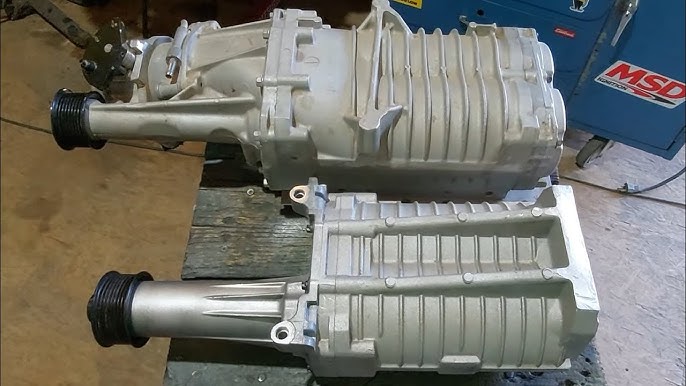
Most performance superchargers on the street today, the ones in a Hellcat, a Shelby GT500, a supercharged Camaro or Corvette, use what's called a roots-type or twin-screw design. Inside the housing are two lobed rotors, shaped almost like fat interlocking screws or figure-eights, spinning in opposite directions at extremely high speed, sometimes over 20,000 RPM inside the blower itself even when the engine is only turning 6,000.
Here's where the whine comes from: those rotors have very tight tolerances between their lobes and the housing, and they're spinning fast enough that the air getting trapped and pushed between the lobes creates a pressure pulse every single time a new pocket of air gets compressed and shoved out the discharge port. That happens dozens of times per rotor revolution. At the RPMs a street supercharger runs, those pressure pulses stack up into a tone in the audible range, and the tighter the rotor tolerances and the faster they spin, the higher and more piercing that tone gets.
It's mechanically identical to how a whistle works. Rapid, repeated pressure pulses at high frequency equal a sound your ear reads as a whine or a howl. The bigger the blower and the higher the boost, the louder and more aggressive it gets. That's why a 2.4-liter Hellcat supercharger sounds like an air raid siren and a smaller factory blower on an older supercharged car sounds more like a polite kettle.
And because a supercharger is mechanically tied to the crankshaft, that whine scales directly with engine RPM. Rev it higher, the blower spins faster, the pitch climbs. There's no delay, no spooling, no separate turbine lag to account for. The sound and the throttle response are locked together in real time, which is part of why supercharged cars feel so immediate and why the sound itself became such a signature. You're not hearing exhaust. You're hearing the intake side doing mechanical work, live, in sync with your right foot.
💨 What a Turbo Actually Is (And Why It Doesn't Howl)
A turbocharger works on a completely different principle, and that's the entire reason it sounds different. Instead of stealing mechanical power from the crankshaft via a belt, a turbo is spun by exhaust gas that would otherwise just exit out the tailpipe and get wasted.
Exhaust gas exits the engine, spins a turbine wheel on one end of a shaft, and that shaft is connected to a compressor wheel on the other end sitting in the intake path. Spin the turbine, spin the compressor, force more air into the engine. It's an energy recycling system more than a direct mechanical pump, which is the source of basically every sonic and behavioral difference between the two.
Turbos spin unbelievably fast, often 100,000 to 200,000+ RPM on a performance application, way beyond what a supercharger's rotors ever see. At those speeds you'd expect an even more intense whine, but the turbine and compressor wheels are smooth, curved, bladed wheels rather than tight-tolerance interlocking lobes. There's no repeated mechanical pressure pulse the way a roots or twin-screw blower creates. Airflow through a turbo's compressor housing is comparatively continuous, which is why what you hear from a turbo tends to be more of a high-frequency hiss or a subtle whistle rather than a distinct musical tone.
The chirp people associate with turbo cars, that little bird-like noise between shifts, isn't the turbo spinning up. It's the blow-off valve or diverter valve venting built-up boost pressure when you lift off the throttle mid-shift, so the compressor doesn't stall against a suddenly closed throttle body. Aftermarket blow-off valves that vent to atmosphere make that chirp louder and more obvious, which is why it became such a signature "I have a turbo car" calling card in tuner culture, even though factory turbo cars with recirculating valves barely make the sound at all.
And because a turbo runs off exhaust energy rather than a direct crank connection, its speed doesn't track engine RPM in a straight line the way a supercharger's does. There's a delay while exhaust flow builds enough to spin the turbine up to a useful speed, which is turbo lag, and it's also why a turbo's sound character shifts depending on load and exhaust flow rather than climbing in a tight lockstep with RPM the way a blower's whine does.
🎯 Why This Difference Became a Car Culture Identity Thing
Car people don't just tolerate this sound difference, they built entire identities around it. Supercharger whine became shorthand for raw, brute-force American muscle: Hellcats, Shelbys, ZR1s, the cars that solve the horsepower problem by strapping a mechanical air pump directly to a big engine and letting physics do the rest. It's loud, it's immediate, it doesn't apologize for existing. That whine sells cars on its own; Dodge leaned into it so hard that engineers reportedly tuned Hellcat intake geometry partly with the sound signature in mind, not just airflow efficiency.
Turbo chirp and hiss became the sound of a completely different scene: JDM tuner culture, small-displacement engines punching way above their weight class, Supras and Evos and WRXs and every 1.6-liter economy car someone turned into a 400-horsepower street terror. It's a sound built on efficiency and cleverness rather than brute displacement, recycling waste energy instead of stealing it straight from the crank, and that engineering philosophy shows up in the culture around it too. Turbo guys talk about spool, boost curves, and lag compensation. Supercharger guys talk about belt ratios and pulley sizes. Different sound, different mechanical relationship with the engine, different whole subculture built around each one.
It's also why hybrid setups exist and why they sound genuinely weird the first time you hear one. A few manufacturers have run superchargers and turbos together on the same engine, using the blower for instant low-RPM response and the turbo for efficient high-RPM power, and the resulting soundtrack is a whine layered under a hiss that takes your brain a second to parse because it's fighting two different mental categories at once.
🚗 The Trade-Offs Behind the Sound
The sound isn't just a side effect, it's a direct readout of the trade-offs baked into each system, and understanding the noise helps explain why enthusiasts pick one over the other for very different reasons.
- Supercharger: instant boost with zero lag because it's mechanically tied to the crank, but it constantly draws parasitic horsepower from the engine to spin itself, even when you don't need boost. That whine you love is, in a very literal sense, the sound of the engine doing extra work just to feed itself air.
- Turbo: more efficient overall because it recycles exhaust energy that would be wasted anyway, and it can make huge power without robbing the crank directly, but you trade that efficiency for lag while the turbine spools up, plus more complexity in the exhaust and cooling systems (hello, heat soak, a topic that deserves its own explainer).
- Twin-screw vs. roots: even within superchargers, twin-screw blowers compress air internally before it exits, which tends to sound a slightly different tone than an older-style roots blower that just moves air without compressing it internally first. Enthusiasts can often tell the difference between blower types by ear alone, the same way they can tell a supercharger from a turbo.
- Turbo size: bigger turbos generally spool slower and can sound different in pitch and delay than smaller, quicker-spooling units, which is why "turbo size" debates in tuner communities are really lag-versus-top-end debates wearing a different hat.
None of this is aesthetic decoration. Every part of what you're hearing traces back to a real mechanical decision about how that engine gets its extra air, which is exactly why the sound became such a reliable identifier in the first place. Car people aren't guessing when they call a pass by ear. They're reading physics.
🧪 Why Your Ears Are Better at This Than a Spec Sheet
Here's the part that trips people up when they first start paying attention: two cars can post nearly identical dyno numbers, similar 0-60 times, similar peak horsepower, and still sound completely different under load because the type of forced induction, not the amount of boost, is what your ear is actually locking onto.
A mildly boosted turbo four-cylinder and a screaming supercharged V8 can both be making 500 horsepower, but nobody confuses them blindfolded. That's because the whine or the hiss isn't proportional to power output the way people assume. It's proportional to mechanism. A tiny turbo four-banger running high boost can still out-hiss a bigger turbo six because of how tight the wastegate or blow-off valve is tuned, and a small factory supercharger on an older SUV can still throw a recognizable, if quieter, whine because the rotor geometry hasn't changed even if the displacement has.
This is also why pulley swaps are such a big deal in supercharger culture specifically. Swap to a smaller supercharger pulley and you're spinning those rotors faster relative to the same engine RPM, which raises boost and, audibly, raises the pitch of the whine right along with it. Car people can often tell a pulley swap happened just from how much higher the note climbed compared to a stock example of the same car, before ever looking at a boost gauge. That's an entire tuning culture built around a sound cue, which says something about how reliable that signal actually is.
Turbo culture built its own version of this ear-training around spool characteristics instead. Enthusiasts talk about a turbo "coming on" at a certain RPM, and part of identifying a well-tuned setup by ear is hearing how cleanly that transition happens, whether the power comes in as a smooth building hiss or a sudden on-off surge that suggests an undersized turbo being asked to do too much too fast. None of that shows up on a spec sheet. It shows up in how the car actually sounds doing its job in real traffic, which is exactly why the sound test has stuck around as a genuine skill inside car culture instead of getting replaced by just reading the window sticker.
🏁 Next Time You Hear It
Next time a whine rips past you before you even see the car, you're not just hearing "a fast car." You're hearing a specific mechanical decision: a belt-driven air pump with tight-tolerance rotors spinning in perfect lockstep with the crankshaft, trading engine power for instant response. And next time you hear that chirp between shifts on something quieter, you're hearing recycled exhaust energy and a valve venting pressure so the whole system doesn't stall itself out.
Spota tip: if you catch one of these in the wild, mid-whine, mid-chirp, doesn't matter, that's exactly the kind of moment a Photo Op or a Garage entry is built for. Log it, don't just let it become another car you heard and never saw.
For more on what's actually happening under a turbo's hood, check out why turbo cars need a cool-down, and if you're the type who can already call a blower by ear, you'll want what is a car enthusiast for the deeper dive into how that instinct gets built in the first place.
Sound is data if you know how to listen to it. Most people just hear noise. Car people hear the whole engineering decision.