
🔥 The Code That's Sent More People to Google Than Any Other
You're driving, everything feels normal, and then the little orange engine icon lights up on the dash. No noise, no smell, no drop in power. You plug in a cheap scanner at the gas station or borrow one from a buddy, and there it is: P0420, catalyst system efficiency below threshold, bank 1.
If you've never seen it before, the first thing you do is exactly what everyone does: type "P0420" into Google at 11pm and immediately land on a forum thread where someone's quoting you $1,800 for a new catalytic converter. That's the moment P0420 earns its reputation as one of the most feared, most searched, and most misdiagnosed codes in the entire OBD2 system.
Here's the thing almost nobody tells you up front: P0420 is a symptom code, not a diagnosis. It doesn't say "your catalytic converter is bad." It says the computer noticed something downstream of the engine isn't behaving the way a healthy exhaust system should, and the catalytic converter is the most common reason, but it is nowhere close to the only one. Car guys who've been burned by this code learn that the hard way, usually after replacing an expensive part that wasn't actually broken.
🧪 What "Catalyst Efficiency" Actually Means
To understand why P0420 is so slippery, you have to understand what your car's computer is actually watching for. Every modern gas car has at least two oxygen sensors around the catalytic converter: one upstream (before the cat, reading raw exhaust straight out of the engine) and one downstream (after the cat, reading what's left once the converter has done its job).
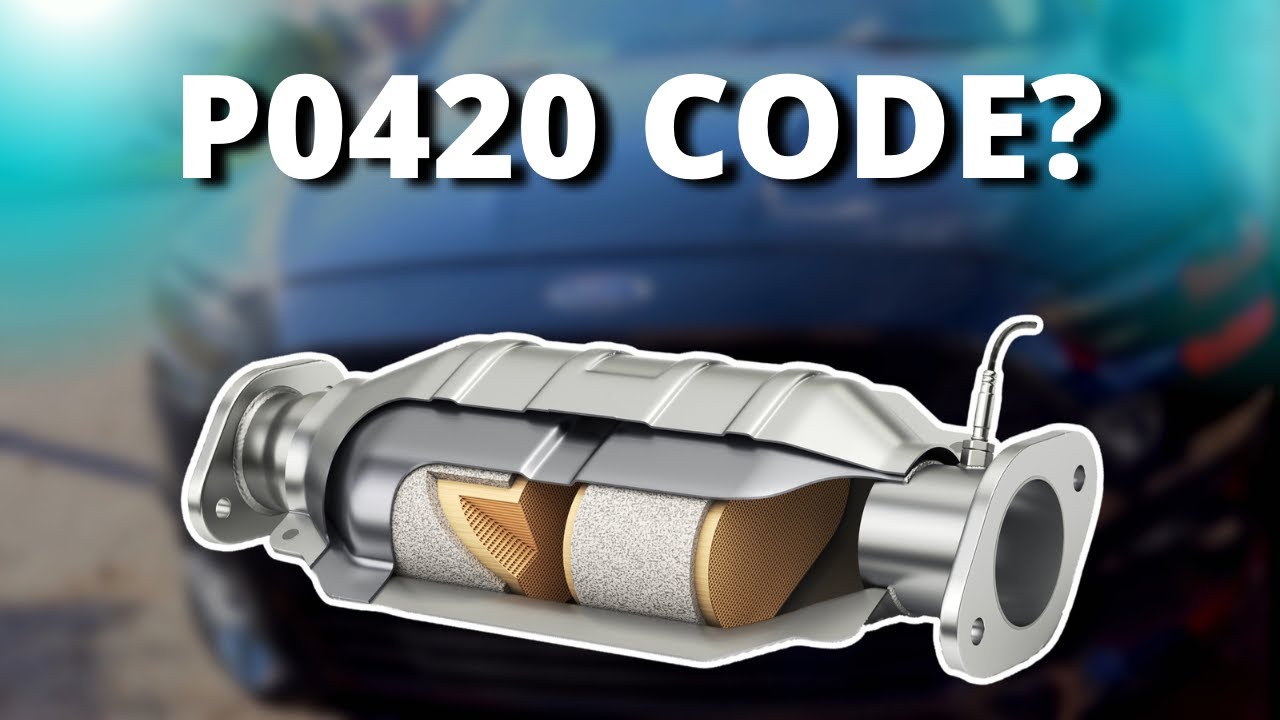
A healthy catalytic converter is a chemical reactor. It takes carbon monoxide, unburned hydrocarbons, and nitrogen oxides coming out of your engine and converts them into carbon dioxide, water vapor, and nitrogen through a set of reactions happening on a honeycomb of precious metals (platinum, palladium, rhodium) inside the cat. Part of that process, specifically the oxygen storage capacity of the catalyst, means the downstream oxygen sensor should read a much steadier, flatter signal than the upstream sensor, which is constantly swinging rich and lean as the engine's air-fuel mixture cycles.
The ECU is essentially comparing the "waviness" of the upstream sensor's signal to the "waviness" of the downstream sensor's signal. When the converter is doing its job, the downstream signal is calm. When the converter has lost its oxygen storage capacity, the downstream signal starts mirroring the upstream signal more closely, swinging almost as much as the sensor in front of it. Once that similarity crosses a threshold the manufacturer calibrated for emissions compliance, the ECU throws P0420 (or P0430 for bank 2 on a V-configuration engine).
That's it. That's the whole test. It's an efficiency comparison between two signals, not a direct measurement of "is the catalytic converter melted, clogged, or fine." Which means anything that disrupts that comparison, on either end, can trigger the same code.
🕵️ The Usual Suspects, Ranked by How Often They're Actually the Problem
Before you buy a catalytic converter, here's the order experienced techs actually check things in, because a real catalytic converter failure is often further down this list than people assume.
- A failing oxygen sensor (upstream or downstream). This is the single most common actual cause of a P0420 that isn't a real cat problem, especially on cars past 80,000-100,000 miles. O2 sensors degrade gradually. A sluggish or drifting sensor, upstream or downstream, can make a perfectly good catalytic converter look inefficient to the ECU, or mask a real problem. Sensors are a fraction of the cost of a cat, which is exactly why skipping this check first is the most expensive mistake in this whole diagnosis.
- An exhaust leak upstream of the downstream O2 sensor. A leaking exhaust manifold gasket, a cracked flex pipe, or a loose flange between the engine and the cat lets outside air into the exhaust stream. That extra oxygen throws off both sensors' readings and can trigger P0420 with a converter that's completely healthy.
- An engine running rich or lean for unrelated reasons. A leaking fuel injector, a failing mass airflow sensor, a vacuum leak, or worn spark plugs causing incomplete combustion all dump more unburned fuel or extra oxygen into the exhaust than the cat was designed to clean up. The cat can be perfect and still get overwhelmed and "fail" the efficiency test because of what's coming into it.
- A genuinely degraded catalytic converter. This does happen, and it's more likely on high-mileage cars, cars that have run rich for a long time without being fixed (which cooks the cat prematurely), or cars that have overheated the exhaust from other issues. Physical damage, internal melting from a misfire dumping raw fuel into the cat, or the precious metal coating simply wearing out over 150,000+ miles are all real failure modes.
- Aftermarket parts that don't match the calibration. A cheap universal or aftermarket "high-flow" catalytic converter, an aftermarket O2 sensor with a different response curve, or a tune that wasn't set up for the actual hardware on the car can all throw the factory efficiency threshold off even when nothing is technically broken.
🚗 Why Modified Cars See This Code So Much More Often
If you've spent any time in car culture forums, you've noticed P0420 comes up disproportionately often from people running aftermarket exhaust, tunes, or intakes. There are real reasons for that beyond bad luck.
Cats age faster on cars that run rich under load, which is a common side effect of aggressive tunes that add fuel for safety margin at high boost or high RPM without also addressing catalyst protection. Aftermarket downpipes and "test pipes" (cats deleted entirely) obviously trigger it directly since there's no catalyst left to be efficient. Even a legal aftermarket cat-back exhaust can occasionally introduce a small leak at a poorly matched flange that throws off the downstream sensor. And spacers or extensions used to relocate an O2 sensor away from a header, a common trick to avoid false lean codes on turbo setups, can change the sensor's response time enough to trip an efficiency comparison that was calibrated for the stock sensor position.
None of that means mods are the enemy here. It means P0420 on a built car deserves a more careful look at what changed recently, not an automatic assumption that the cat itself failed.
🔧 How to Actually Diagnose It Instead of Guessing
A cheap Bluetooth OBD2 reader that only clears the code and shows you the code number isn't enough to diagnose P0420 properly. Here's what an actual diagnosis looks like.
- Pull live data, not just the code. A scan tool that shows live upstream and downstream O2 sensor voltage graphs (or air-fuel ratio if you have wideband sensors) side by side tells you immediately whether the downstream sensor is mirroring the upstream one. That's the actual test the ECU is running, visualized.
- Inspect for exhaust leaks first. A visual and a listen-and-feel check (engine running, cold, carefully) around every exhaust joint between the engine and the downstream O2 sensor rules out the cheapest possible cause before you touch anything else.
- Check for other stored or pending codes. A misfire code (P0300 series), a fuel trim code, or a MAF code sitting alongside P0420 is a strong signal the catalytic converter is a victim, not the culprit. Fix the root cause first, clear the code, and drive it before assuming the cat needs replacing.
- Check fuel trims. Long-term and short-term fuel trim values well outside normal range point at a rich or lean condition upstream that's stressing the cat, rather than a cat problem in isolation.
- Only then consider a converter efficiency test or replacement. If the sensors check out, there's no exhaust leak, fuel trims are normal, and no other codes are present, a genuinely inefficient catalytic converter becomes the most likely remaining explanation. At that point, replacement is a legitimate fix, not a guess.
💸 The Real Cost Conversation Nobody Frames Honestly
A lot of the fear around P0420 comes from cost, and that fear isn't unreasonable. A quality catalytic converter, especially an OEM or CARB-compliant unit required in emissions-strict states, can run anywhere from a few hundred dollars for a common economy car up to well over a thousand for a V6 or V8 with two cats, before labor. That's real money, and it's exactly why skipping straight to "just replace the cat" without ruling out the cheaper causes first is such an expensive habit.
The flip side is just as important: driving around with a genuinely dead catalytic converter isn't a great long-term plan either. Beyond failing an emissions test (which will strand your registration renewal in most states that require testing), a badly clogged converter can eventually restrict exhaust flow enough to hurt performance and fuel economy, and a converter that's overheating internally can become a fire risk in extreme, neglected cases. This isn't a code you want to just clear and ignore indefinitely.
🚫 The "Just Delete It" Trap
Anyone who's spent time in exhaust-mod threads has run into the shortcut: skip the diagnosis entirely, throw on a test pipe or an aftermarket "high-flow" cat delete, and clear the code. It's cheap, it's fast, and on paper it makes the light go away.
It's also one of the more legally exposed mods in car culture right now. Removing or gutting a catalytic converter on a car that's required to have one is a federal Clean Air Act violation in the US, not just a state emissions technicality, and enforcement has gotten noticeably more aggressive in the last few years as catalytic converter theft and aftermarket delete parts both spiked at the same time. States with mandatory smog or emissions testing will fail a car with a missing or gutted cat on sight, some now specifically visually inspect for it, and a handful have started issuing fines directly for verified deletes even outside the testing process. An aftermarket cat that doesn't carry CARB Executive Order approval for your specific vehicle can trigger the exact same emissions test failure, even though it's technically still "a catalytic converter."
None of that is a moral judgment on people who've done it. It's just the actual risk picture, and it's worth knowing before treating a delete pipe as the easy fix instead of the diagnosis above. If the real problem was a forty-dollar downstream O2 sensor, a delete pipe doesn't just skip that fix, it trades a cheap repair for a legal and inspection liability that follows the car.
❓ Myths Worth Killing Before You Spend Money
- "P0420 always means the cat is dead." The single most common misconception, and the one that costs the most money. It's an efficiency signal, and a sensor, leak, or fueling issue trips it just as easily as a truly failed converter.
- "Clearing the code and it not coming back means it's fixed." The efficiency monitor doesn't run every single drive cycle. It needs specific conditions (warmed-up engine, steady cruise, sometimes a full drive cycle across a cold start) to complete its test. A code that hasn't come back after two days of short trips to the grocery store hasn't necessarily passed, it might just not have run the test yet.
- "A universal cat from the parts store is basically the same as OEM." For emissions-tested states, this is often flatly untrue. Universal converters usually lack the CARB EO number required for legal installation and inspection, and cheaper units frequently use less catalyst material, meaning they can trip P0420 again within months even when installed correctly.
- "If it passes a visual smog check, the cat is fine." Most modern emissions tests are OBD2-based, meaning the testing computer is checking your car's own stored monitors, including the exact catalyst efficiency monitor this article is about, not just looking at the pipe. A car that's cleared P0420 by disconnecting a battery right before the test will simply fail for "monitors not ready" instead.
🏁 The Bottom Line
P0420 has earned its reputation as one of the most panic-inducing codes on the board, but the panic is usually aimed at the wrong culprit. It's an efficiency comparison, not a verdict, and in a huge number of real-world cases, the actual fix is a fifty-dollar oxygen sensor or a exhaust gasket, not a brand new catalytic converter.
The car guys who handle this code right are the ones who slow down, pull live sensor data, rule out the cheap stuff first, and only reach for the catalytic converter as a last resort once everything upstream checks out clean. Everyone else ends up in that forum thread, quoted $1,800, for a part that was never actually broken.
Got a P0420 story, a diagnosis war story, or a build that's been chasing this code for months? Compare notes with people who've actually been there. Find car enthusiasts near you or track your own maintenance history and mods in your Garage on Spota so the next code doesn't catch you guessing.