
🌀 The Dial That Ruins Motors
Every turbo car guy has met this person. Bought a boost controller, cracked open the hood, twisted a little Allen key three turns clockwise, and drove off convinced they just added 50 horsepower for $80.
Sometimes they did. Sometimes their car is now making metal shavings in the oil pan.
Boost controllers are one of the cheapest, most accessible mods in the turbo world, and also one of the most misunderstood. Car people talk about "running more boost" like it's a volume knob. It's not. It's the difference between a well-tuned setup that makes real power safely and a bottom end that's counting down to a rod through the block.
Let's actually break down what a boost controller does, why turning it up isn't the same as making power, and why the guys who understand this mod best are usually the ones who talk about it the least.
⚙️ What a Boost Controller Actually Controls
It's Not a Power Knob
A boost controller doesn't make power. It manages wastegate behavior, which is a completely different job.
Here's the actual mechanism:
- The turbo's wastegate is a valve that bleeds exhaust gas away from the turbine wheel
- Bleeding gas away slows the turbo down, which caps boost pressure
- A boost controller changes how much pressure it takes to open that wastegate
- Less pressure needed to hold it shut = the turbo spools harder before the gate opens = higher peak boost
So a boost controller's real job is regulating the wastegate's opening point, not "injecting" power. The power comes from the turbo spinning up and cramming more air into the cylinders. The controller just decides how hard the turbo is allowed to work before the safety valve kicks in.
Why This Distinction Matters
Car guys who think of it as a power knob skip the part where more boost means:
- More air and more fuel need to enter the cylinder in the correct ratio
- More cylinder pressure on every part of the bottom end
- More heat through the entire intake and exhaust path
- A completely different ignition timing requirement
Turn boost up without addressing any of that, and you're not "unlocking power." You're pushing the engine past the limits it was tuned for and hoping nothing gives first.
🎛️ Manual vs. Electronic: Two Very Different Tools
Manual Boost Controllers (MBCs)
The classic $60-$150 mod. A ball-and-spring valve plumbed into the wastegate line that bleeds off a portion of the pressure signal before it reaches the actuator.
What it's good at:
- Simple, mechanical, nothing to program
- Cheap and reliable
- Works great for a single, fixed boost target
What it's bad at:
- One setting for every condition. Cold morning, hot summer day, low gear, high gear: same boost target regardless
- Prone to boost spikes, especially on more aggressive turbos, because it reacts to pressure rather than actively controlling it
- No gear-based or load-based logic
- Easy to crank up without understanding what else needs to change
An MBC is a blunt instrument. It works, but it doesn't know anything about your engine, your fuel system, or your safety margins. It just changes a spring rate.
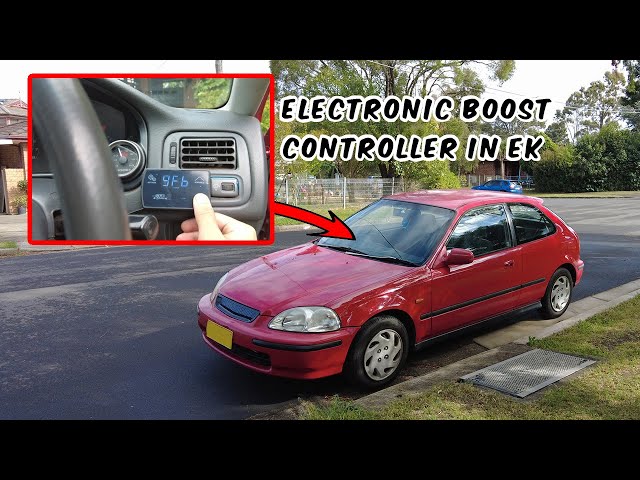
Electronic Boost Controllers (EBCs)
A solenoid-based system that actively duty-cycles the wastegate signal, usually tied into the ECU or its own standalone controller.
What it's good at:
- Multiple boost maps (street map, race gas map, low-boost valet map)
- Gear-based boost control, so first gear doesn't get the same psi as fourth
- Tighter, more consistent boost curves with less overshoot
- Closed-loop control that actually targets a number instead of just bleeding pressure
What it's bad at:
- More expensive, more complex to install and configure
- A badly configured EBC can spike boost just as hard as a bad MBC, sometimes worse, because duty cycle errors compound faster than spring pressure ever could
Spota tip: if you're documenting a boost controller install or a tune revision in your Garage, log the exact PSI, gear, and conditions. Future-you (and anyone shopping your build later) will actually want that history instead of "I turned it up a bit."
🔥 What Actually Breaks When Boost Goes Up Unsupported
The Fuel System Gets Left Behind First
More air needs more fuel to stay at a safe air/fuel ratio. If the injectors, fuel pump, and lines were sized for stock boost, cranking the wastegate spring doesn't magically scale the fuel system with it.
Run lean under boost and you get:
- Detonation (knock): the fuel/air mixture ignites unevenly and hammers the pistons with pressure spikes it was never designed for
- Melted pistons: sustained lean conditions under load can melt a piston crown in minutes, not miles
- Burnt exhaust valves: excess heat from a lean mixture cooks valves that were only rated for stock temperatures
Ignition Timing Doesn't Know Boost Went Up
Stock ECU tunes calculate timing advance around a specific boost curve. Push boost past what the tune expects and the ignition timing is now too aggressive for the actual cylinder pressure, which is a textbook recipe for detonation even with correct fueling.
This is the single biggest reason "just crank the MBC" is dangerous on a car with a stock ECU tune: the fueling and timing tables weren't written for the boost level you just created.
The Bottom End Pays the Real Bill
Cylinder pressure scales with boost. Rod bolts, bearings, and ring lands are all rated for a specific pressure ceiling based on the factory (or tuned) boost target.
Common bottom-end failures from unmanaged boost increases:
- Rod bearing failure from sustained overpressure
- Ring land failure, where the piston literally cracks around the ring groove
- Head gasket failure as cylinder pressure exceeds clamping force
- Rod knock, which is usually the sound of a bearing that's already gone
None of this happens because "boost is dangerous." It happens because the rest of the engine's tune wasn't built to support the new number.
🧠 Why "Turn It Up" Became a Meme
The Cheap Mod, Instant Feedback Problem
A boost controller is one of the few mods where the result is immediate and physical. Turn the screw, drive the car, feel the pull. There's no dyno appointment, no waiting on a tune revision, no reading a datalog. That instant feedback loop is exactly why it gets abused.
Compare that to something like injector sizing or tune revisions, which require actual expertise and take time to show results. A boost controller rewards impatience, and car culture has a lot of impatient people in it.
Forums Made It Worse
For years, forum culture treated boost numbers like a bragging stat. "I'm running 22 psi" sounds impressive until someone asks what fuel system, what tune, what internals are backing that number up. A stock-internals car safely running 22 psi on a proper tune and upgraded fueling is a completely different animal from a stock car with an MBC cranked to the same number and nothing else changed.
The number got separated from the context that makes it safe or unsafe, and that's how "turn the boost up" became shorthand for "make more power" instead of what it actually is: one variable in a much bigger equation.
The Guys Who Actually Know Better Are Quiet About It
The car people running real numbers safely usually aren't posting about their boost controller setting. They're posting dyno sheets, fuel system specs, and tune revisions, because that's the actual story. The loudest "I turned mine up" posts tend to come from the setups least equipped to handle it.
🛠️ How to Actually Raise Boost Without Wrecking Your Engine
If you're serious about running more boost, here's the order that keeps engines alive:
- Confirm your fuel system has headroom. Injector duty cycle and fuel pump flow need margin above what the new boost target requires, not exactly enough.
- Get a proper tune for the new boost level. Ignition timing, fuel maps, and boost targets all need to be written together, not stacked on top of an old tune that assumed a lower number.
- Know your internals' limits. Stock rods and pistons have a real ceiling. Research what your specific engine platform tolerates on stock internals before assuming yours is the exception.
- Watch your air/fuel ratio and knock data, not just the boost gauge. A boost gauge tells you pressure. It tells you nothing about whether that pressure is safe.
- Change one variable at a time. Boost controller setting, fuel system, and tune should each be verified independently, not adjusted all at once and hoped for the best.
This isn't about being scared of boost. Turbo cars make huge, reliable power all the time. It's about respecting that a boost controller is one input into a system, not a standalone power upgrade.
🏁 The Bottom Line
A boost controller doesn't make power. It changes when the wastegate opens, which changes how hard the turbo is allowed to work before the safety valve steps in. Everything downstream of that decision, fuel, timing, internals, has to be able to handle the result.
The mod isn't dangerous. Treating it like a shortcut is.
The car guys who run big numbers reliably for years aren't the ones who twisted a screw and hoped. They're the ones who understood that boost is a variable in a system, backed it with the fuel and tune to support it, and actually verified the result instead of trusting a gauge needle.
Turn the boost up if you want to. Just make sure the rest of the car got the memo first.
❓ FAQs
Does a boost controller add horsepower by itself?
No. A boost controller changes when the wastegate opens, which can allow the turbo to build more boost. The extra power only comes if the fuel system and tune can actually support that higher boost level safely.
What's the difference between a manual and electronic boost controller?
A manual boost controller (MBC) is a mechanical valve set to one fixed boost target using a spring. An electronic boost controller (EBC) actively manages the wastegate signal with a solenoid, allowing multiple boost maps, gear-based logic, and tighter control with less overshoot.
Is it safe to raise boost on a stock tune?
Generally no. Stock tunes calculate fuel and ignition timing around a specific boost curve. Raising boost past that without a matching tune revision risks lean conditions and detonation, even if the fuel system technically has enough flow.
How much boost can stock internals handle?
It varies significantly by engine platform. Some factory bottom ends handle meaningful boost increases safely, others are right at their limit from the factory. Research your specific engine's known tolerances before assuming yours has headroom.
What are the warning signs of running too much boost?
Knock or detonation (a metallic pinging or rattling sound under load), rough idle after a hard pull, a check engine light for knock or fuel trim codes, and any unusual smell or smoke are all signs boost has outrun what the rest of the setup can safely handle.
Do boost controllers cause boost spikes?
They can, especially manual controllers on aggressive turbos, because they react to pressure rather than actively targeting it. Electronic controllers reduce spiking when configured correctly, but a poorly tuned EBC can spike just as badly.
A boost controller is one of the cheapest mods in the turbo world and one of the easiest to misuse. Respect what it actually controls, and it's a great tool. Ignore it, and it's just an expensive way to find your engine's breaking point.