
💧 The Water Beading That Broke the Internet
Scroll through any car account for more than thirty seconds and you'll see it. Water hitting a hood and instantly balling up into perfect little beads, sliding off like the paint is scared of it. Slow motion. Dramatic lighting. A caption that just says "9H ceramic."
Ten years ago that clip didn't exist. Wax was wax, sealant was for people who read too many detailing forums, and "coating" meant something you paid a body shop to do after an accident. Now ceramic coating is a $500 to $3,000 line item that car guys budget for before they even think about their first mod.
Something happened. And it wasn't just marketing.
This is the actual chemistry behind why ceramic coating works, why it costs what it costs, why it became a status symbol instead of a maintenance product, and where the hype outran the substance.
🧪 What Ceramic Coating Actually Is
Real talk before anything else: ceramic coating is not wax, and it's not really "paint protection" in the way most people mean it.
Wax is a soft, sacrificial layer. It sits on top of your clear coat, looks great for a few weeks, and wears off from UV exposure, washing, and road grime. You reapply it every month or two because that's the whole point. It's meant to disappear.
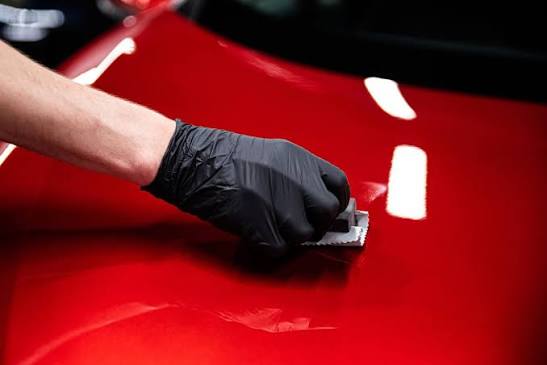
Ceramic coating is a liquid polymer, usually built around silicon dioxide (SiO2), that chemically bonds to the clear coat instead of just sitting on it. Once it cures, it's not a layer you wipe off next week. It's semi-permanent, hard, and glassy. Professional-grade coatings are rated on the pencil hardness scale, and a lot of them land around 9H, which is basically as hard as that scale goes before you're talking about actual glass or diamond coatings.
The core benefits that are real, not marketing:
- Hydrophobic surface: water genuinely beads and sheets off instead of sitting flat, which is why the slow-mo clips look the way they do
- UV resistance: the coating absorbs UV rays before they can oxidize and fade your clear coat
- Chemical resistance: bird droppings, bug guts, and tree sap are less likely to etch into the paint before you can wash them off
- Easier washing: dirt and grime have less to grip onto, so a rinse does more of the work
- Gloss enhancement: the coating fills in microscopic imperfections in the clear coat, which is why freshly coated paint looks noticeably deeper
What it does not do is make your car scratch-proof, rock-chip-proof, or immune to a shopping cart in a parking lot. That confusion is where half the internet arguments start.
💰 Why It Costs What It Costs
A DIY consumer-grade ceramic spray runs $20 to $50 and takes an afternoon. A professional multi-stage ceramic coating package can run $800 to $3,000 and take two to five days at a detail shop. That's not a typo, and it's not just labor markup.
Here's where the money actually goes:
- Paint correction first: before any coating goes on, a proper install includes machine polishing to remove swirl marks, light scratches, and oxidation, because the coating locks in whatever condition your paint is in when it cures. Skip this step and you're sealing in every flaw permanently
- Controlled environment: coatings need to cure in a dust-free, temperature-controlled space, which is why a lot of shops have dedicated coating bays
- Product cost: professional-grade coating products from brands like Gtechniq, CQuartz, and Ceramic Pro aren't cheap to begin with, and shops mark up accordingly
- Skill and liability: apply it unevenly and you get high spots, streaking, or a hazy finish that's genuinely hard to fix. Shops are charging for the risk of getting it wrong on a $60,000 car
The DIY sprays exist in a completely different category. They're closer to a really good sealant than a true multi-year coating, and most detailers will tell you that outright if you ask.
📈 How It Became a Status Symbol
Ceramic coating's rise tracks almost exactly with the rise of car content on Instagram and TikTok, and that's not a coincidence.
A few things converged at once:
- It's inherently visual. Water beading is one of the only detailing effects that translates instantly to video. Nobody's filming a wax job. Everybody films a coated hood in the rain
- It signals investment. A $1,500 ceramic package tells other car people you're serious about the build, the same way a $1,500 wheel setup does, just in a different category
- Detailing became content. Channels dedicated entirely to correction and coating jobs turned a maintenance task into a genre of entertainment, complete with satisfying before-and-afters
- It fits the flex economy of car culture. Builds aren't just judged on horsepower anymore. Paint depth, panel gaps, and how the car looks under direct sun at a meet all matter now, and coating is the fastest way to win that specific category
That last point is worth sitting with. Car culture has always had a status layer, whether it was chrome in the 60s, body kits in the 2000s, or stance in the 2010s. Ceramic coating is the current era's version: a way to show you care about a car beyond just making it fast or loud.
⚖️ Ceramic vs. Wax vs. Sealant: The Honest Breakdown
Every detailing forum has this argument on a loop, so here's the actual comparison without the brand loyalty.
Wax:
- Cheapest option, easiest DIY entry point
- Lasts weeks, not months
- Adds warmth and depth some people prefer visually
- Zero learning curve, forgiving if applied wrong
Paint sealant:
- Synthetic, lasts 3-6 months typically
- More durable than wax, less than ceramic
- Cheaper than professional ceramic
- Good middle ground for daily drivers that see real weather
Ceramic coating:
- Lasts 2-5+ years depending on the product and maintenance
- Highest upfront cost, especially professional installs
- Requires paint correction first to be worth it
- Best hydrophobic performance and gloss retention long-term
- Unforgiving of application mistakes
If your car sits in a garage and only comes out for meets, ceramic makes a lot of sense as a long-term investment. If it's a daily driver getting rock chips and parking lot dings weekly, a good sealant refreshed twice a year might genuinely serve you better for the money, and that's not a controversial opinion among actual detailers, even if it's not the popular one online.
🚫 What Ceramic Coating Doesn't Fix
This is where the hype does real damage, because people skip steps they shouldn't skip.
Ceramic coating will not:
- Hide existing swirl marks or scratches (it locks them in if you don't correct first)
- Prevent rock chips or stone damage (that's what paint protection film is for, a completely different product)
- Eliminate the need to wash your car (it makes washing easier, not optional)
- Last forever without maintenance (even the best coatings benefit from a maintenance spray or top-up over the years)
- Fix bad paint from the factory (some manufacturers use thinner clear coats than others, and coating can't add material that isn't there)
A lot of the disappointed reviews you'll find online trace back to one of these. Someone skips correction, coats over swirls, and then blames the coating when the car still looks imperfect up close.
🛠️ Is It Actually Worth It?
Depends entirely on what you're optimizing for.
If you want maximum protection and don't mind spending real money, a professional ceramic coating with proper paint correction beforehand is genuinely the best long-term option available right now, short of a full paint protection film wrap (and plenty of serious builds run both together, PPF underneath and ceramic on top).
If you're chasing the look for content or meets and your budget is tighter, a quality consumer ceramic spray applied correctly on clean, corrected paint will get you 70% of the visual result for a fraction of the price. It just won't last as long or perform as well in year two and beyond.
Either way, the honest advice from people who actually do this for a living is consistent: the prep matters more than the product. A $40 spray on properly corrected paint will outperform a $2,000 coating slapped over swirl marks and dust nibs.
Spota tip: if you're documenting your build's detailing progress, your Garage profile is the natural place to log it. Before-and-after correction shots, the coating date, and the maintenance schedule all live in one spot instead of scattered across your camera roll.
🔁 Where This Goes Next
Coating technology keeps getting faster to apply and more durable, and graphene-infused coatings are already pushing past what SiO2-based products could do a few years ago. The gap between DIY and professional results keeps shrinking too, which is good news for anyone priced out of the shop route.
But the core lesson holds regardless of which product wins the next chemistry war: coating protects good prep work, it doesn't replace it. Skip that step and no amount of hydrophobic beading is going to save you.
If your paint's ready for it, it's one of the few upgrades that actually pays you back every single time it rains.
For more on keeping a build looking sharp between meets, check out how to build your garage and add mods or browse more under-the-hood breakdowns.