
⚡ Two Garages, One Argument
Post a Tesla Plaid beating a Lamborghini in a stoplight drag race and watch what happens. Half the comments are popcorn emojis. The other half are a full-blown essay about how "real" performance isn't about a number on a timing slip, it's about sound, feel, mechanical sympathy, the thing you can't put a spec sheet on. Neither side is wrong exactly. They're just not arguing about the same thing.
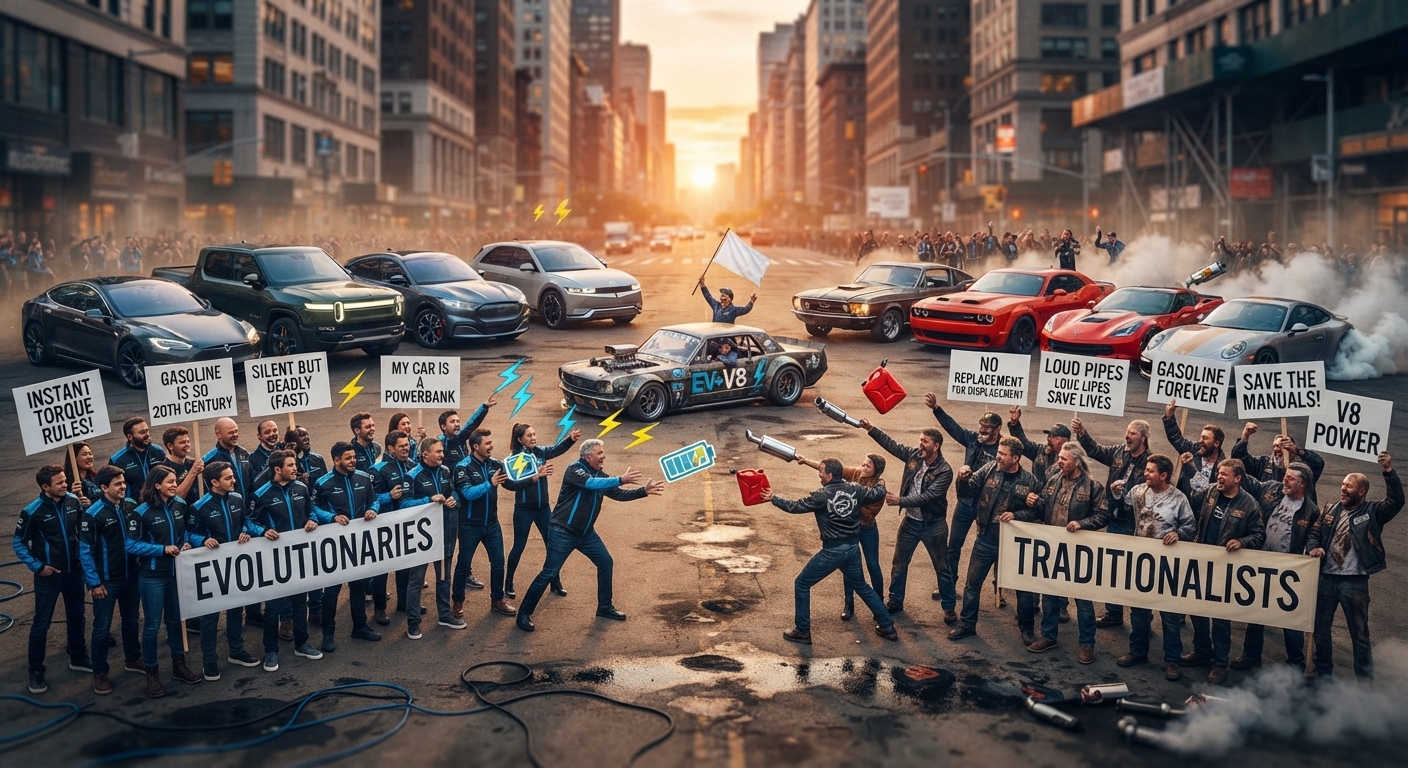
That's the EV vs. ICE fight in a nutshell. It looks like a debate about horsepower, range, and charging times. It's actually a debate about what a car is for, and that's a much harder argument to settle with numbers.
Car culture has survived plenty of technology shifts before. Carburetors gave way to fuel injection. Analog gauges gave way to digital dashes. Turbos went from race-only exotica to everyday commuter tech. None of those caused this much noise. The electric motor is different, and if you actually break down why, the whole fight starts to make a lot more sense.
🔋 It's Not About the Numbers (The Numbers Aren't Even Close)
Let's get the boring part out of the way, because the "EVs aren't really fast" argument died years ago.
A base Tesla Model 3 Performance runs a mid-3-second 0-60. A Rivian R1T, a three-row electric truck the size of a small building, does the same. The Porsche Taycan Turbo S and Lucid Air Sapphire trade blows with hypercars that used to be the exclusive property of Bugatti and Koenigsegg. Electric motors deliver 100% of their torque at 0 RPM, no waiting for a turbo to spool, no needing to hold a gear, no launch control drama. In a straight line, from a stop, almost nothing with a combustion engine can touch a serious EV without spending hypercar money.
So if it's not about speed, what is it about?
- Sound. A big one. Combustion cars have a voice. An EV, even a fast one, mostly just whooshes. For a culture built partly around exhaust notes, downshift snarls, and the specific bark of a cold start, silence reads as absence, even when the performance is objectively superior.
- Involvement. Manual transmissions, throttle blips, heel-toe downshifts, the physical choreography of driving a car well: all of that came from combustion cars needing a human to manage them. EVs mostly don't need that management, which some drivers experience as freedom and others experience as being cut out of the loop.
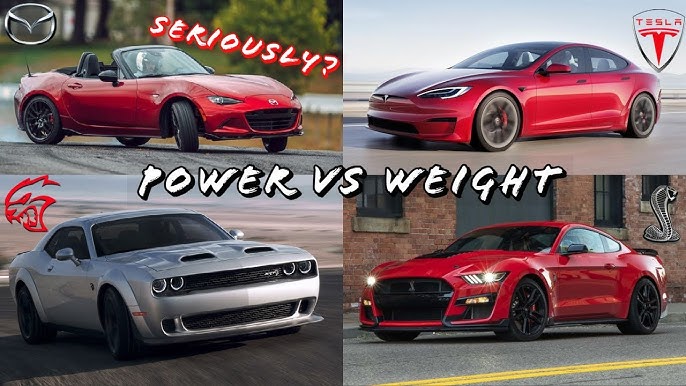
- Weight and feel. Battery packs are heavy. A Model S weighs more than a Chevy Suburban. Engineers work miracles hiding that weight through low centers of gravity and instant torque, but corner-carving purists can usually still feel it, especially at the limit on a track.
- Ownership ritual. Oil changes, spark plugs, timing belts, the smell of a garage: annoying maintenance to some people, a bonding ritual to others. EVs mostly remove it. Fewer moving parts means fewer excuses to be in the garage on a Saturday.
None of that is really an argument that EVs are slow or bad. It's an argument that they feel different, and car culture has always been at least as much about feeling as it is about specs.
📉 A Short History of Car Culture Panicking About Change
This isn't the first time gearheads have collectively lost their minds over a new technology, and it's worth remembering how those fights actually ended.
When fuel injection started replacing carburetors in the late '70s and '80s, plenty of old-school mechanics swore it was the death of "real" engine tuning. No more jetting, no more feeling your way through a rebuild with a screwdriver and a vacuum gauge, just a computer deciding how much fuel to spray. Forums didn't exist yet, but garages and swap meets carried the same argument word for word: this isn't a real car anymore, it's an appliance with a steering wheel.
Turbochargers went through their own version of this. For years, naturally aspirated purists dismissed forced induction as cheating, a shortcut for people who couldn't build real displacement. Now turbo fours power everything from base Camrys to Porsche 911s, and nobody blinks. Automatic transmissions caused the same fight decades earlier: real drivers rowed their own gears, an automatic was for people who didn't actually love driving. Dual-clutch automatics now out-shift most humans on a drag strip, and the debate quietly moved on.
Every one of these fights followed the same arc: new tech shows up, it threatens some skill or ritual that used to define "doing it right," a loud contingent declares the hobby dead, and a decade later the technology is just part of the furniture, argued about on its own terms instead of as an existential threat. There's no obvious reason the EV transition breaks that pattern, even though it currently feels bigger because it touches the engine itself, not just how the engine is managed.
🏁 The Identity Problem
Here's the part people don't say out loud as often: for a lot of enthusiasts, "car guy" isn't just a hobby label. It's an identity built over years, sometimes decades, around a specific relationship with machines that talk back. You learn a car's quirks. You wrench on it yourself or you know the guy who does. You build a mental model of what's happening under the hood just from the sound and the way it shifts weight through a corner.
Electric cars, especially ones locked down by software and proprietary diagnostics, threaten that identity in a very specific way. You can't easily swap a part from the junkyard. You can't tune it in your driveway with a laptop and a forum thread the way you could tune an engine's fuel maps. A lot of EVs are, by design, appliances you're not really supposed to open up.
That's a legitimate loss for a subculture that's always taken pride in understanding and modifying its machines. It's not irrational to mourn that, even while acknowledging the tech underneath is genuinely impressive.
On the flip side, EV owners often come to cars from a completely different angle: efficiency, tech, sustainability, or just wanting the fastest thing they can buy without a maintenance headache. They're not necessarily rejecting car culture. A lot of them are car people too, just car people who grew up with smartphones instead of carburetors, and they get tired of being treated like they don't count.
Both groups are protective of something real. That's why the arguments get so heated. It's rarely actually about a 0-60 time.
🔊 The Arguments You'll Actually Hear (And What's True in Each)
Scroll through any thread about EVs on a car forum and the same handful of arguments show up on repeat. Worth sorting the genuinely valid points from the ones that are more feeling than fact.
"EVs are heavy and it ruins the driving experience." Partly true. A Model 3 weighs around 4,000 pounds, and bigger EVs like trucks and SUVs can push past 6,000 or 7,000. That mass has to go somewhere in a corner, and no amount of clever suspension tuning makes physics optional. But it's also worth noting plenty of beloved combustion performance cars, like modern Mustangs, Chargers, and full-size trucks, are just as heavy. Weight is a real tradeoff, but it's not unique to EVs.
"Charging takes forever compared to filling up a tank." True for road trips, mostly irrelevant for daily driving. A 5-minute gas stop beats a 20-30 minute DC fast charge every time on a long haul, and that gap matters a lot for anyone doing road trips or cruises to distant meets. But most EV charging happens overnight at home, meaning most EV owners start every single day with a "full tank" they never had to stop for. Both things are true depending on how you actually use the car.
"There's no soul in an EV." This one's not really a factual claim, it's an aesthetic and emotional one, and it's honestly the most defensible argument on this whole list. Sound, vibration, and mechanical feedback are a huge part of why people fall in love with cars in the first place, and EVs genuinely don't replicate that (yet; some manufacturers are already experimenting with synthetic engine notes piped through the speakers, which is its own can of worms).
"The battery will die and cost more than the car is worth." Increasingly outdated. Early EV battery degradation fears were legitimate a decade ago. Modern EV batteries, backed by 8-10 year warranties from most manufacturers, are proving far more durable in the real world than early skeptics predicted, with many packs retaining 85-90% capacity well past 100,000 miles. Real risk, but a shrinking one.
"EV owners don't actually care about cars, they just care about tech." Unfair as a blanket statement. Plenty of EV owners came from combustion enthusiast backgrounds, still attend meets, still care about handling, styling, and performance. The stereotype exists because early EV adopters skewed toward tech-first buyers, but the EV owner base has diversified a lot as the cars themselves have gotten more performance-focused.
🛠 Where the Two Worlds Actually Overlap
Strip away the internet arguing and the overlap is bigger than either side usually admits.
- Drag culture has already absorbed EVs. Local 1/4-mile nights and outlaw drag events increasingly have an EV class, and plenty of combustion racers have started running numbers against a Model S Plaid just to see what happens. Competition has a way of erasing tribal lines fast.
- Modding culture is starting to show up in EVs too. Aftermarket wheels, coilovers, wraps, even early aftermarket ECU-adjacent tuning for range and power on certain platforms. It's younger and smaller than combustion mod culture, but it's growing, and it looks a lot like the early days of import tuning in the 2000s.
- Track days are shared ground. An EV's instant torque out of a corner and a combustion car's higher top speed and lighter weight create genuinely interesting matchups on a road course, and track day organizers increasingly run mixed run groups.
- Restomods are the unofficial truce. Companies are now dropping electric powertrains into classic muscle car and Porsche 911 shells, keeping the body and stance enthusiasts love while swapping in modern power. It's controversial in some corners, but it's also proof the two camps can share a build.
The people who actually spend time around both types of cars, at meets, at drag strips, at track days, tend to argue about this a lot less than the people who only encounter it online. That's not a coincidence.
🧬 It Also Depends Which Corner of Car Culture You're Standing In
"Car guys" isn't one group, and the EV reaction looks completely different depending on which subculture you're talking to.
- JDM and import scenes tend to be some of the most resistant, and it makes sense: that entire culture is built around specific engines with specific personalities, the SR20, the RB26, the 2JZ, each with its own reputation and mod path. An electric motor with a badge on the trunk doesn't slot into that tradition the same way.
- Truck and off-road culture has been surprisingly quick to adopt EVs, partly because instant torque is genuinely useful for towing and low-speed crawling, and partly because trucks like the Rivian R1T and Cybertruck lean into a rugged, capable identity that overlaps with what truck people already valued.
- Track day and time attack communities are more split by discipline than by ideology. Autocross and short-track events increasingly welcome EVs because instant torque out of tight corners is legitimately fun, while longer endurance-style track days still favor combustion cars that don't need to worry about thermal management and battery degradation over 20-lap stints.
- Classic car and restoration communities mostly aren't affected day to day, but they're watching the "restomod EV conversion" trend with real tension: some see it as a smart way to keep beloved classics on the road as gas becomes less available in certain markets, others see it as sacrilege that erases what made the car special in the first place.
- Drift culture has been quietly experimenting with EVs for a few years now, and the early verdict is mixed but curious: instant torque makes maintaining a slide easier in some ways, but the lack of an engine note removes a huge part of what makes drift events a sensory experience for spectators.
None of these groups agree with each other even before you bring EVs into it, which is a good reminder that "car culture" was never actually one unified opinion to begin with. It's always been a loose federation of tribes that mostly get along because they share a love of cars more than they share specific taste in cars.
🌆 Spota's Take: The Scene Doesn't Care What's Under the Hood
Spota tip: your car's category doesn't gate you out of the game. Whether you're running a supercharged V8, a turbo four-banger, or an electric motor with silly torque numbers, you're building the same Garage, hitting the same Photo Ops, and chasing the same city completion percentage as everyone else. The app was built around the idea that car culture is bigger than one engine type; it's about the people who care enough to show up, shoot their build, and be part of the scene in real life.
If anything, the rise of EVs is expanding who counts as a "car person" in the first place, and that's a good thing for a platform built on getting more people out in their cities discovering builds and meeting each other in person.
🔮 So Who Wins?
Nobody, and that's kind of the point. Car culture has never been one monolithic thing. It's drift kids and Radwood collectors and truck guys and stanced Civic owners and Cars and Coffee retirees, all coexisting under one very loose umbrella because they share a base-level obsession with cars as objects worth caring about.
EVs are just the newest and loudest addition to that mix. Give it another decade and the "EV vs. ICE" framing will probably look as dated as "import vs. domestic" does now: a real rivalry in its moment, eventually absorbed into a bigger, weirder, more inclusive car culture that still finds new things to argue about.
That argument is half the fun anyway. The day car people stop debating what counts as a "real" car is the day car culture actually dies. Right now, it's louder than ever.
For more on where car culture is headed, check out why manual transmissions refuse to die or browse more of under the hood.