
🚗 The Meme That Refuses to Die
Ask any car forum a question. Doesn't matter what the question is. "What should I buy for track days?" "What's a good winter beater that's still fun?" "I want a project car under $10k, ideas?" Somewhere in the replies, guaranteed, someone types four words: "Miata is always the answer."
It's a joke. It's also not a joke at all.
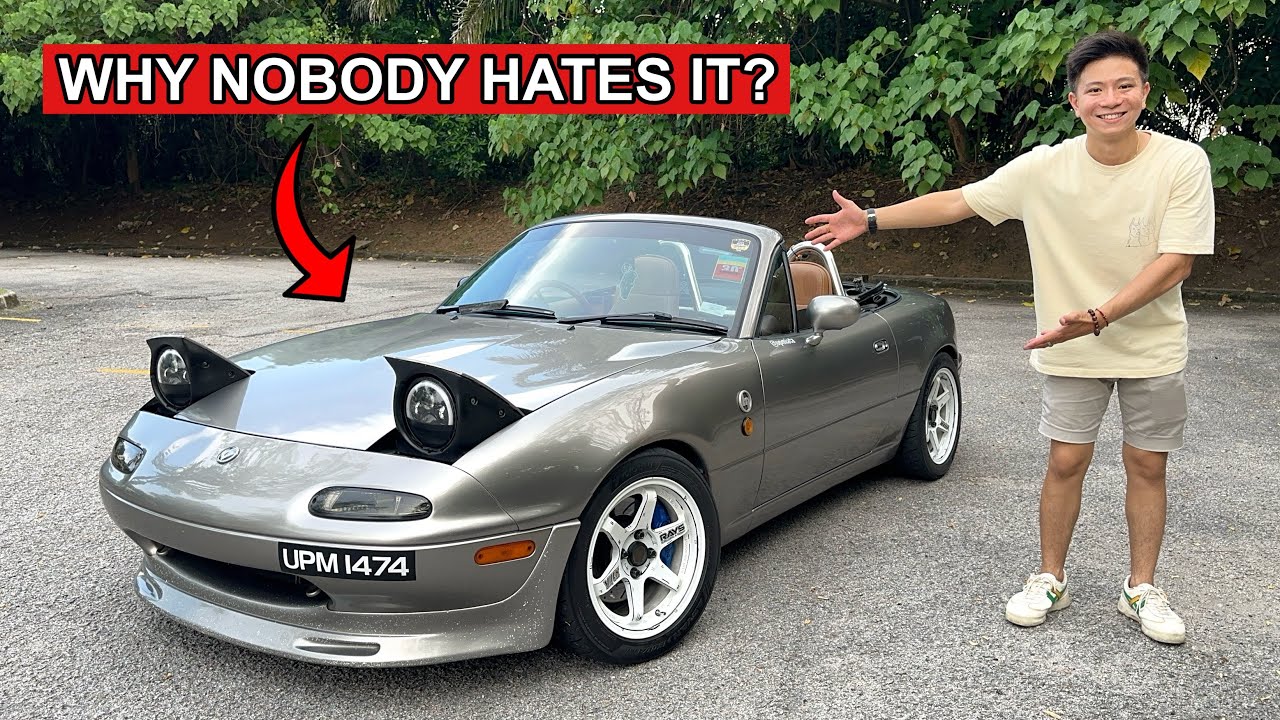
Walk any car meet parking lot in America and count the Miatas. There's always at least one, usually three, sometimes a whole cluster of NAs and NBs parked together like they formed a support group. Ask the owners how they ended up there and you'll hear a version of the same story almost every time: they owned something bigger, faster, more expensive, or more "serious" first, and they sold it to buy a car that makes 130 horsepower and weighs less than a modern Civic's options list.
That's not a coincidence. That's a pipeline. And once you understand why it happens, you start to see it's less a meme and more a prediction that keeps coming true.
📉 The Downsizing Arc Nobody Talks About
Here's the pattern, and if you've been in car culture more than a few years you've watched it play out dozens of times, maybe lived it yourself.
Phase 1: The horsepower chase. Someone gets into cars and immediately wants power. A modded WRX, a Mustang GT, a 350Z with a turbo kit, a Civic Si with an intake and exhaust that sound louder than they make power. The goal is straight-line speed, and for a while that's genuinely fun.
Phase 2: The reality check. They take that car to an actual track day, an autocross, a canyon run with people who know what they're doing, and get walked by someone in something dramatically slower on paper. A stock Miata. A CRX. A Fiat 124 Spider. The lesson lands hard: power is easy to buy, chassis balance isn't.
Phase 3: The pivot. They start researching why the slow car was fast. They learn about weight distribution, unsprung mass, roll center, the difference between a car that has grip and a car that communicates grip. Somewhere in that research, "Miata" comes up. It always comes up.
Phase 4: The purchase. They buy one, usually a beat NA or NB for a few thousand dollars, expecting it to be a stopgap. It is never a stopgap.
This arc has a name in car culture circles because it happens so consistently: some call it "car guy puberty," others just call it inevitable. Either way, the destination is the same little roadster, over and over, across generations of owners who never talked to each other and somehow arrived at the identical conclusion.
⚖️ Why the Chassis Physics Actually Back the Meme Up
This isn't just nostalgia talking. There's real engineering behind why a 30-year-old Mazda with modest power keeps beating cars that dramatically outgun it on a spec sheet.
- Weight is the ultimate mod. An NA Miata weighs roughly 2,200 pounds. A modern Civic Type R, which is considered light for its class, weighs closer to 3,100. Every pound you don't have is a pound you don't have to accelerate, brake, or turn. Power-to-weight matters, but so does raw mass in every corner, every stop, every direction change.
- Near-perfect weight distribution. The Miata's front-engine, rear-wheel-drive layout with the engine set low and back gives it close to a 50/50 front-to-rear split. That balance is exactly what a chassis engineer is chasing when they design a purpose-built sports car, and Mazda basically nailed it on a budget from the jump in 1989.
- Low center of gravity. A low, compact car rolls less in corners, which means the tires stay flatter and grip more consistently. You don't need huge power to feel fast when the car changes direction like it's on rails.
- Feedback over isolation. Modern performance cars increasingly numb the driver from the road: electric power steering tuned for comfort, sound deadening, driver aids smoothing everything out. A Miata, especially an older one, tells you everything the tires are doing in real time. That feedback is what makes a slow car feel fast and, more importantly, feel fun, which is the entire point that gets lost in horsepower wars.
- Rear-wheel drive on a light chassis rotates predictably. You can feel the back end start to slide well before it actually lets go, and you can catch it without drama. That predictability builds real driving skill instead of just building confidence in electronic nannies.
None of this is opinion. It's the same reasoning Colin Chapman built Lotus around decades earlier: "simplify, then add lightness." The Miata is arguably the most successful mass-produced execution of that philosophy that's ever existed, and car people who actually drive instead of just spec-sheet compare eventually figure that out.
💸 The Ownership Economics Nobody Admits Drive the Decision
Chassis physics gets people curious. Cost is what seals the deal, even though almost nobody says that part out loud because "I bought it for the driving dynamics" sounds better than "I bought it because I could actually afford to enjoy it."
Purchase price stays realistic. A clean NA or NB Miata still trades in the $4,000 to $9,000 range in most of the country, depending on mileage and rust. An early NC can be found for similar money if you look for one with a few more miles. That's project-car money for a car that doesn't need to be a project.
Parts are everywhere and cheap. Nearly 30 years of production, massive enthusiast demand, and a simple mechanical layout means the aftermarket for Miatas is enormous. Suspension components, cooling upgrades, interior parts, even full engine swaps have well-documented paths because thousands of people have already done exactly what you're trying to do.
Insurance doesn't punish you for having fun. A modest four-cylinder roadster with a long safety record and a driver demographic that skews toward people who actually maintain their cars insures for a fraction of what a modified turbo car costs to cover, even before you factor in that many insurers still treat "sports car" as a red flag regardless of actual horsepower.
Fuel and maintenance stay boring in the best way. These are Mazda four-cylinders. Timing chains, not belts, on most generations. No forced induction stressing internals from the factory. Maintenance intervals and part costs read like a Corolla's, not a performance car's, right up until you start modifying it, and even then the ceiling is forgiving.
Track days cost less when the car costs less to fix. Push a $60,000 performance car too hard and a mistake is financially devastating. Push a $6,000 Miata too hard and worst case, you're out a fender and a weekend, not a second mortgage. That lowered stakes lets owners actually explore the limits of the car and their own skill, which ironically makes them better, more confident drivers.
Add it up and the Miata isn't just physically well-suited to being a great driver's car. It's financially well-suited to being a car you actually use hard instead of babying in a garage, which for a huge chunk of the enthusiast community is the entire point of owning a car in the first place.
🏁 It's Also a Gateway Into Real Motorsport
A huge, often underrated part of the "Miata is always the answer" pipeline is that it's the cheapest legitimate on-ramp into wheel-to-wheel racing that exists in American motorsport.
- Spec Miata is one of the largest and most competitive spec racing classes in the country, run through the SCCA and NASA. Because every car is mechanically leveled to the same rules, races come down to driver skill, not who spent the most money, which is rare in racing and exactly why so many pro drivers cite Spec Miata as where they actually learned to race.
- Chump Car and LeMons endurance racing lean heavily on Miatas because the platform is cheap to build, cheap to fix after contact, and genuinely competitive against much more expensive metal.
- Autocross regionally is dominated by Miata classes because the car rewards precise driving over raw power, which is exactly what autocross tests.
That motorsport pathway matters because it means the meme isn't just about a fun cheap car. It's about a fun cheap car that can legitimately turn into a racing career, or at minimum a genuine racing hobby, without the six-figure buy-in that most forms of motorsport require. Plenty of car people who "just wanted something fun for weekends" end up at a race school within a year because the on-ramp was right there.
🧠 The Cultural Ego Hurdle, and Why Getting Over It Changes Everything
Here's the part of the story that's less about engineering and more about psychology, because it explains why so many people resist the Miata for years before finally caving.
There's a real ego barrier to buying what a lot of people still perceive, wrongly, as a "hairdresser's car." Decades-old stereotypes about the Miata being underpowered, unmasculine, or not a "real" enthusiast car have followed it since the '90s, and plenty of people avoid the car specifically because they don't want to deal with the jokes.
Then they drive one. Or worse for their wallet, they drive a properly set up one with a limited-slip diff and decent tires, on a canyon road or an autocross course, and the stereotype evaporates in about four corners. What replaces it is usually some version of genuine frustration: frustration that they spent years and thousands of dollars chasing a feeling this car delivers for a fraction of the cost, and frustration that they let a stereotype talk them out of trying it sooner.
That conversion moment is exactly why the meme has staying power. It's not marketing. It's not a hype cycle. It's tens of thousands of individual car people independently reaching the same conclusion after actually driving the thing, which is a much harder trend to fake than anything social media manufactures.
🔧 Which Generation People Actually End Up With
Not every Miata generation gets recommended for the same reasons, and the "which one" debate is its own rabbit hole worth knowing before you go looking.
- NA (1989-1997) is the purist's pick: simplest, lightest, cheapest to fix, and the one most associated with the original "Is Always the Answer" reputation. Rust in the rear frame rails and rockers is the main thing to check before buying.
- NB (1998-2005) refines the NA with a stiffer chassis and better factory options while keeping the same basic recipe. The 1999-2000 NB with the more powerful 1.8L is a common favorite for a reason.
- NC (2006-2015) is bigger and heavier than purists like, but it's also the most livable daily, with better safety, a usable trunk, and available options like a retractable hardtop.
- ND (2016-present) brought the car back down in weight after the NC's gain and is widely considered the best-driving generation stock, at the cost of a higher buy-in than the older cars.
Whichever generation someone lands on, the underlying reasoning stays the same across all four: light weight, balanced chassis, honest feedback, low stakes. The car evolved. The philosophy behind why people keep buying it didn't.
🥊 What About the Cars That Are Supposed to Beat It?
Every generation, something new gets crowned the "Miata killer," and it's worth asking honestly why none of them have actually killed it.
- The Toyota 86 / Subaru BRZ twins are the closest modern equivalent in philosophy: light-ish, rear-wheel-drive, built around handling over power. They're excellent cars, and plenty of enthusiasts genuinely prefer the coupe layout and slightly more aggressive styling. But they've never undercut the Miata on price or matched its decades of accumulated cheap parts and community knowledge, and the convertible-versus-coupe preference alone keeps a chunk of buyers on the Mazda side regardless of spec sheets.
- The Fiat 124 Spider is, mechanically, a rebadged ND Miata with a turbo engine and Italian styling. It proves the point rather than disproving it: even Fiat's own answer to "how do we beat the Miata" was to build a Miata.
- Hot hatches like the GTI or Civic Si solve a different problem. They're faster in a straight line, more practical, and arguably better daily drivers. But they're heavier, front-wheel-drive, and don't deliver the same rear-wheel-drive rotation and low-CG feel that the whole Miata pitch is built around. Different tool, different job.
- Older lightweight rivals like the Honda S2000 or Toyota MR2 have passionate followings and, in the S2000's case, a genuinely faster engine. What they don't have is the Miata's production numbers, meaning parts availability, community size, and price floor all favor the Mazda by a wide margin. Rarity is cool until you need a part on short notice.
None of this is to say the alternatives are bad. It's that the Miata occupies a specific intersection of cheap, plentiful, balanced, and proven that nothing else has fully replicated in three decades of people trying.
👥 The Community Compounds the Appeal
There's a reason Miata ownership tends to turn into Miata culture rather than just Miata ownership. Because the car has been around so long and sold in such volume, nearly every region has an active Miata-specific club, a local track day crew that knows the platform inside out, and forums with three decades of accumulated fixes for problems that have already been solved a thousand times over.
That density matters more than it sounds like it should. Buy an obscure enthusiast car and you're often troubleshooting alone. Buy a Miata and whatever's wrong with yours, someone in a local club or a regional Facebook group has already fixed the exact same thing on the exact same generation, usually with photos.
It's the same reason Clubs on Spota tend to have outsized Miata representation relative to how many are actually on the road: the car doesn't just attract owners, it attracts people who want to talk about, wrench on, and drive with other owners. That's a car culture trait, not just a car trait.
🎯 Spota Tip: Log the Moment You Give In
If you're mid-pipeline right now, still telling yourself you don't need one, know that the Garage on Spota is built for exactly this kind of story: track your build's mods and progress from whatever you're driving today straight through to the day you finally give in and buy the roadster everyone told you to buy years ago. Plenty of Garage profiles on the app tell that same downsizing arc in photos, one mod and one sold car at a time.
If you want to see how other owners document theirs, how to build your garage and add mods walks through setting one up, and if you're curious what actually makes a car "an enthusiast's car" in the first place, what is a car enthusiast is a good companion read to this one.
🏆 The Answer Was Always the Answer
Car culture argues about almost everything. Manual versus automatic, imports versus domestics, form versus function. The one thing an unreasonable number of car people from wildly different corners of the hobby agree on, often without ever meeting each other, is that a light, balanced, cheap-to-run roadster is one of the purest ways to actually enjoy driving.
That's not a meme holding on by nostalgia. That's a conclusion enough people have independently reached that it stopped being a joke and started being received wisdom. Buy the horsepower first if you want. Most people do. Just don't be surprised when you end up here anyway.