
🔦 The Blinding Truth Nobody Wants to Admit
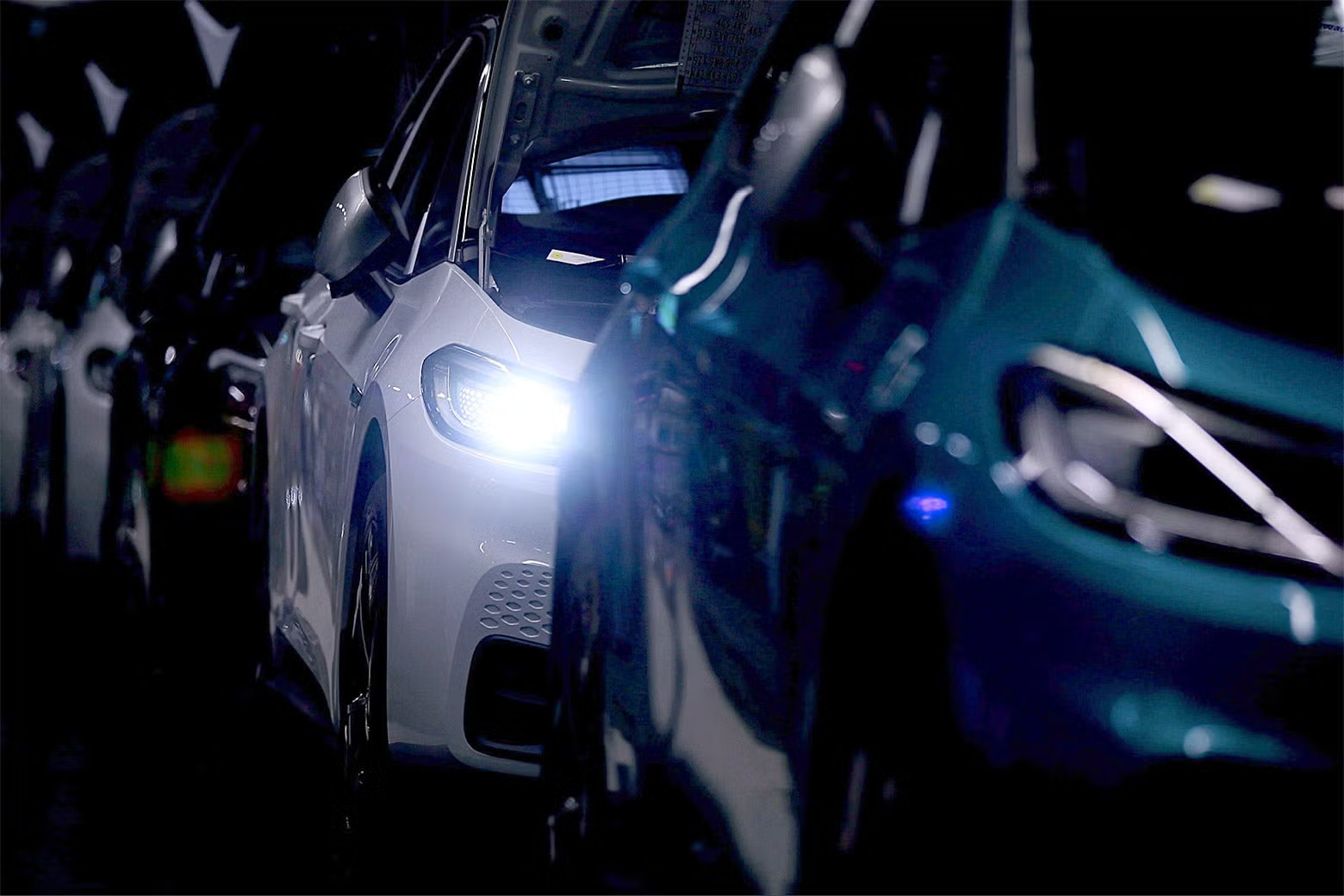
You're driving home at 11pm. A crossover crests the hill in the oncoming lane and suddenly your entire windshield turns into a wall of white light. You squint, you flinch, you drift half a foot toward the shoulder without meaning to. Your eyes don't recover for a good three or four seconds after it passes.
That's not your imagination and it's not just old eyes struggling with new tech. It's a real, measurable, increasingly common problem, and the car industry has known about it for years.
Headlight glare complaints have exploded over the last decade. AAA studies keep finding a majority of drivers say oncoming headlights are worse than they used to be. Insurance data backs it up. And the honest answer for why involves a regulatory loophole, a marketing arms race over "whiter" light, and yes, car people themselves making it worse with bolt-on bulb kits that were never supposed to leave the box they came in.
Let's actually break down what's happening, because "cars got brighter" is true but it's not the whole story.
🕰 A Quick History of How We Got Here
Headlights barely changed for most of the 20th century. Sealed-beam halogen units were standard from the 1970s through the early 2000s: warm, relatively dim by modern standards, and universally compatible because there was really only one type. HID (high-intensity discharge, sometimes called xenon) headlights started showing up on luxury cars in the late 1990s and became the first mainstream taste of that cooler, whiter light. They were genuinely brighter and threw light further, and they were also the first wave of "why is that car blinding me" complaints, because they hit the market well before regulation or beam-shaping tech caught up.
LEDs followed in the 2010s and solved some of HID's problems (faster warm-up, longer lifespan, more compact housings that let designers get creative with shapes) while introducing new ones around beam scatter when paired with the wrong housing. Laser headlights exist too, mostly on high-end European models, using LED to excite a phosphor that produces an extremely long, precise beam, though they're still rare enough in the U.S. market that most drivers have never actually seen a set. Each generation solved real problems from the last one. Each generation also arrived faster than the regulations built to handle it, which is the actual throughline connecting all of this.
👀 It's Not Just You: Aging Eyes and Modern Light Don't Mix
Before getting into the tech, it's worth understanding why this problem hits some drivers so much harder than others. Human night vision (scotopic vision) relies on rod cells in the eye that are extremely sensitive to low light but recover slowly once they've been overwhelmed by a bright source. That recovery time, sometimes called photostress recovery, gets measurably longer as people age. A driver in their 20s might shake off a bright oncoming flash in a second or two. A driver in their 60s can be looking at five, six, sometimes ten seconds of significantly reduced vision after the same exposure. At highway speed, ten seconds is the length of a football field covered half-blind.
This is exactly why AAA and other groups have flagged headlight glare as a road safety issue and not just an annoyance. It disproportionately affects older drivers, and older drivers are already a growing share of people on the road. The complaint isn't nostalgia for dimmer cars. It's a genuine, physiologically measurable problem that gets worse every year as the vehicle fleet turns over to brighter tech.
💡 LED Isn't the Villain, Physics Is
Why LEDs Read as So Much Brighter
Old halogen headlights put out light in the 3,000-3,500K color temperature range: warm, yellowish, familiar. Most factory LED and HID setups run closer to 5,000-6,500K, which sits near daylight-white. Aftermarket "upgrade" bulbs routinely push past that into 8,000-10,000K territory, which tips into blue.
Here's the part that trips people up: higher color temperature doesn't necessarily mean more lumens. A 6,000K bulb and a 3,000K bulb can output similar total light and the 6,000K one will still look dramatically brighter to the human eye. Blue-white light hits the cones in your eyes differently than warm light does, and your brain interprets it as more intense even when the raw output is comparable. Car people who swap bulbs "for visibility" are often buying a light that feels brighter without necessarily lighting the road better, while making it measurably worse for everyone driving toward them.
The Beam Pattern Problem
The bigger issue isn't color, it's shape. Halogen bulbs were designed as a single small filament sitting at a specific point inside a reflector or projector housing that was engineered around that exact filament geometry. Swap in an LED bulb and you've usually got multiple diodes arranged in a totally different pattern, sometimes with the light source itself facing a different direction inside the housing.
The result: light that was supposed to get shaped into a crisp cutoff (dark above the line, bright below it, so oncoming drivers aren't hit directly) instead scatters. Some of it shoots upward, some of it refracts off the housing at the wrong angle, and a chunk of it goes straight into oncoming eyeballs instead of the road. This is why a car with "upgraded" LED bulbs in a housing designed for halogen can look like it's running brights even in low-beam mode. It's not an illusion. It's genuinely misdirected light.
🚨 The Regulation Loophole Nobody Talks About
For decades, U.S. headlight rules under Federal Motor Vehicle Safety Standard 108 were built almost entirely around halogen technology: fixed beam patterns, specific bulb types, specific output limits calibrated for that tech. When LED and HID lighting arrived, manufacturers found ways to meet the letter of decades-old rules with light sources the rules were never written to handle. Total lumen output climbed steadily because the standard measured old assumptions, not new brightness.
Spota tip: if you're the kind of person who notices this stuff on every drive, our Photo Ops and night-city Playlists are a good excuse to actually look closely at how different cars handle their lighting. You start noticing which builds nail it and which ones are lighting up the whole block.
Regulators have been playing catch-up. Adaptive driving beam (ADB) technology, which uses cameras and can shape the beam in real time to carve out a dark zone around an oncoming car while keeping everything else lit, has been standard equipment in Europe for years. It only got a formal green light for U.S. sale in 2022, and actual adoption has been slow because automakers have to redesign lighting systems and states have to update their own separate vehicle codes to allow it. So the tech that could mostly fix this problem exists. It's just barely on American roads yet.
Why Nobody Agrees On A Fix
Part of the regulatory mess is that headlight brightness isn't measured or regulated the same way state to state, and enforcement is basically nonexistent. A cop pulling someone over for "headlights too bright" is a much harder case to make than a broken taillight. There's no simple lumen meter a roadside stop can use. That gap between "this is clearly a problem" and "this is enforceable" is exactly why it's persisted this long.
The Trucks and SUVs Make It Worse Problem
There's a geometry issue stacked on top of everything else. Headlight height keeps climbing because ride height keeps climbing. A headlight mounted at 40+ inches off the ground, which is common on modern trucks and body-on-frame SUVs, sits much closer to eye level for the driver of a sedan or hatchback in the next lane or coming the other way. The exact same light source that would sweep mostly below eye level on a low car instead lands close to dead-on for anyone in something smaller. This is a big part of why the complaint has intensified over the last decade specifically. It's not only that lights got brighter. It's that brighter lights got mounted higher at the same time the market shifted hard toward trucks and SUVs, and those two trends compounded each other.
🛠 The Aftermarket Bulb Problem (Yes, This Is On Us)
Here's where car culture has to own its part of this. Walk into any online marketplace and you'll find thousands of LED "conversion kit" bulbs designed to plug straight into a factory halogen housing. They're cheap, they're a five-minute install, and they genuinely do make your headlights look more modern.
They're also, in the overwhelming majority of cases, not street legal. In the U.S., a headlight assembly has to be certified as a complete unit under FMVSS 108, bulb and housing together. Swap the bulb type without swapping the whole housing to one engineered and certified for that bulb, and you've created an assembly that was never tested or approved as a combination, no matter how legitimate the bulb packaging looks. Plenty of these bulbs even ship stamped with fine print bulbs admitting they're for off-road use only, buried under bright "PLUG AND PLAY UPGRADE" marketing.
The honest breakdown:
- Factory LED/HID headlights: Engineered as complete housing-and-bulb systems, tested and certified together. These are legal and, when aimed correctly, genuinely safer than old halogens.
- Aftermarket LED bulbs in a halogen housing: The most common source of the worst glare complaints. Cheap, popular, and almost never legal for road use.
- HID retrofit kits: An older version of the same problem, real light output gains paired with the wrong beam geometry for the housing, same scatter issues.
- Misaimed headlights of any type: Even a fully legal, factory LED setup can blind people if the aim is off by a couple of degrees, which happens more than you'd think after suspension work, aftermarket springs, or just a car that's been sitting nose-down loaded with gear.
None of this makes upgrading your lighting a bad move. It means doing it right: housing-matched setups, correct aim, and resisting the urge to chase the whitest, coldest-looking bulb just because it photographs better for a Garage post.
🔧 How to Check If Your Car Is Part of the Problem
You don't need a shop visit to do a basic gut check. A few things worth actually looking at:
- Look at your own beam pattern on a flat, dark surface. Park facing a garage door or a flat wall about 25 feet away at night. A properly aimed low beam should show a clear horizontal cutoff, dark above the line, lit below it, with the passenger side aimed slightly higher than the driver side (this is intentional, it lights the shoulder/signs without blinding oncoming traffic). If you see a hot spot well above that line, or light scattering wide instead of forward, something's off.
- Check what bulb type came stock vs. what's currently installed. If the car left the factory with halogen and now has LED bulbs in the same housing, that's very likely an aftermarket swap, and it's almost certainly not street legal regardless of how good it looks.
- Watch for flicker or color shift at certain RPMs or electrical loads. Cheap aftermarket LED kits sometimes flicker under specific voltage conditions, which is both annoying and another sign the housing and bulb weren't designed together.
- Get your alignment checked after any suspension work. Lowering springs, coilovers, lift kits, and even long-term sag from age all change ride height, and ride height changes aim. Most shops that do alignments can check headlight aim in the same visit, and it's a cheap fix compared to the goodwill it costs you on the road.
- If you're buying a used modified car, ask directly. "Are the headlights stock or swapped?" is a completely normal question in a pre-purchase inspection, right up there with asking about the clutch or the tune.
None of this is about shaming anyone's build. It's the same mindset serious enthusiasts already apply to brakes, tires, and suspension: do it right, or don't do it at all.
🗣 Why Car Culture Keeps Arguing About This
Spend ten minutes in any car forum's lighting subforum and you'll find the same debate looping endlessly. One camp treats bright white or blue-tinted light as a legitimate style upgrade, the same category as tint or wheels, something that makes a build look more finished and more modern. The other camp treats it as one of the few mods that actively makes other people's driving experience worse, putting it in a different category entirely from something like an exhaust note or a wrap color that mostly just affects the owner's own experience.
Both sides have a point buried in there. A clean, correctly-aimed LED retrofit really can look sharp and function better than tired, yellowed factory halogens. The problem was never "LED bad." It's that the fastest, cheapest path to that look, a fifteen-dollar bulb swap with zero attention to housing compatibility or aim, is also the path most likely to blind the next car over. The mods that actually respect the housing (full assembly swaps engineered for LED, projector retrofits done by someone who knows what they're doing, proper aim verification afterward) rarely draw complaints. It's almost always the shortcut version causing the problem, which is a pattern car culture has seen before with exhausts, with tints, with pretty much every mod category that has a cheap-and-wrong version sitting right next to the expensive-and-right version.
🌃 Why This Debate Isn't Going Away
The forces pushing headlights brighter aren't slowing down. SUVs and trucks keep growing, and a factory LED bar mounted higher on a lifted truck sits closer to eye level for the sedan behind it, which makes an equally bright light feel far more aggressive. Manufacturers keep marketing "premium" white-blue light as a styling feature, the same way chrome trim or bold grilles used to sell. And the used aftermarket bulb market isn't going anywhere as long as it's five bucks and ten minutes to make an old car look newer.
What's actually likely to move the needle: wider adoption of adaptive driving beam tech as states update their codes, and enough public pressure (AAA, insurance groups, and state legislators have all been vocal about this the last few years) to force clearer standards. Until then, the burden mostly sits with drivers to not make it worse, which is a genuinely reasonable ask.
If you're modding lights on your build, do the research the same way you'd research an ECU tune or a suspension kit. A headlight upgrade that blinds half the drivers you pass isn't a flex, it's just inconsiderate, and it's the kind of thing that gets whole categories of mods a bad name for everyone else trying to build something clean. For more on doing mods the right way, check out our guide on what order to mod your car in, or browse more culture breakdowns like this one in under-the-hood.
Light your car up right. Just don't light up everyone else's night while you're at it.