
🚨 The Gadget Everyone Said Was Dead
For a while there, it looked like the radar detector was headed for the same drawer as your old iPod. Waze had crowdsourced cop locations for free. Cities were leaning on fixed speed cameras that don't care what's stuck to your windshield. And plenty of car guys just figured detectors were a relic from an era before smartphones did everything.
Then something funny happened. Sales climbed back up. Forums that had gone quiet on the topic lit back up with debates about mounting angles and false-alert filtering. Companies that had been coasting on decade-old hardware suddenly started shipping units with GPS databases, app integration, and artificial intelligence doing real-time signal analysis.
The radar detector isn't dead. It just went through a growth spurt while nobody was watching.
If you've ever wondered why a piece of tech that predates the smartphone is still relevant, or why some of the most serious car guys you know treat their detector with the same reverence as their exhaust setup, this is that story.
📡 How Radar and Laser Actually Work (The Part Most People Skip)
Before you can understand why detectors matter, you need to understand what they're actually detecting.
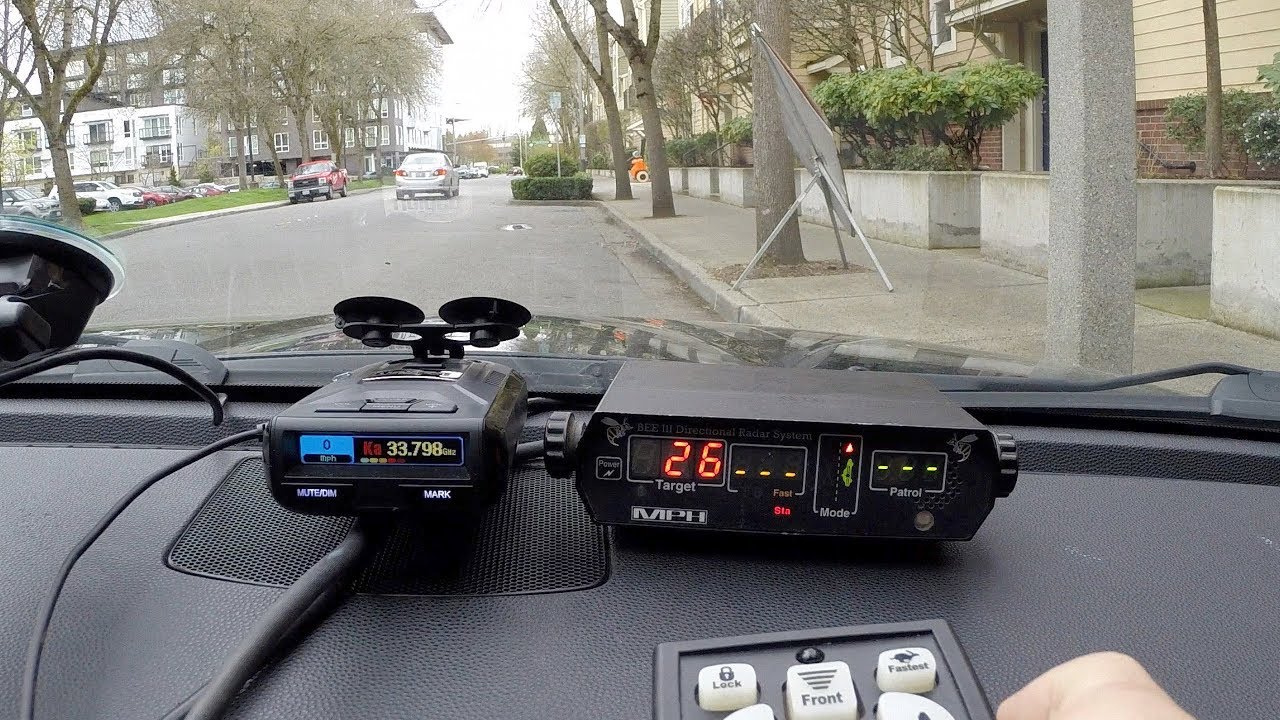
Radar (RF) speed enforcement works by bouncing radio waves off your car and measuring the frequency shift when they bounce back. That shift, the Doppler effect, tells the officer's unit how fast you're closing distance. Radar guns operate on a handful of known bands:
- X-band: The oldest, slowest, and easiest to detect. Barely used by police anymore but still triggers false alerts from automatic doors and adaptive cruise systems.
- K-band: The most common band still in active use by law enforcement today.
- Ka-band: Higher frequency, narrower beam, harder to detect early. This is where most modern enforcement lives.
Laser (LIDAR) speed enforcement is a different animal entirely. Instead of a wide radio beam, it's a tight, focused pulse of infrared light aimed directly at a specific reflective point on your car, usually the front plate or grille. Because the beam is so narrow and the light travels so fast, laser gives an officer almost no warning time to your detector. By the time a laser detector picks it up, you're often already being clocked.
That gap between radar and laser is the entire reason the radar detector industry had to reinvent itself. A detector that only listens for radio waves is only solving half the problem.
🕵️ Why the Comeback Happened
1. Crowdsourced Data Grew Up
Early standalone detectors were dumb in one specific way: they could only tell you a signal existed right now, in this exact spot. They had no memory. Every red-light camera, every speed trap, every stationary radar unit had to be discovered fresh, every single time, by every single driver unlucky enough to drive past it first.
Modern connected detectors flipped that. Brands like Escort and Uniden now run live, crowdsourced networks (Escort's Defender Database, Uniden's Nighthawk system) that pull confirmed camera and hot-spot locations from thousands of other users in real time, then feed that data straight into the detector's GPS. You're not just reacting to radar anymore. You're getting warned about the permanent fixed camera two exits ahead before it's even in range.
That single upgrade did more to revive the category than any hardware change.
2. Laser Jammers Entered the Chat
Detecting laser is one thing. Actually beating it is another. Laser jammers, which emit a signal back at the LIDAR gun to scramble or delay its read, became the natural next arms-race move once laser enforcement spread. Combine a detector (early warning on radar and cameras) with a jammer (a fighting chance against laser) and you've got a setup that actually addresses both enforcement methods instead of just one.
Worth noting up front: laser jammers are illegal in a meaningful number of states, and even where legal, using one on an officer who's already locked your speed can escalate a routine stop fast. This isn't a "beat every ticket forever" device. It's a piece of a bigger system, and like anything in this space, the legal line matters more than the marketing copy.
3. Speed Cameras Made Detectors Relevant Again, Not Obsolete
The assumption a decade ago was that fixed cameras would kill the detector market: why detect a moving radar gun when the real threat is a camera bolted to a pole that never gets tired? What actually happened is the opposite. Because most modern detectors now integrate GPS-based camera databases alongside live RF detection, a single unit handles both threats at once. The camera boom didn't replace the detector, it gave the detector a second job.
4. Phone Apps Turned Out to Have a Ceiling
Waze is genuinely useful, and plenty of car guys run it alongside a dedicated detector rather than instead of one. But a phone app depends entirely on other drivers actively reporting in real time. If nobody's reported the mobile unit sitting in the median two minutes ago, Waze has nothing to tell you. A dedicated detector doesn't wait on crowd participation. It's listening to the actual radio spectrum, live, the entire time you're driving. The two tools solve overlapping but genuinely different problems, and a lot of serious drivers run both.
💰 What You're Actually Paying For
Radar detector pricing spans a wide range, and the differences aren't just marketing fluff:
- Entry-level ($150-$250): Basic radar and laser detection, minimal false-alert filtering, no GPS database. Fine for casual use, frustrating for daily highway driving because you'll get buried in false alerts from blind-spot monitoring systems and automatic doors.
- Mid-range ($300-$500): GPS-locked known false alerts, camera database, better range on Ka-band, some app connectivity.
- Flagship ($500-$700+): Real-time crowdsourced alerts, arrow-based directional indicators (front/side/rear threat), extreme range, minimal false positives, seamless app integration.
- Laser jammers: Typically sold separately and installed at the front of the car, often running another $300-$1,000+ depending on how many heads you install and whether you want them concealed behind the fascia.
A serious setup, detector plus jammer plus professional install, can run well past $1,000. That's not a casual accessory price tag, and it's exactly why the people who buy in tend to be genuinely serious about it rather than impulse shoppers.
⚖️ The Legal Patchwork Nobody Explains Clearly
This is where things get genuinely confusing, because the legality of radar detectors varies wildly depending on where you're driving and what kind of vehicle you're driving it in:
- Radar detectors are legal for private, non-commercial vehicles in the vast majority of US states. Virginia and Washington D.C. are the notable holdouts where they're banned outright for regular passenger vehicles.
- Commercial vehicles face much stricter rules. FCC regulations prohibit radar detector use in commercial trucks over 10,000 lbs GVWR nationwide, regardless of state law.
- Laser jammers are illegal in several states even where radar detectors are perfectly legal, because jamming a signal is treated legally different from simply detecting one.
- Military bases and federal property generally ban them regardless of the surrounding state's law.
None of this is a suggestion to speed. It's genuinely just a messy legal landscape, and if you're buying a detector or jammer, checking your specific state's current law is worth five minutes before you spend real money on hardware that might be illegal to even have mounted on your windshield where you live.
📜 A Short History of the Arms Race
Radar guns for traffic enforcement first showed up in the early 1950s, and the first consumer radar detectors followed almost immediately after. That's not a coincidence. This has been a back-and-forth escalation from day one, not a modern phenomenon:
- 1950s-60s: X-band radar guns hit the road. The earliest detectors are crude, bulky, and barely functional.
- 1970s-80s: K-band arrives specifically because X-band detectors got too good at giving early warning. Detectors adapt within a couple of years.
- 1990s: Ka-band shows up for the same reason K-band did: to close the detection gap. Instant-on radar (guns that stay dormant until the officer triggers them for a split-second read) becomes standard practice specifically to defeat early-warning detectors.
- 2000s: Laser/LIDAR enforcement spreads widely because it's nearly impossible to detect early with radar-only hardware. Detector companies respond with dedicated laser sensors, then with jammers.
- 2010s: GPS databases and smartphone connectivity turn standalone detectors into networked devices for the first time.
- 2020s: Crowdsourced live data, AI-based false-alert filtering, and integrated jamming push detectors further than they've ever been, right as camera enforcement and connected-car speed data expand too.
Every single escalation on the enforcement side has been met with an escalation on the detector side, usually within a couple of product cycles. That pattern is exactly why "detectors are dead" predictions keep aging badly. The technology on both sides keeps moving, so the gap that makes detectors useful never actually closes for long.
🔇 The False-Alert Problem Nobody Warns You About
Ask anyone who's owned a cheap detector for more than a week and they'll tell you the real enemy isn't cops, it's noise. Modern cars are packed with radar-emitting systems of their own: adaptive cruise control, blind-spot monitoring, automatic emergency braking, even some automatic doors at grocery stores run on the same K-band frequency police radar uses.
A low-end detector treats every one of those as a potential threat and screams at you constantly, which trains most owners to tune the thing out entirely within a month, defeating the entire purpose. This is the real, unglamorous reason the mid-range and flagship tiers exist. GPS-locked filtering that remembers "this exact intersection has a false alert from an automatic door, ignore it here specifically" is the feature that actually makes a detector usable on a daily basis, not a novelty you mount once and forget about.
It's also the number one topic on every detector forum and Reddit thread on the subject: not "does this work," but "how do I get this to shut up about things that don't matter so I actually trust it when it matters."
🧭 Mounting, Etiquette, and the Small Culture Around It
Detector culture has its own set of unwritten rules, the same way exhaust tone and wheel fitment do:
- Mounting position matters. Too low behind the windshield trim and you lose range on oncoming Ka-band. Too high and you're fighting your rearview mirror for space. Most serious owners spend real time dialing in the exact spot.
- Concealment is its own subculture. Owners running laser jammers often pay extra for "concealed" heads mounted behind the front fascia specifically so the setup isn't visible, both to avoid theft and to avoid tipping off anyone who might have opinions about it.
- Firmware updates are taken seriously. Because enforcement tech keeps shifting, flagship detectors ship regular firmware and database updates, and owners who skip them are basically running last year's information on this year's roads.
- There's a real etiquette debate about sharing alerts. Crowdsourced networks only work if people report accurately, and there's genuine forum debate about false-reporting, over-reporting, and whether some users game the system.
None of this is niche for niche's sake. It's the same pattern every corner of car culture follows: give enthusiasts a tool with real depth, and a real community builds itself around getting the most out of it.
🧠 Why This Is Really About Something Bigger Than Tickets
Here's the part that gets missed in every "are radar detectors worth it" listicle: for a lot of car people, this was never purely about dodging a $200 fine. It's about the same instinct that drives half the mod culture you already know: wanting information, wanting an edge, wanting to understand the system you're operating inside of rather than just reacting to it blind.
The same guy who wants to know exactly what his tune is doing to his air-fuel ratio is often the same guy who wants to know exactly what's on the RF spectrum around his car at 75 mph. It's not recklessness. It's the enthusiast mindset applied to the one part of driving that's genuinely adversarial: the constant, low-grade cat-and-mouse game between drivers and enforcement that's existed since the first radar gun went into service in the 1950s and has never actually stopped, just changed weapons.
That's also why detector culture has real community behind it. Forums dedicated entirely to mounting positions, false-alert filtering settings, and firmware updates aren't fringe, they're some of the most active corners of car enthusiast spaces online. It's a hobby inside the hobby.
Spota tip: if you're chasing a good rolling shot or heading to a Photo Op, drive it safe and legal. A detector doesn't change what's smart on public roads, it just tells you more about what's around you while you're on them.
🛣 Is a Detector Actually Worth It in 2026?
If you drive a lot of highway miles, especially through states with heavy speed enforcement or a lot of fixed camera deployment, a mid-range connected detector genuinely pays for itself the first time it saves you a ticket. If you're a casual, mostly-city driver, the crowdsourced app on your phone probably covers 80% of what you'd get from hardware at a fraction of the cost.
Where it gets genuinely worth it is for the people already deep in car culture: track day regulars who drive spirited on public roads getting to and from events, enthusiasts who put serious highway miles on a car they actually care about, and anyone who's already invested in understanding their vehicle at a deeper level than "point and drive."
The radar detector didn't come back because the technology got nostalgic. It came back because the arms race between drivers and enforcement never actually ended, just went quiet for a minute while everyone figured out what tools they had. Now that the tools caught up, the game's back on.
If you're diving deeper into car culture and the tech that surrounds it, check out why dash cams became non-negotiable for car guys or browse more explainers over in under the hood.