
🔧 "Just LS Swap It" Is Basically a Law of Physics Now
Ask any corner of the internet what to do with a tired, underpowered project car and you'll get the same three words back almost every time. Doesn't matter if it's a Miata, a Volvo wagon, a rotary-powered RX-7, a boat, or a riding lawnmower someone posted as a joke. Just LS swap it.
It's a meme at this point. It's also, unfortunately for the joke, mostly correct. The LS family of GM small block V8s has become the default answer to "what if this car had more power" across nearly every corner of car culture, including plenty of corners that have every reason to hate the idea of a Chevy engine showing up.
That's the part that's actually interesting. JDM guys who'd never buy a Camaro will drop an LS in their RX-7. European car people who spend their weekends debating BMW inline-six firing order will pull a straight-six for an LS without blinking. This isn't brand loyalty. It's something closer to a universal constant that car people discovered by accident and now can't unsee.
Let's get into why this specific engine, out of every V8 ever built, became the one everybody reaches for.
⚙️ The Engineering Case: Why LS Specifically
It's Small For What It Makes
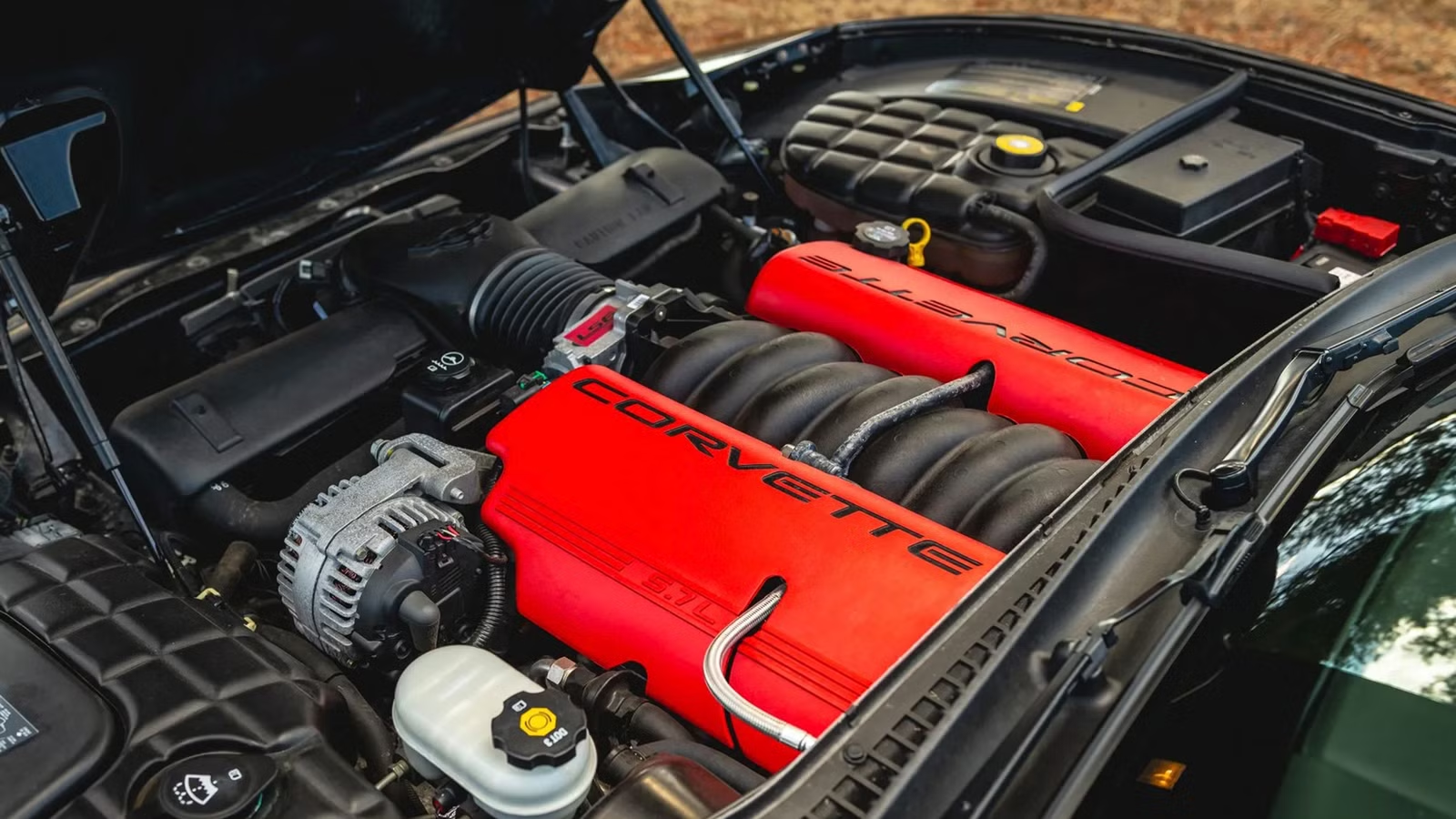
A lot of American V8s are big, heavy, and physically awkward to package. The LS is not. GM designed it in the late 1990s with a compact deep-skirt block and a relatively narrow bank angle, which means it fits into engine bays that were never designed for a V8, let alone this much power. That's the whole ballgame for swap culture: an engine that makes real power but doesn't need a car built around it.
The packaging numbers that matter:
- Roughly 24 inches long and around 26 inches wide depending on the specific LS variant, smaller than most inline-sixes people assume would fit better
- Aluminum block options (LS1, LS2, LS3, LS7, LS9) that weigh close to what a cast-iron four-cylinder weighs
- A front accessory drive that's been reworked into compact aftermarket kits specifically for swap applications
- Bellhousing patterns that bolt to a genuinely enormous range of transmissions, manual and automatic
That last point matters more than people give it credit for. A swap isn't just "will the engine fit," it's "can I actually get power to the wheels without machining custom parts for six months." LS engines solved that problem because so many other people had already solved it first and shared the answer.
It Makes Real Power Without Trying Very Hard
This is the part that turns skeptics into believers. A junkyard LS pulled from a wrecked pickup truck, with zero performance intent in its original design, will often make more naturally aspirated horsepower than a built four-cylinder that's been boosted, tuned, and fought with for two years. Stock LS1s were rated in the 305-350 horsepower range depending on year and application. LS3s pushed past 400. None of that required forced induction, exotic parts, or a specialist tuner flying in from out of state.
Why the power comes so easy:
- Pushrod design keeps the engine short and the valvetrain simple, which means less parasitic loss and fewer failure points than a comparable overhead cam V8
- Factory cylinder heads flow well enough that mild bolt-ons (cam, headers, intake) unlock real gains without touching the bottom end
- The bottom end itself is famously overbuilt for the power level GM originally rated it at, which is why people regularly turbo a stock short block to 600+ horsepower and it just... holds
Compare that to trying to extract 400+ reliable horsepower out of a stock four-cylinder or inline-six. You're usually deep into forced induction, built internals, and a tune that's walking a tightrope. With an LS, 400 horsepower is often just "buy the truck version, bolt some parts on."
💰 The Economic Case: Junkyards Made This Inevitable
Millions of Trucks Made This Engine Cheap
GM put LS-family engines in an enormous range of trucks and SUVs for roughly two decades: Silverados, Tahoes, Suburbans, Escalades, Sierras, and more, on top of every Camaro and Corvette that used the platform. That volume means LS engines flooded junkyards and salvage auctions for years, and a running, low-mileage 5.3L or 6.0L truck LS can often be had for a fraction of what a comparable import performance engine costs, sometimes under a thousand dollars depending on the market and condition.
Spota tip: if you're chasing down a build like this in person, a lot of the best junkyard and swap-parts finds get shared inside local car communities before they ever hit a public listing. Joining an active Club on Spota is a fast way to hear about an engine, a parts car, or a swap kit before it's gone.
That price gap is the entire foundation of swap culture. It's not that people love Chevy small blocks with some kind of brand devotion. It's that the math is obvious. Spend the same money on a built import engine and you might get half the power with none of the parts support. Spend it on a truck-pull LS and a swap kit, and you're making real numbers with a part that's been proven in millions of daily drivers already.
The Aftermarket Did the Rest
Once enough people started doing LS swaps, an entire industry grew up specifically to make the next one easier. Companies now sell purpose-built motor mounts, oil pans, headers, wiring harness adapters, and standalone ECMs for specific chassis: Miata, S13/S14 Nissans, BMW E30 and E36, Volvo wagons, Foxbody and SN95 Mustangs, and dozens more. Some of these kits are genuinely bolt-in.
What the aftermarket solved that used to be the hard part:
- Wiring: standalone harnesses and plug-and-play ECUs mean you no longer need to reverse-engineer GM's factory wiring diagram
- Mounts: chassis-specific mount kits exist for combinations nobody would have attempted 15 years ago
- Transmission adapters: bellhousing adapter plates let you keep a manual gearbox from the donor chassis or run a T56 six-speed behind the LS
- Documentation: forum threads, YouTube build series, and swap-specific Discord servers mean almost every question has already been answered by someone who did the exact swap before you
That last point is underrated. A first-time swap used to mean a lot of expensive trial and error. Now it means following a build thread from someone who already made the mistakes for you.
🌍 The Culture Case: Why Even the Haters Do It
It Crosses Every Tribal Line in Car Culture
Car culture is famously tribal. JDM people talk trash about domestic muscle. European car people talk trash about both. Import versus domestic used to be one of the sturdiest divides in the whole hobby. The LS swap is one of the only things that consistently crosses every one of those lines without anyone feeling like they betrayed their side.
An RX-7 owner who LS swaps their car isn't rejecting rotary culture, they're usually a rotary purist who got tired of rebuilding apex seals every 40,000 miles and wanted something that would survive a road trip (read more on that specific tradeoff in our piece on why rotary engines are so beloved despite being so unreliable). A Miata owner who LS swaps their car usually still loves the chassis, they just wanted the power-to-weight ratio a stock 1.8-liter was never going to give them. The engine bay changes, the identity of the car doesn't.
Common LS swap platforms and why people pick them:
- Mazda RX-7 / RX-8: keeps the chassis balance, ditches the rotary maintenance schedule
- Mazda Miata: turns a fun lightweight roadster into a genuinely fast one with minimal weight penalty
- Nissan S-chassis (240SX/Silvia): drift community favorite for cheap, reliable, high-power builds
- BMW E30/E36: European chassis feel with American reliability and parts cost
- Volvo wagons (240, 740, 940): the internet's favorite joke build that turns out to actually work incredibly well
- Foxbody/SN95 Mustang: sometimes an LS swap into a Mustang that originally had a Ford small block, purely for the power and reliability gap
It Became a Meme Because It Kept Being True
"LS swap it" became a running joke specifically because it was the correct answer often enough that people started saying it reflexively, as a bit, even when it obviously wasn't the actual plan for that build. That's a specific kind of internet meme: the ones that survive are the ones grounded in something real. Nobody makes a lasting joke out of bad advice.
The joke also captures something true about car culture generally: enthusiasts respect solved problems. An LS swap isn't creative in the way a wild turbo four-cylinder build is. It's not the "purist" answer for most chassis. But it works, it's documented, it's affordable, and it's reliable enough to actually drive instead of trailer to every meet. There's a reason "reliable enough to daily" carries real weight in this hobby: a build you can't drive isn't really a build yet, it's a project. That tension between purism and practicality shows up constantly. It's the same instinct behind why guys keep buying Hellcats despite the reliability reality, and it's a big part of why manual transmissions refuse to die even as the market pushes automatics: car people will absorb real tradeoffs for a build that actually matches what they wanted, on purpose, with eyes open.
🚧 What the LS Swap Actually Costs You
It's not free, and it's worth being honest about the tradeoffs, because "just LS swap it" undersells the actual project.
Real costs and complications people run into:
- Weight distribution changes on lighter chassis like the Miata, and it needs to be accounted for with suspension and brake upgrades to actually handle the added power
- Cooling setups often need to be redone, since factory radiators and fan shrouds weren't designed around this engine or this bay
- Fuel system upgrades are frequently required, factory fuel delivery on a lightweight chassis usually can't support LS-level power without modification
- Insurance and registration can get complicated depending on state emissions and modification disclosure rules, especially in states with strict smog requirements
- Resale value is a real question mark. An LS swapped car appeals to a specific buyer, and it can actually shrink your buyer pool compared to a clean, stock example of the same chassis
None of that erases the case for doing it. It just means "universal answer" doesn't mean "free lunch." The people who do this well treat it as a real build, budget accordingly, and don't cut corners on the parts of the car that now have to handle two or three times the original power output.
🏁 The Real Reason It Won
Strip away the memes and the tribal car culture rivalry, and the LS swap phenomenon comes down to something simple: it's the rare case where the cheap option and the good option are the same option. Usually in this hobby you pick one. With an LS, a junkyard engine, a proven swap kit, and a weekend with a lift gets you power numbers that would otherwise require years of tuning and thousands more dollars chasing a different platform.
That's not marketing, that's not brand loyalty, and it's definitely not because Chevy small blocks are the most exotic or interesting engine architecture on paper. It's because enough people ran the actual math, on enough different chassis, enough times, and it kept coming out the same way. When an entire hobby full of people who disagree about almost everything else agrees on one answer, that answer usually earned it.
If your build's engine bay is currently empty and you're staring at spreadsheets trying to talk yourself out of the obvious move: you already know what the internet's going to tell you.