
🌬️ You Know The Sound Before You Know What It Means
Every car person has the same core memory. A modified car rolls up to a stoplight, lets off the throttle, and out comes that sharp, hissing pssshhhh. Heads turn. Someone nods like they just heard a secret handshake. Nobody in that parking lot could explain what actually made the noise, but everyone agreed it sounded fast.
That sound has a name (blow-off valve, or BOV if you're not trying to sound like a beginner) and a real mechanical reason for existing. It is also, depending on the car making it, sometimes completely fake. Not "exaggerated." Fake. As in a speaker wired into the trunk playing an MP3 of a BOV because the driver's actual turbo setup can't make that noise on its own.
This is one of those topics that splits car culture right down the middle. Half the community treats the BOV hiss as the single most satisfying sound a modified car can make. The other half treats it as the loudest possible signal that someone doesn't know what their car is actually doing under the hood. Both sides are right about different things, and untangling why takes an actual look at how forced induction works, not just vibes.
Spota tip: if you've got a build with a legitimately loud BOV, that's exactly the kind of detail worth documenting in your car's Garage timeline. Sound clips and dyno sheets tell a more convincing story than a caption ever will.
🔧 What A Blow-Off Valve Actually Does
Start with the boring but important part: a turbocharger is a compressor. It spins a turbine using exhaust gas, and that turbine is on the same shaft as a compressor wheel that crams extra air into your intake. More air (plus more fuel to match it) equals more power. That's the entire pitch of forced induction in one sentence.
The problem shows up the instant you lift off the throttle. Say you're accelerating hard, the turbo is spun up and shoving pressurized air through the intake piping, and then you suddenly close the throttle body to shift gears or slow down. That compressed air has nowhere to go. It slams into the now-closed throttle plate and bounces back down the intake tract, straight into the still-spinning compressor wheel.
That reverse airflow does two bad things. It creates a pressure spike called compressor surge, which sounds and feels like the turbo "coughing," and over time it puts real mechanical stress on the compressor wheel and the turbo's thrust bearing. Do that enough times and you're shortening the life of an expensive part.
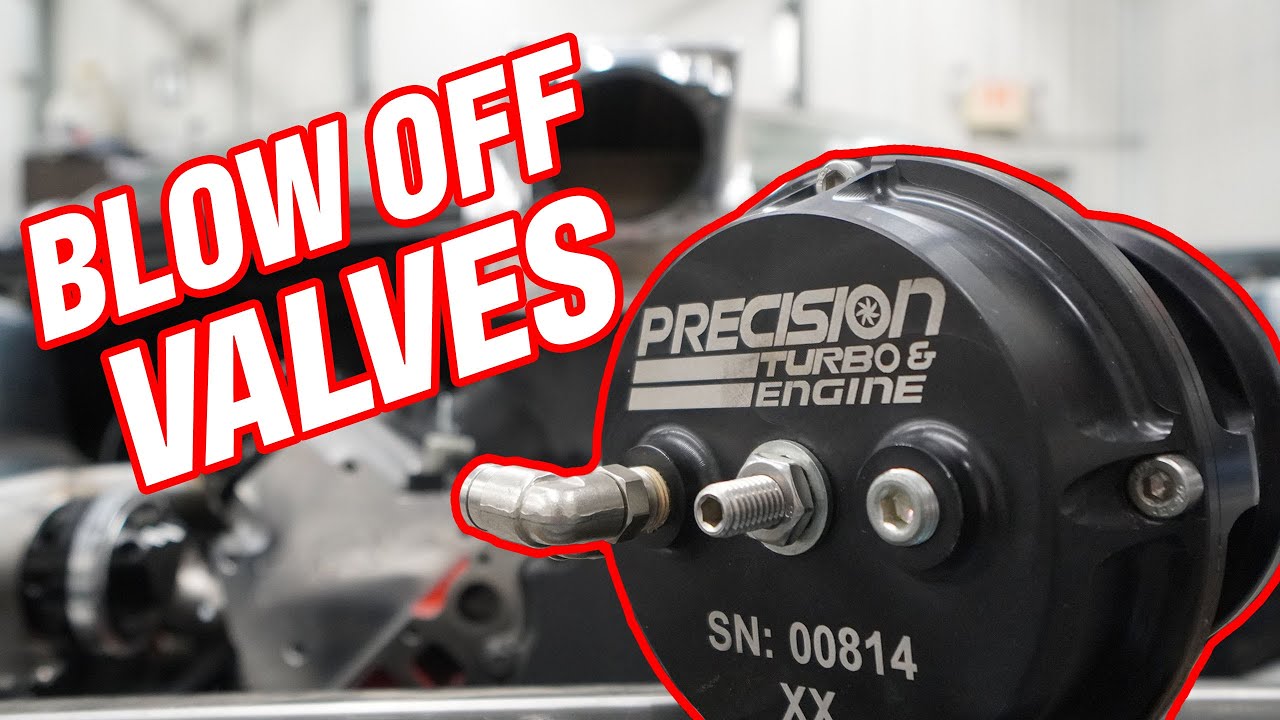
A blow-off valve (sometimes called a bypass valve or diverter valve depending on where the vented air goes) solves this with a simple pressure-release mechanism. It sits on the intake piping between the turbo and the throttle body. When the throttle snaps shut and pressure spikes, the valve opens for a fraction of a second and vents that trapped air somewhere else, protecting the turbo and the compressor wheel from that backward shock.
Where the air goes after that is the entire reason two turbo cars with the same setup can sound completely different.
🔊 Atmospheric vs Recirculating: The Whole Sound Debate In Two Words
This is the actual technical split that explains 90% of the internet arguments about BOV sound.
Atmospheric blow-off valves vent the pressurized air straight out into the open engine bay, dumping it to atmosphere. That sudden release of high-pressure air rushing through a narrow valve opening is what makes the classic hiss, chirp, or "pssshhhh" you hear in every car meet video. It's genuinely just physics: compressed gas escaping fast makes noise, the same reason an air compressor line makes that sharp hiss when you disconnect a tool.
Recirculating blow-off valves (also called diverter valves) route that same pressurized air back into the intake tract, upstream of the turbo's compressor inlet, instead of dumping it out into open air. Mechanically it does the exact same job protecting the turbo from surge, but because the air stays contained inside the piping instead of shooting out into open space, it makes almost no audible sound. Maybe a soft "psh" if you're standing right next to the engine with the hood open, nothing you'd hear from the driver's seat, let alone from across a parking lot.
Here's the part that surprises people who are new to this: virtually every modern factory turbocharged car uses a recirculating setup. Your buddy's stock WRX, that turbo Civic Si, basically any daily-driver turbo car built in the last fifteen years, all recirculating, all essentially silent by design. That's not a coincidence. It's deliberate engineering, and the reasons matter more than most people realize.
🏭 Why Automakers Deliberately Kill The Sound
If the hiss is genuinely just physics, why would every manufacturer engineer it out on purpose? Three real reasons, and none of them are "because it's not cool enough."
- Mass airflow sensor accuracy. Modern fuel injection relies on a mass airflow sensor (MAF) positioned before the throttle body to measure exactly how much air is entering the engine, which the ECU uses to calculate the correct fuel mixture. On a MAF-equipped car, air that gets dumped to atmosphere through an atmospheric BOV has already been measured by the sensor but never actually makes it into the combustion chamber. The ECU thinks more air went in than actually did, which can throw the fuel trim off and, in bad cases, trigger a check engine light or a rough idle. Recirculating the air back upstream of the MAF (or after it, depending on the setup) keeps the accounting correct.
- Emissions compliance. Atmospheric venting releases unmetered, sometimes partially fuel-mixed air straight into the atmosphere, which complicates emissions certification. Recirculating keeps everything inside the closed system, which is exactly what emissions testing wants to see.
- Efficiency. That vented air already cost fuel and turbo work to compress. Dumping it to atmosphere is just wasted energy. Feeding it back into the intake keeps at least some of that work useful.
None of that is exciting to talk about at a meet, which is exactly why it rarely comes up. The unglamorous engineering reason is also the correct one.
🎭 So Where Does The Fake Sound Come In
This is where things get genuinely contentious, and it's worth being precise about the different flavors of "fake" because they're not all equally bad.
Aftermarket atmospheric BOV swap. This is the most common and most legitimate version. Someone with a factory recirculating turbo setup swaps in an aftermarket atmospheric blow-off valve specifically to get the hiss. This is a real mechanical change, real compressed air, real physics making a real sound. The catch: on a MAF-equipped car, this can genuinely hurt drivability if it's not tuned around properly, since you're now dumping metered air the ECU thinks is still coming. Plenty of tuners will tell you straight up that an atmospheric BOV on a MAF car without a supporting tune is a rough idea. It's not fake, but it's not free either.
Blow-off valve simulators. These are small electronic boxes, sometimes called "fake turbo sound" or "BOV sound simulator" units, that plug into a car's vacuum line or throttle position sensor and trigger a small speaker to play a BOV-style hiss sound at the right moment, engineered to sync roughly with a throttle lift. Some of these exist as standalone aftermarket parts specifically marketed for four-cylinder econoboxes that don't even have a turbo, which tells you everything about how much status got wrapped up in this one sound.
Full sound systems and infotainment fakery. A handful of manufacturers actually pipe synthesized engine and turbo sounds through the car's own speakers as part of the factory "sport mode" experience, blending real engine noise with amplified or synthetic layers. This isn't some shady aftermarket trick, it's literally built into the car by the manufacturer, and it's a genuinely divisive topic among car people for the same reason: is the sound you're hearing actually happening under the hood, or is it theater?
The community reaction to all three is not equal. Atmospheric BOV swaps get accepted as a legitimate mod, even by people who think it's unnecessary. Simulator boxes get mocked relentlessly the moment they're discovered, because the entire point of the sound is signaling that your turbo is doing real work, and a box wired to a speaker breaks that signal completely. Factory-piped sound gets a more complicated reaction, somewhere between "that's kind of lame" and "every performance car with a turbo does some version of this now, get over it."
🕵️ How To Actually Tell The Difference
If you want to know whether a hiss is real, here's what actually separates them, no guessing required:
- Timing consistency. A real atmospheric BOV only makes noise when there's actually boost pressure built up to vent, meaning it stays silent at low RPM and light throttle, and gets louder and more frequent the harder the car was driven right before the lift. A simulator often fires on a fixed pattern tied to throttle position alone, so it can "hiss" even when there's clearly no boost built up yet, like right off idle.
- Location of the sound. Real BOV hiss originates from the engine bay, specifically wherever the valve is mounted on the intake piping. Simulator sounds come from wherever the speaker is hidden, which is sometimes tucked somewhere that doesn't quite match where you'd expect actual air to be venting from.
- Correlation with actual power. A genuinely built turbo car making real boost and a real atmospheric BOV hiss should also come with the other signs of a serious setup: an aftermarket intake, supporting mods, a tune, actual pull when you're behind it. A four-cylinder commuter car with a suspiciously loud, suspiciously well-timed hiss and no other performance mods anywhere is the single most common red flag in the entire car meet ecosystem.
- The idle test. This one's blunt but effective. Turbos need boost pressure to trigger a real BOV, so at a dead stop with the engine idling, a real BOV makes zero noise no matter how many times you blip the throttle unless you're actually building boost first. A simulator triggered off throttle position alone will often hiss on a simple throttle blip at idle, boost or no boost.
⚖️ Why This Debate Isn't Actually About The Sound
Step back from the mechanics for a second, because the real reason this argument never dies has nothing to do with acoustics. The BOV hiss became a status symbol because it used to reliably mean something: this car has a turbo, that turbo is making real boost, and someone spent real money and real time building it out. It was audible proof of work.
Once fake versions entered the picture, that signal got noisy in every sense of the word. Now the sound alone proves nothing, which is exactly why the car community reacts so strongly when a fake one gets caught out. It's not really about disliking the noise. It's about a shortcut being taken around something that used to require actually doing the thing.
That's also why real builders tend to be pretty relaxed about aftermarket atmospheric BOVs even when they know it's partly for the sound. If the car's actually boosted and actually tuned around it, the hiss is a genuine byproduct of genuine work, same as it always was. It's the simulator boxes and the try-hard shortcuts that get the community's collective eye roll, because they're trying to borrow a reputation without doing anything to earn it.
If you're building a turbo car and trying to decide whether to go atmospheric, recirculating, or leave the factory setup alone entirely, that decision belongs in the same category as every other mod choice: pick it because it fits what you actually want the car to do, get a proper tune if you're changing how it manages boost, and let the sound be a side effect of the build instead of the entire point of it. That's the version of this mod that actually holds up under scrutiny, and it's the only version that will still sound good a year from now instead of just sounding loud today.
Related reading: check out our breakdown on why turbo cars need a cool-down period for more on what's actually happening to your turbo between drives, or browse the full under-the-hood category for more culture-meets-mechanics breakdowns like this one.