
🔩 The Mod Everyone Wants, Then Second-Guesses
Ask any car guy what's next on the mod list and coilovers come up fast. Not springs, not a cheap lowering kit, coilovers. Adjustable ride height, adjustable damping, that dropped stance that makes a stock car look like it's still wearing its factory shoes. It's the mod that photographs the best and gets the most comments at a meet.
Then six months later, half the people who installed them are quietly cranking the ride height back up, complaining about clunks over speed bumps, or explaining to a mechanic why their car sounds like a shopping cart full of loose change. Nobody warns you about that part before you buy.
Coilovers aren't a bad mod. They're one of the most misunderstood ones. The gap between what people expect and what they actually get is where most of the regret lives, and almost none of it gets talked about honestly in the group chats where everyone's hyping the next set of KWs or BCs.
This is the full picture: what coilovers actually do, why they feel incredible on day one, why that feeling fades for a lot of daily drivers, and how to buy a set you won't be apologizing for a year from now.
⚙️ What a Coilover Actually Is
A stock suspension setup is a shock absorber and a spring as two separate, fixed components, tuned by an engineer whose entire job was making the ride livable for the widest range of drivers and road conditions possible. Nothing about it is adjustable. It is what it is until something wears out.
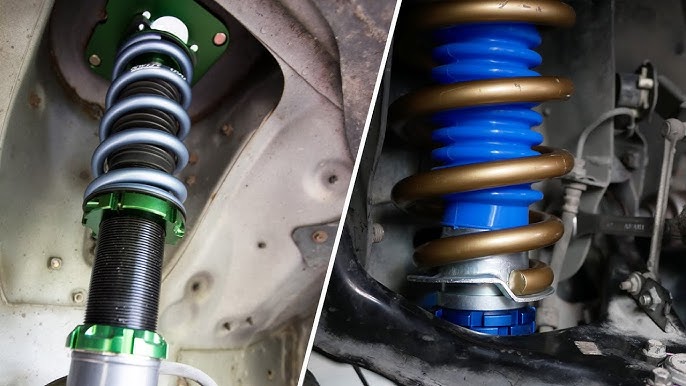
A coilover collapses that into one assembly: the spring is coiled directly around the shock body (hence the name), sitting on a threaded perch that lets you spin the ride height up or down. Better sets add adjustable damping, meaning you can dial in how stiff or soft the shock reacts to bumps, sometimes with separate knobs for compression and rebound.
That's the appeal in one sentence: a stock suspension gives you one setup, forever. A coilover gives you a range, and lets you pick where in that range your car lives.
What coilovers change:
- Ride height: how low the car sits, adjustable independently at each corner
- Spring rate: most aftermarket coilovers use a stiffer spring than factory, sometimes dramatically stiffer
- Damping: how the shock controls the spring's movement, adjustable on mid-tier and higher sets
- Corner balance: the ability to set each corner's height individually, which matters more for track alignment than most street guys realize
None of that is a lie. Coilovers genuinely do all of it. The problem is what the spec sheet doesn't tell you about living with the result.
📉 Why the First Drive Feels Like a Revelation
There's a reason coilovers have such a devoted fanbase, and it's not just the look. The first drive on a fresh set of coilovers, especially coming off worn factory struts, feels transformative. Body roll that used to make you nervous in an on-ramp disappears. The car turns in sharper. Bumps that used to feel vague and floaty now feel controlled and precise.
Some of that is the coilovers doing exactly what they're built to do: less body roll, tighter damping, a lower center of gravity from the drop in ride height. Real, measurable improvements in how the car handles a corner.
But some of it is also just contrast. A worn factory strut with 80,000 miles on it feels mushy compared to almost anything new, coilover or not. A lot of people mistake "this feels way better than my old, tired shocks" for "this is objectively the correct suspension for my car," and those aren't the same thing.
That distinction matters, because it's the setup for what comes next.
🦴 The Part Nobody Puts In The Review
Stiffer springs and tighter damping don't just improve handling. They also transmit more of the road directly into the chassis, and from the chassis into you. Every expansion joint, every pothole, every bit of broken pavement that a stock suspension quietly absorbs now gets felt, sometimes sharply, through the seat and the steering wheel.
For a car that lives at the track or gets driven hard on canyon roads on the weekend, that tradeoff is the entire point. You're buying control, and you're willing to pay for it in comfort. That's a completely rational trade for that use case.
For a car that's also someone's daily driver, commuting on the same beat-up city streets and highway expansion joints every single day, that tradeoff turns into fatigue fast. What felt sporty in month one starts feeling exhausting in month six. Long drives get tiring. Passengers start complaining. The lower back starts filing complaints of its own.
This is the single biggest reason people quietly raise their ride height back up or swap to a softer spring rate a year in. Not because coilovers are bad, but because they bought a track-oriented setup for a daily-driver life and didn't realize the two demand different things.
Spota tip: if you're chasing the dropped look for photos more than the performance for lap times, dial the ride height down for the shoot and back up for the drive home. A Garage timeline that tracks every height and spring change is a much better record of "what actually worked" than trying to remember it six months later.
💸 The Maintenance Bill Coilovers Don't Advertise
Lower, stiffer suspension doesn't just change how the car rides. It changes how fast parts wear out.
- Bushings take more abuse. Control arm and sway bar bushings that were engineered around factory spring rates and travel now deal with sharper, more frequent loads. They wear faster, and a worn bushing turns into a clunk over every bump.
- Alignment drifts more. Aggressive camber and toe settings, especially the kind people run for a stanced look, wear tires unevenly and fast. A set of tires that should last 40,000 miles can be gone in a third of that.
- Extreme lowering hits more than it should. Speed bumps, steep driveways, parking lot lips, all of them become obstacles instead of non-events. Scraped bumpers and cracked splitters are a real cost, not a meme.
- Cheap coilovers fail cheap. A budget set with a mono-tube shock that isn't rebuildable will eventually blow, and when it does you're buying the whole corner again instead of a rebuild kit. A mid-tier or higher set with rebuildable shocks costs more up front and less over five years.
None of this means don't buy coilovers. It means budget for what comes after the purchase, not just the purchase.
🏁 How To Actually Buy A Set You Won't Regret
The car guys who love their coilovers years later almost always did one thing differently at the start: they bought for how the car is actually driven, not for how they wanted it to look in one Instagram post.
- Be honest about the car's job. Daily driver first, weekend fun second? Buy a comfort-leaning set with a moderate spring rate and don't chase the lowest possible stance. Track car first, street-driven occasionally? Go stiffer, and accept the tradeoff going in instead of discovering it later.
- Buy adjustable damping if the budget allows it. The ability to soften the ride for a long highway trip and stiffen it for a track day solves most of the regret before it starts. A fixed, non-adjustable cheap set locks you into one compromise forever.
- Don't max out the ride height drop. The lowest setting on a coilover is rarely the setting you should actually run on the street. A moderate drop keeps the geometry closer to what the suspension was engineered around, which means less binding, less bushing wear, and a ride that doesn't beat you up.
- Get a proper alignment after install, every time. Coilovers change camber, caster, and toe the moment they go in. Skipping the alignment is how you turn a $1,000+ mod into a $400 set of tires gone in 15,000 miles.
- Rebuildable beats disposable. Brands that sell rebuild kits and offer valving services mean the set can be serviced and re-tuned for years instead of replaced outright when a shock finally wears out.
🛞 The Bottom Line
Coilovers aren't overhyped. What they do, they genuinely do well: sharper handling, a lower stance, a setup you can actually tune instead of just living with. The regret doesn't come from the mod being bad. It comes from buying the track version of a decision when you actually needed the daily-driver version, or ignoring the maintenance that comes with lowering a car in the first place.
Buy for the car you actually drive, not the one in your head, and coilovers stay exactly what they're supposed to be: the mod that made the car feel like yours. Get the fit wrong, and it's the mod you're quietly undoing a year later.
Track your setup and every change you make in your Garage so future-you remembers what actually worked, and if you're deciding between coilovers and a simpler lowering spring first, the tradeoffs in our wheel fitment breakdown cover a lot of the same ground.
Buy it for the drive you actually have, not the one in your head.