
🔘 The Button Every Car Guy Wants
Picture this. You're pulling out of your neighborhood at 7am, quiet as a library, cat intact, neighbors asleep. Twenty minutes later you're on an empty back road with nobody around, you tap a button on your key fob or your phone, and your car suddenly sounds like it just got let off a leash. No wrench required. No trip to the shop. Just a valve opening somewhere under the car and rerouting the exhaust straight past the muffler.
That's the entire pitch behind an electronic exhaust cutout, and it's why the mod has quietly become one of the most-installed upgrades in car culture over the last few years. It solves a problem car guys have complained about since the invention of the aftermarket exhaust: you either build your car loud and deal with the drone on every commute and every cop who gives you a second look, or you keep it quiet and never get to hear what it's actually capable of. The cutout says you don't have to choose.
It sounds almost too simple. A valve, a motor, a switch. But the story of how that simple idea went from a fringe race-car part to a $300 Amazon add-on says a lot about how car culture spreads a mod, and it also explains why so many of the same people installing cutouts right now are the ones who'll be pulled over for it later.
🏎️ Where Cutouts Actually Came From
Exhaust cutouts aren't new. They go back to actual racing, where a "cutout" originally meant something closer to what the name implies: a section of exhaust pipe with a removable cap or plate, bolted on to satisfy street-legal noise rules and physically unbolted at the track to dump exhaust straight to atmosphere before it ever reaches the muffler. Drag racers have used this trick for decades. Take the cap off, lose the muffler's backpressure, gain a little top-end power, drive home quiet with it capped back on.
That manual version required tools, a jack, and a reason to be underneath your car. It stayed a niche, dedicated-race-car thing for a long time because most people weren't willing to do that dance every time they wanted to hear their car open up.
The shift happened when electric actuators got cheap and reliable enough to put a servo-controlled valve inline with the exhaust itself, wired to a switch inside the car (or later, a phone app and a remote). Suddenly you didn't need to crawl under the car. You just pushed a button, an electric motor rotated a butterfly valve inside the pipe, and exhaust gas either routed through the muffler like normal or bypassed it entirely. High-end manufacturers like Ferrari, Corvette, and Porsche started building factory versions of exactly this into performance trims: a "quiet mode" and a "track mode" baked right into the exhaust system from the factory.
Once car guys saw that OEMs were doing it, the aftermarket did what the aftermarket always does. It figured out how to sell the same idea for a tenth of the price.
🔧 What's Actually Happening Under the Car
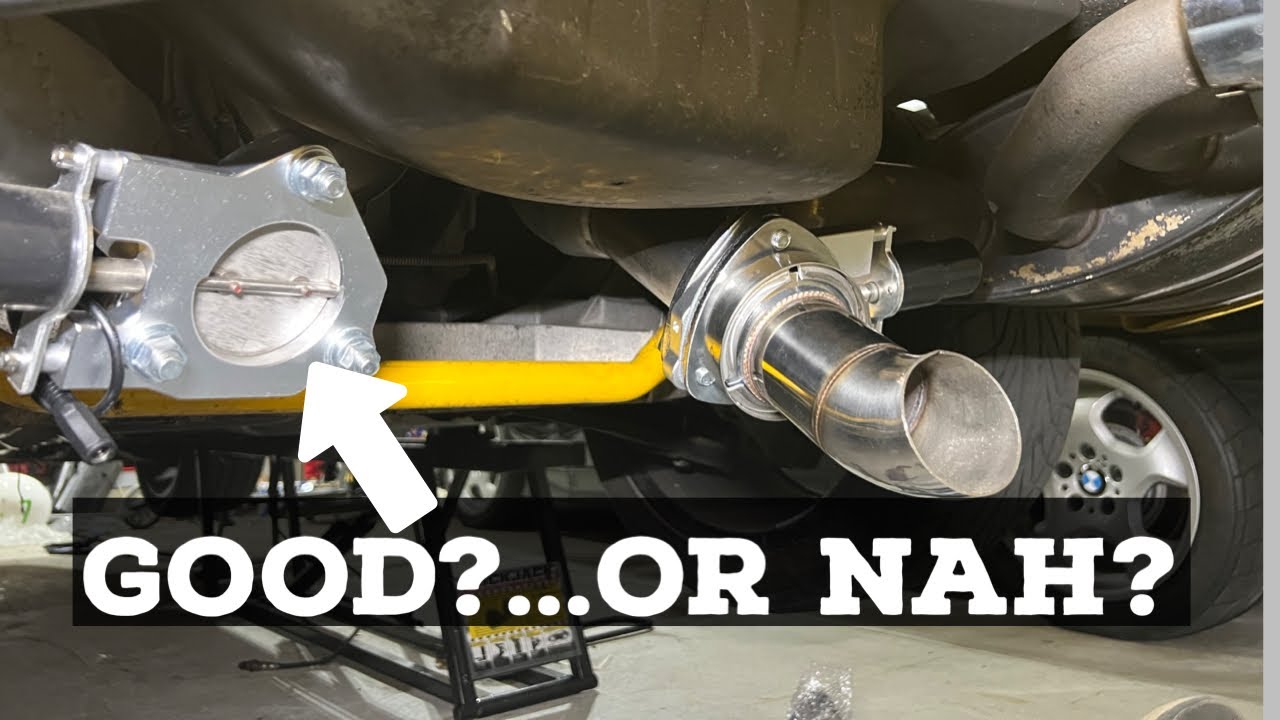
Here's the mechanism, stripped down. A standard cutout kit is a Y-section that gets welded or clamped into your exhaust piping, usually right before the muffler or resonator. Inside that Y-section sits a valve, most commonly a butterfly-style flap on a rotating shaft, driven by a small electric motor. In the closed position, exhaust gas is forced through the normal path: through the muffler, through whatever resonators are in the system, out the tip, quiet like stock. In the open position, the valve rotates and exhaust gas takes the path of least resistance straight out through the cutout section, completely bypassing the muffler.
That's it. That's the whole trick. You're not changing the engine, you're not changing the piping diameter for most of the run, you're just giving the exhaust gas a shortcut around the one component in the system whose entire job is to make things quiet.
A few things follow directly from that:
- The gain is real, but it's specific. Bypassing a muffler reduces backpressure, and reduced backpressure on a modern engine can free up a small but real amount of horsepower, usually in the single digits to low double digits depending on how restrictive the stock muffler was. It's not nothing, but it's not the 30-horsepower fantasy some sellers imply either.
- The sound change is dramatic. This is the actual point for most buyers. A muffler is specifically engineered to cancel sound waves through internal baffling or packing material. Remove that from the exhaust path entirely and the raw, unfiltered exhaust note comes through. It's the difference between a car and a much louder, much angrier version of the same car, on demand.
- It's genuinely reversible in a way most sound mods aren't. Close the valve and you're back to whatever quiet you had before, no unbolting, no swap.
That third point is the whole reason this mod exploded. Every other loud-exhaust mod is a binary choice you commit to every single time you turn the key. A cutout lets you have both, and car guys have wanted "have both" for exhaust sound since the first person ever got a noise complaint.
💸 Why the Price Dropped and the Install Exploded
Ten years ago, an electronic cutout system from a name-brand manufacturer ran well over a thousand dollars, sometimes closer to two thousand once you included installation. That kept it in enthusiast-only territory, mostly on cars that already had serious performance exhaust work done.
Now you can find generic 2.5-inch or 3-inch cutout kits for under $200, complete with the valve, a wireless remote, and mounting hardware, and a shop will weld one in for another couple hundred bucks. That price collapse did to exhaust cutouts what cheap turbo timers and boost gauges did to their respective categories: it moved the mod from "serious build" territory into "reasonable weekend project for basically anyone with a modified exhaust" territory.
It also helped that the install got dramatically easier to document and copy. Every generation of car culture learns its mods from watching someone else do it, and once a few high-view YouTube installs and TikTok "before and after" clips showed how straightforward a cutout install actually is (cut a section of pipe, weld or clamp in the Y-piece, run a wire to a switch, done in an afternoon), the barrier to entry basically disappeared. If you can already imagine what your exhaust sounds like without a muffler, you can now buy that exact sound on demand for less than a tank of race gas costs at some tracks.
Spota tip: if you're documenting a cutout install in your Garage, log the before-and-after dB difference if you've got a meter handy. It's one of the more satisfying "spec" entries you can add to a build timeline, right up there with dyno numbers.
🚨 The Legal Reality Nobody Reads Before Buying
Here's where the story gets less fun. Almost every US state has some version of an exhaust noise law, whether it's a strict decibel limit measured at idle or a set distance, or a vaguer "no modification that increases noise beyond stock" standard, or an outright ban on any exhaust component designed to bypass emissions or noise-control equipment. An electronic cutout that dumps exhaust gas around the muffler is, by design, exactly the kind of device those laws were written to catch.
A few realities worth knowing before you install one:
- "It's got a remote so I can turn it off" is not a legal defense. In most jurisdictions, having the capability to make the car exceed the legal noise limit, whether or not it's currently switched on, is what gets flagged. An officer who hears a valve open (or notices the hardware during a stop) doesn't need to catch you mid-blast to write the ticket in some states.
- Cutouts that route exhaust around the catalytic converter, not just the muffler, are federally illegal for on-road use, full stop. This is a distinct issue from noise. The EPA treats any device that bypasses emissions equipment on a street-driven vehicle as a defeat device, and that carries real fines. Most reputable cutout kits are installed after the cat, specifically to avoid this, but plenty of cheap kits get installed wherever's easiest, cat position included, without the buyer realizing the legal line they just crossed.
- Insurance can get complicated. A car with an undisclosed exhaust modification, especially one flagged in a police report after an incident, can give an insurer grounds to dispute a claim. It's one more reason to actually understand what you're bolting on, not just what it sounds like on YouTube.
None of this means don't do it. It means know exactly where the valve sits in your exhaust system, keep it closed in areas where you'll get flagged, and don't be the reason your local track day host has to add another line to the noise waiver.
For more on how car culture's relationship with law enforcement actually plays out at meets and on the road, why car meets get shut down by cops covers the broader pattern this fits into.
🎭 Why This Mod Says Something About Car Culture Itself
Step back from the hardware for a second and the popularity of the exhaust cutout tells you something bigger about what modern car guys actually want. It's not just "loud car." It's control. It's the ability to be invisible when you need to be and impossible to ignore when you want to be, switched with a thumb.
That instinct shows up everywhere in current car culture, not just in exhausts. Adjustable coilovers exist so you can be comfortable on the highway and stiff on a canyon road. Selectable drive modes exist so the same car can be a commuter and a track toy depending on a dial. Tunable ECUs exist so you can run pump gas on a road trip and race fuel at the strip. The cutout is just the loudest, most literal version of a trend that's been building in car culture for years: the modern enthusiast doesn't want to pick a lane, they want a car that can be two completely different personalities depending on the situation.
It also fits neatly into car culture's long-running obsession with sound as identity, the same instinct that made huge exhaust tips a meme in the first place. The difference is that a fake tip changes nothing and a cutout changes everything about how the exhaust actually flows. It's the rare mod that delivers on the theater it promises, which is probably the real reason it caught on as fast as it did.
🔍 Should You Actually Install One?
If you're on the fence, the honest breakdown looks like this. A cutout makes the most sense if you already have a performance exhaust system with real piping diameter behind it, meaning there's an actual power gain available when you bypass the muffler, not just a stock 2-inch pipe getting a louder exit for no reason. It makes the most sense if you have genuine access to roads or tracks where running it open isn't going to get you a ticket or a neighbor's noise complaint. And it makes the most sense if you're honest with yourself about running it closed the other 95% of the time, because the whole value proposition collapses if you're just using it as a permanently-open loud exhaust with extra steps.
If none of that applies, and you just want a louder daily driver, you're probably better served by a simpler muffler swap you actually commit to, at a fraction of the wiring and legal risk.
Either way, it's one of the more interesting mods to hit the mainstream in years: cheap enough for almost anyone, simple enough to understand in thirty seconds, and dramatic enough that it's not going anywhere. Just know which law you're bending before you push the button.