
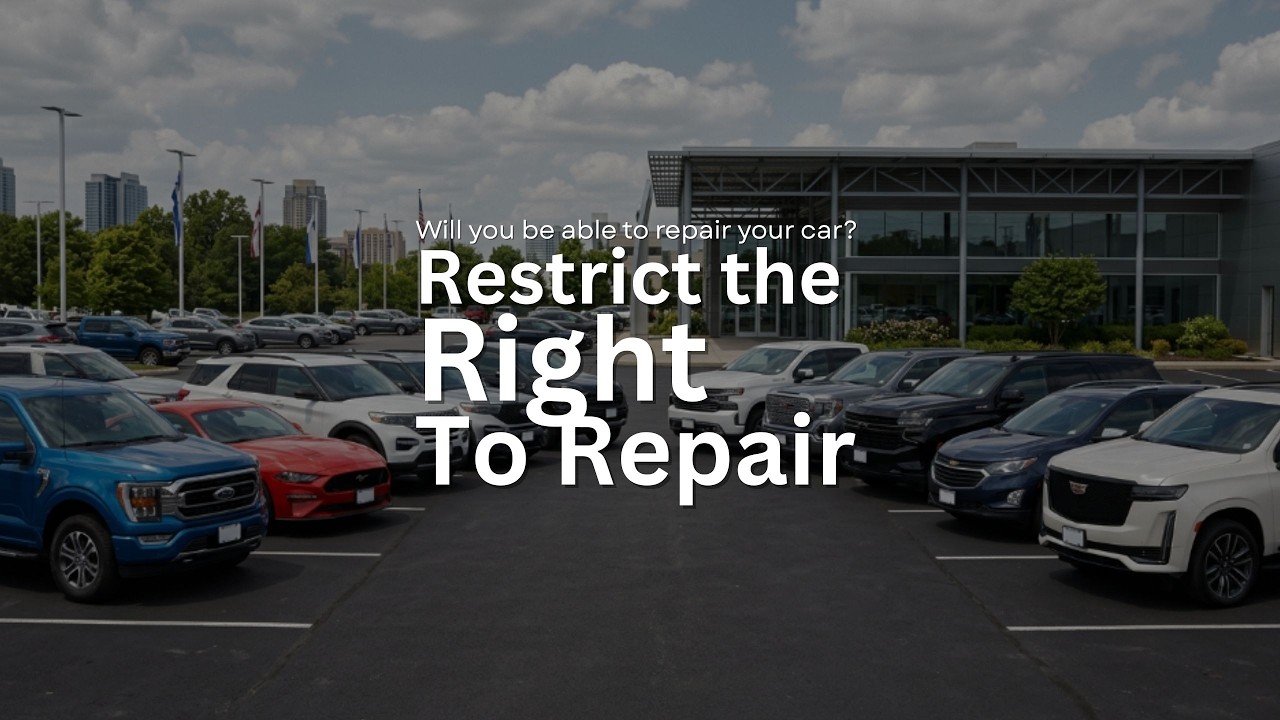
🔐 The Wrench You Can't Legally Use Anymore
Pop the hood on a car built before, say, 2010, and a decent mechanic with a code reader and a Haynes manual could diagnose almost anything wrong with it. Pop the hood on plenty of cars built today and the diagnostic computer that actually knows what's wrong lives behind a login screen your local shop doesn't have access to.
That's not an exaggeration. It's the entire fight.
"Right to repair" used to be a phrase for tractors and iPhones. Farmers fighting John Deere over locked-down combines, or people fighting Apple over glued-in batteries. Somewhere in the last few years, it became one of the biggest legal and legislative battles in the entire car industry, and most car owners have no idea it's happening until the day their check engine light comes on and their usual mechanic tells them, "sorry, you have to take this one to the dealer."
For a hobby built on the idea that you own your car, wrench on it, tune it, and make it yours, that should sting a lot more than it currently does. So let's break down what's actually happening, who's fighting who, and why this matters way more to modified car owners than the average commuter.
🛠️ What "Right to Repair" Actually Means
At its core, right to repair is simple: the idea that when you buy something, you should be able to fix it yourself or take it to whoever you want, using the same tools, parts, and information the manufacturer's own network gets.
For cars specifically, that breaks down into a few concrete things people are actually fighting over:
- Diagnostic data access: the ability for independent shops (not just factory dealers) to read the same error codes, sensor data, and telematics that a dealership technician sees
- Repair manuals and procedures: official documentation for how to actually fix something, not just what's broken
- Special tools and software: the same scan tools, programming interfaces, and calibration software the dealer network uses
- Parts access: genuine or compatible replacement parts without artificial restrictions
- The right to modify: whether the manufacturer can legally lock out aftermarket parts and tunes through software, even after you own the car outright
None of this is new in spirit. Owners have always wanted the option to go to an independent shop instead of paying dealer labor rates. What's changed is how modern cars make that decision for you before you even get a say.
💻 How Cars Quietly Became Impossible to Fix Yourself
The shift didn't happen with one dramatic announcement. It happened gradually, as cars turned into rolling computers.
Twenty years ago, a car's computer controlled the engine and maybe the transmission. Today's cars run dozens of interconnected control modules for everything from the brakes to the seat heaters, all of it wrapped in proprietary software that reports data back to the manufacturer over a cellular connection. That's telematics, and it's the center of this entire fight.
Here's the practical problem it creates. When something goes wrong, the car's own systems often know exactly what happened first, sometimes before a warning light even comes on. That data gets streamed straight to the manufacturer. Your independent mechanic, the one who's worked on your family's cars for twenty years? He doesn't get a copy. Only the dealer network does, because the automaker built the pipeline that way.
Then there's parts pairing, a practice that's crept into more and more vehicles: certain replacement parts (some infotainment modules, some ADAS cameras, in a few documented cases even simple parts like window switches) have to be electronically "paired" to the car's computer using manufacturer software before they'll work. An independent shop can install the correct OEM part perfectly and the car will still refuse to recognize it, because the software handshake never happened. That's not a repair problem anymore. That's a permissions problem.
And for modified cars specifically, there's a third layer: software locks on the ECU itself. Some newer platforms actively detect and resist unauthorized tunes, flag warranty claims when aftermarket parts are detected through onboard monitoring, or require an internet-connected manufacturer login just to clear a code after a repair. The car isn't just harder to fix. It's designed to know when you've touched it.
⚖️ The Legal Fight That's Actually Happening
This isn't a hypothetical culture-war argument. There's real, active litigation and legislation behind it, and it's been grinding through courts for years.
The clearest flashpoint is Massachusetts, which passed a ballot measure back in 2020 (Question 1) expanding the state's existing right-to-repair law to specifically cover telematics data: real-time, wirelessly transmitted vehicle data, not just the stuff you could pull through a physical OBD-II port. Automakers, through their trade group the Alliance for Automotive Innovation, sued to block it almost immediately, arguing that opening up telematics data to independent shops and toolmakers created real cybersecurity risk since a car's telematics system is directly connected to safety-critical functions like braking and steering.
That fight has dragged through federal court for years since, with automakers losing key rounds and the case still working its way through the First Circuit as of this year. It's one of those slow-moving legal battles that most car owners never hear about, but the outcome will set precedent for what telematics access looks like nationwide.
At the federal level, momentum has been building too. A bill known as the REPAIR Act has circulated in Congress with bipartisan support, aiming to guarantee vehicle owners and independent shops access to the same diagnostic and repair information dealers get, nationwide, instead of relying on a state-by-state patchwork like Massachusetts'. It hasn't cleared Congress in full form. What has moved is a scaled-back version folded into broader vehicle legislation, which tells you exactly how contested this still is: automakers aren't fighting a settled fight, they're fighting a slow retreat.
Meanwhile the broader aftermarket and independent repair industry, represented by groups like the Auto Care Association, keeps pushing state by state, the same strategy that eventually got a voluntary national agreement out of automakers back in 2014 on OBD-era diagnostic access. That old agreement is exactly why any car from the last couple decades even has a usable OBD-II port with readable codes at all. The current fight is essentially round two, for the telematics era.
🌎 Not Just a Massachusetts Problem
Massachusetts gets the headlines because it has an actual law and an actual court case, but it's the tip of a much bigger iceberg.
Several other state legislatures have introduced their own versions of a telematics-focused right-to-repair bill, most of them explicitly modeled on the Massachusetts language, because that's the only version that's actually survived a legal fight so far. None of them wants to be the test case. They want to be the fast-follower once the First Circuit settles what's actually enforceable.
The newer, more software-native the car, the sharper this edge gets. Legacy automakers at least built decades of business relationships with independent shops before telematics existed, so there's institutional muscle memory around sharing some access. Newer, EV-first manufacturers built their entire service model around a tightly controlled, often mostly-online or mobile-only repair network from day one, with far less precedent for opening that up voluntarily. That's a big part of why "my car is basically an iPhone with wheels now" isn't just a joke among owners of the newest platforms. It's an accurate description of how tightly the repair experience mirrors a phone's app-store-style ecosystem: one company controls the parts, the software, and increasingly, who's allowed to touch it.
That pattern matters because it's the direction the entire industry is heading, not a quirk of one or two brands. As more manufacturers move toward over-the-air updates and centralized vehicle computers, today's right-to-repair carve-outs (or lack of them) are becoming the template for how every future car gets serviced, tuned, and kept alive long after the manufacturer stops caring about it.
🚗 Why This Hits Modified Cars Harder Than Anyone Else
Here's the part that should actually worry enthusiasts specifically, more than the average daily-driver owner.
If you own a bone-stock commuter car, worst case you're stuck paying dealer labor rates for a repair an independent shop could've done cheaper. Annoying, but survivable. If you own a modified car, the stakes are different:
- ECU tunes can trigger flagged service records on cars with onboard tune-detection, potentially voiding warranty coverage on unrelated components under a broad reading of the Magnuson-Moss Warranty Act's exceptions
- Aftermarket parts that require calibration (certain suspension systems, some forced-induction setups on newer platforms) may need manufacturer-level software access that independent tuners simply don't have
- ADAS recalibration after something as basic as a wheel alignment or a bumper swap increasingly requires proprietary calibration targets and software that only dealers and a shrinking list of licensed shops can perform
- Locked infotainment and gauge clusters make it harder to install aftermarket data loggers or boost gauges the way you could on an older platform with an open CAN bus
None of this is theoretical scaremongering. It's already showing up in build threads and forums: guys with newer platforms discovering their preferred tuner can't get the access they need, or that a routine repair after fixing their own suspension work triggers a dealer-only recalibration step that costs more than the part did.
If you want the deeper, related mess this connects to, we've already covered why car subscription features have enthusiasts furious. Right to repair and pay-to-unlock software are two heads of the same animal: manufacturers treating the car you paid for as a platform they still control after the sale, not a machine you fully own.
🏭 The Automakers' Side (It's Not Purely Villainous)
It's worth being fair here, because automakers aren't wrong about everything.
Cybersecurity is a real concern, not a manufactured one. A car's telematics and CAN bus systems touch braking, steering, and airbag deployment. Opening broader access to that data and those systems genuinely does create attack surface for bad actors, and there have been real, documented vehicle hacking demonstrations over the years that make this more than theoretical.
Liability is a genuine mess too. If an independent shop or a home mechanic gets access to reflash a safety-critical module and does it wrong, who's responsible when something fails on the highway? Automakers argue that keeping certain procedures dealer-only protects owners from botched repairs on systems where a mistake isn't just expensive, it's dangerous.
The counterargument from the right-to-repair side is straightforward: independent shops have safely handled increasingly complex repairs for decades, the OBD-II mandate already proved a shared standard can work without a security apocalypse, and "safety" has historically been the exact argument manufacturers reach for whenever they want to protect a repair monopoly, going back to the printer-cartridge and farm-equipment fights that started this whole movement. Both things can be true: there's a real security question here, and it's also a convenient argument for keeping repair revenue in-house.
🔧 What This Actually Means for You Right Now
Right to repair is still being fought out in courtrooms and statehouses, which means the practical reality on the ground varies a lot by state, brand, and how new your car is. A few things are worth knowing today:
- Older platforms are mostly fine. If your car predates the heavy telematics push, your independent shop almost certainly has everything it needs already. This mostly affects newer, more connected vehicles.
- Ask before you buy, if this matters to you. Some brands are far more locked down than others. A quick search for "[model] right to repair" or "[model] independent shop tuning" before a purchase can save a real headache later.
- Massachusetts owners have the strongest legal footing for telematics data access right now, since that's where the active law and litigation live, though enforcement and manufacturer compliance are still catching up to the letter of the law.
- Support the aftermarket shops that are fighting this, because independent mechanics and tuners are the ones with the most to lose, and they're often the loudest, most informed voices tracking how this actually plays out brand by brand.
- Document everything. If you're getting pushback from a shop or dealer about accessing your own car's data or getting a repair done independently, a documented paper trail matters if this ever needs to go further.
Spota tip: if access to independent shops and honest diagnostics matters to you, it's worth logging that history in your Garage anyway: what got fixed, where, by who, and with what parts. A documented maintenance and mod timeline is exactly the kind of paper trail that helps if you ever need to prove what work was actually done to your car, whether that's for insurance, resale, or your own peace of mind.
If dealership trust (or the lack of it) is a topic that gets you fired up, this connects straight into why every car guy distrusts the dealership service department: a lot of that distrust isn't paranoia, it's the direct result of a repair ecosystem increasingly designed to funnel you back to one door.
❓ FAQs
What is "right to repair" for cars, in plain terms? It's the push to guarantee that car owners and independent shops get the same diagnostic data, repair information, tools, and parts access that manufacturer dealerships get, instead of certain repairs being possible only at a dealer.
Is right to repair actually law anywhere for cars? Massachusetts has the strongest law specifically covering vehicle telematics data, passed by ballot measure in 2020, though it's been tied up in federal litigation for years. A federal version (the REPAIR Act) has been proposed in Congress but hasn't passed in full.
Does this affect me if I just want an oil change? Probably not much yet. Routine maintenance on most cars is still fully accessible to independent shops. This mostly matters for complex diagnostics, calibrations, and repairs on newer, heavily connected vehicles.
Does modifying my car void my warranty because of this? Modifying your car alone doesn't automatically void an entire warranty under federal law (the Magnuson-Moss Warranty Act generally requires manufacturers to prove a specific modification caused a specific failure). But newer cars with onboard tune-detection can make that argument easier for manufacturers to raise, which is part of why this fight matters to modified car owners.
Why do automakers want to keep repairs dealer-only? Officially: cybersecurity and safety, since telematics systems connect to safety-critical functions. Unofficially: dealer service departments are a major, reliable revenue stream, and independent competition cuts into that.
Will this get easier or harder over time? Both, depending on where you live and what you drive. Litigation and legislation are actively moving the line, but cars are also getting more software-dependent every model year, so the fight is likely to keep escalating rather than resolve quietly.
You bought the car. Whether you actually control it anymore is being decided in a courtroom you've probably never heard of, and the outcome will decide whether "wrenching on your own car" stays a real option or becomes a permission slip.