

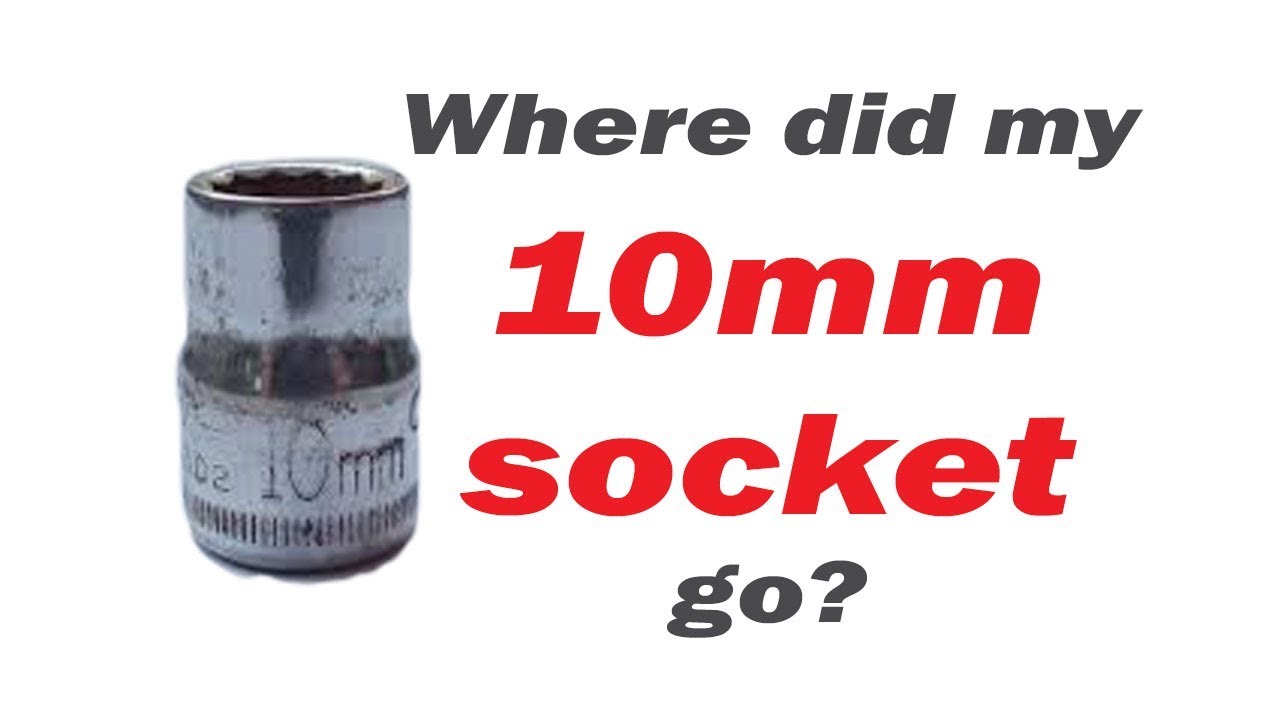
🕳️ The Socket That Isn't There
You're twenty minutes into a job. Battery terminal, valve cover, intake bracket, doesn't matter what. You reach for the same size you always reach for first. It's not there.
You check the rail. Not there. You check the floor. Not there. You check your pocket, the cup holder, the dog's bed, a drawer you haven't opened in six months. Still not there. Somewhere between the last job and this one, your 10mm socket has left the building, and you are now performing a full forensic investigation on your own garage instead of fixing your car.
If you've wrenched on anything for more than a year, you already know exactly which size did this to you. It's never the 17mm. It's never the 8mm. It's always the 10mm, and the fact that literally every car guy on earth has the same story is the actual mystery worth digging into.
This isn't bad luck repeating itself a thousand times over. There's a real reason one specific socket size has become car culture's most reliable running joke, and it's a mix of hard mechanical fact, basic probability, and a little bit of how human memory works under stress.
🔧 Why It's Specifically the 10mm
Metric fastener sizing isn't evenly distributed across a car. Automakers lean hard on a small cluster of sizes for the fasteners you touch constantly: battery terminals, interior trim clips, engine covers, splash shields, accessory brackets, wiring harness clamps. 10mm sits dead center in that cluster.
That means a few things stack up against it at once.
- It shows up more than any other size. A modern engine bay can have dozens of 10mm bolts and nuts. More exposure means more chances to set it down somewhere it doesn't belong.
- It's used for low-torque, easy-access fasteners. Big structural bolts (17mm, 19mm, 21mm) live in one or two places and get torqued once. A 10mm gets removed and reinstalled constantly for maintenance access, which means it's in your hand, not in the case, most of the time you're working.
- It's small enough to actually disappear. A 10mm socket is light and compact enough to roll off a fender, drop into an air intake, slide behind a battery tray, or get swept into a pile of shop rags without you noticing. A 24mm socket doesn't vanish like that. Gravity and size work against the small guys.
- It's the size you grab without thinking. Because it's used so often, a lot of car guys skip the "put it back in the tray" step specifically for the 10mm, since they know they'll need it again in five minutes anyway. That habit is exactly how it ends up loose in a pocket, on a shelf, or wherever it eventually gets lost for good.
None of that is mystical. It's just frequency, size, and human laziness lining up perfectly against one specific piece of chrome vanadium steel.
🧠 The Psychology Behind the Meme
Here's the part that actually makes this a car culture phenomenon instead of just a minor annoyance: memory works on emotional weight, not on raw event count.
You lose plenty of tools over the years. Most of those losses don't stick in your memory because they don't cost you anything in the moment. But losing your 10mm always seems to happen at the worst possible time, mid-job, hands dirty, something half-disassembled, and that frustration is what actually gets encoded into memory. Psychologists call this the availability heuristic: events that are emotionally vivid feel more common than they statistically are, because they're easier to recall.
So when a 10mm goes missing on a Tuesday and nothing else does for the rest of the month, your brain files that one loss under "this always happens," not "this happened once." Multiply that across millions of car guys independently having the exact same emotional experience, and you get a meme that feels universally true because, functionally, it is: it happens often enough, and it hurts enough each time, to feel constant.
Add in that mechanics and car guys talk to each other constantly, in shops, forums, group chats, comment sections, and you get rapid social reinforcement. Someone posts "where does the 10mm go" and thousands of people instantly recognize the exact feeling. That recognition is what turns a minor annoyance into a shared cultural inside joke that's been running for decades and shows no sign of stopping.
📦 The "10mm Black Hole" Theory (And Why It's Basically Real)
Car culture has half-jokingly settled on the idea that there's a black hole somewhere in every garage that specifically consumes 10mm sockets. It's a joke, obviously, but the underlying mechanism is closer to reality than people give it credit for.
Every garage has real physical "sinks," places where small objects go and effectively never come back out on their own:
- Under a floor jack or creeper that never gets moved
- Behind or under a workbench, wedged against the wall
- Inside a shop vac that already ran over the floor once that week
- In the folds of a mechanic's seat or floor mat in the car itself
- Mixed into a junk drawer with fifteen other loose sockets from different sets
None of those spots are supernatural. They're just low-visibility zones that most people never fully clear out, so anything small enough to fall into them tends to stay there indefinitely. The "black hole" isn't a place, it's a category of hiding spot, and the 10mm hits that category more than any other size because of everything covered above: it's used constantly, it's small, and it's handled carelessly precisely because it's so familiar.
🛠️ What Actually Stops It From Happening
The joke is fun, but there are real fixes that work if you're tired of buying your fourth replacement 10mm this year.
- Buy in bulk, on purpose. A lot of experienced mechanics keep 4-6 loose 10mm sockets in rotation specifically because they know it's going to wander off. Cheap insurance against an inevitability.
- Use a magnetic tray, every time, no exceptions. Most 10mm losses happen because the socket got set down on a flat, non-magnetic surface, a fender, a bumper cover, a tire, and rolled somewhere you weren't looking. A magnetic parts tray fixes this at the source.
- Color-code or paint-mark your most-used sockets. A dab of bright paint on the top of your go-to 10mm makes it dramatically easier to spot against a dark engine bay, a gravel driveway, or a dirty garage floor.
- Foam-cut tool organizers. A shadow-foam socket tray shows you an empty slot immediately, instead of letting you assume the socket's "around here somewhere" until you're three tools deep into a job and stuck.
- Do a walk-back at the end of every session. Before you close the hood, walk your exact path: fender, floor jack area, driver's seat, workbench. Most lost sockets are found in the first sixty seconds of an honest search, the problem is usually that nobody actually does the search until days later.
None of this eliminates the phenomenon completely. It's still going to happen occasionally, because the underlying math (frequent use, small size, careless handling) never fully goes away. But it turns "constant recurring disaster" into "rare annoyance," which is about as good as anyone's going to do.
Spota tip: if you're logging maintenance on your Garage profile, a quick note on what tools a job actually needed (and how many you lost doing it) is exactly the kind of real, lived-in detail that makes a build's timeline feel honest instead of like a spec sheet. Other car guys reading it will laugh, and they'll believe you.
🏁 Some Traditions Don't Need Fixing
At some point, losing a 10mm stops being a problem and starts being a rite of passage. Every car guy has a story. Every garage has a graveyard of stray sockets nobody can account for. It's one of the few things the entire car community agrees on without argument, no debate, no "well actually," just universal, tired recognition.
So buy the spares, get the magnetic tray, do the walk-back. And when it disappears anyway, mid-job, at the worst possible moment, just laugh and grab the spare. You already knew this was coming.
For more of the small, specific things that define life around cars, check out why every car guy's glovebox is full of broken parts or browse the full under-the-hood category.