
🚿 The $8 Wash That Costs You $2,000
Drive past any car wash on a Saturday and you'll see two very different cars in line. A minivan with a week of pollen on the hood, windows down, driver on the phone. And a modified GTI, freshly lowered, owner sitting outside the entrance in the parking lot, watching the brushes through the window like they're about to commit a crime.
He's not being dramatic. To a lot of car people, he's watching a crime.
Ask any enthusiast why they won't run their car through a tunnel wash and you'll get the same answer, usually before you even finish the question: "those things destroy your paint." It's one of the few opinions that's completely universal in car culture. JDM guys, muscle car guys, truck guys, exotic owners: nobody agrees on anything, but everybody agrees the automatic wash is the enemy.
The thing is, they're not wrong. They're just not always right about why, either. The real story involves actual chemistry, actual physics, a genuine engineering arms race inside the car wash industry, and a ritual that's become as much about identity as it is about clean paint.
🧽 What a Brush Wash Actually Does to Your Car
Here's the part that gets glossed over in most "just wash your car by hand" advice: not all automatic washes work the same way, and lumping them together is where a lot of the panic comes from.
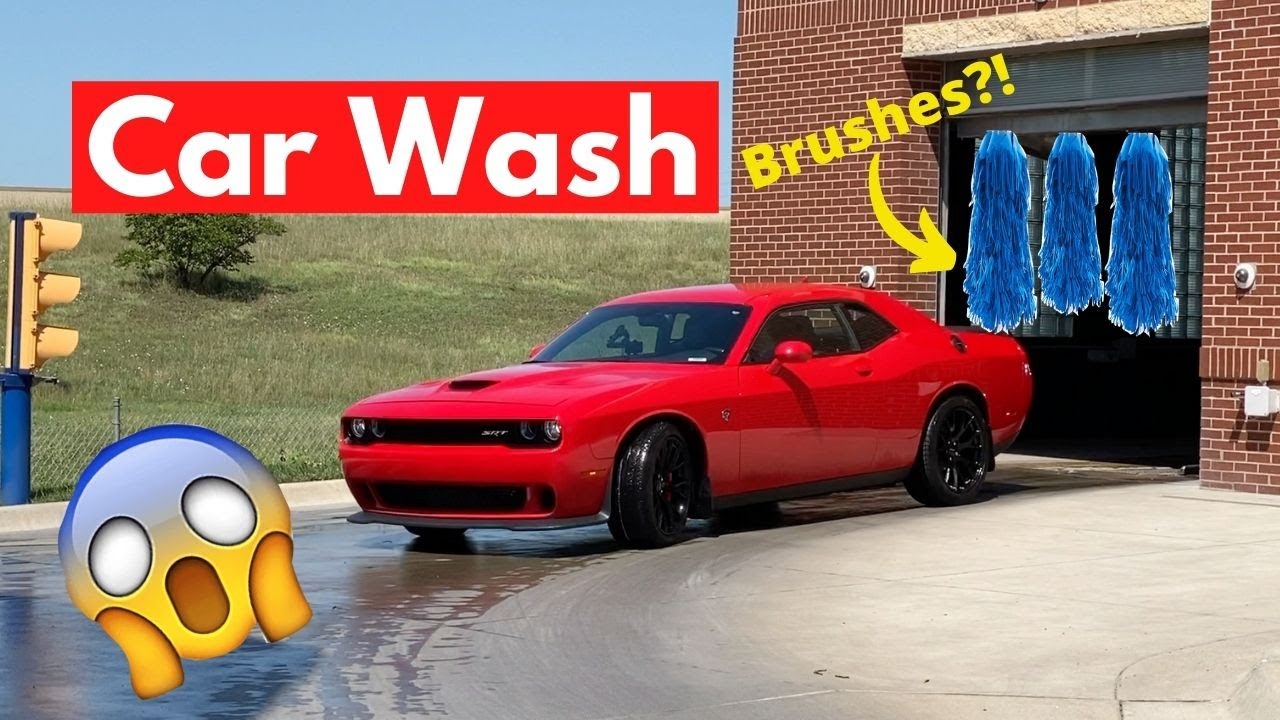
The old-school friction wash (the kind with spinning cloth strips or foam brushes) is the one that earned the entire category its reputation. Those brushes touch every car that goes through the tunnel. They pick up brake dust, road grit, sand, and whatever else was stuck to the last twelve vehicles, and they never really get clean between cars. Then they drag all of it directly across your clear coat under pressure.
That's not washing. That's sanding your car with a dirty rag, over and over, every single visit.
The damage shows up as:
- Swirl marks: the fine, circular micro-scratches you only notice in direct sunlight or under a flashlight at an angle, caused by grit being dragged in tight arcs across the clear coat
- Spider webbing: dense clusters of swirls that overlap into a hazy, cloudy look, especially bad on dark paint
- Deeper scratches: when the brush is carrying something harder than dirt, like a lost bolt, a zipper pull, or grit embedded in the cloth itself
- Antenna and mirror snaps: brushes and cloth strips catching on anything that sticks out
- Stripped wax or coating: the mechanical action and the harsh detergents strip protective layers faster than they should wear down naturally
None of this happens in one trip. That's exactly why it doesn't feel dangerous. You run the GTI through on a Tuesday, it looks clean, you move on with your day. It's only after twenty, thirty, fifty trips through the same brushes that the paint develops that hazy, spiderwebbed look under direct sun that no amount of car soap fixes. By the time you notice it, the damage has been compounding for months, and now you're looking at a paint correction bill instead of a wash bill.
That's the trap in the headline. The $8 wash is cheap every single time you do it, right up until the day you need $1,500 to $2,500 in machine polishing to cut the swirls back out, or worse, a respray on a panel where the clear coat got cut through completely.
🔬 The Chemistry Nobody Thinks About
Brushes get all the blame, but the soap itself does real damage too, and it's the part almost nobody outside detailing forums actually understands.
Most automatic car washes run high-pH alkaline detergents because they need to cut through grease, road film, and bug guts fast enough to keep the line moving. Speed is the entire business model: a tunnel wash makes money on volume, not on babying your clear coat. Those aggressive detergents are genuinely effective at stripping wax, sealant, and yes, even ceramic coatings faster than normal washing would.
This is the uncomfortable part for anyone who just dropped $800 on a coating: that hydrophobic beading effect everyone shows off online doesn't survive repeated trips through a harsh-chemical tunnel wash nearly as long as it survives hand washing with a proper pH-neutral shampoo. You're paying for premium paint protection and then actively stripping it every time you take the fast route.
Add in the fact that a lot of automatic washes recycle their water to cut costs, and you've got a wash solution that's carrying trace grit and old detergent residue from every previous car. It's not always visible. It's still there.
👁️ Touchless Washes: The "Safe" Option That Isn't Always Safe
The industry's answer to the brush problem was the touchless (or "laser") wash: no physical contact at all, just high-pressure water and stronger chemicals to compensate for the lack of scrubbing.
On paper, this sounds like the perfect fix. No brushes means no swirl marks. In practice, it created a different tradeoff:
- Chemicals have to work harder without mechanical scrubbing to help lift dirt, so touchless washes typically use even more aggressive detergents than brush washes
- High-pressure water alone often can't fully remove baked-on grime, bug residue, or heavy road film, so cars can come out still visibly dirty in spots
- Stripped protection is almost guaranteed since the stronger chemicals are specifically formulated to compensate for zero physical agitation
- No swirl marks, but real chemical etching is possible on already-weathered clear coat, especially with repeated exposure
So the honest answer is: touchless is meaningfully safer for the paint's surface than a brush wash, but it's not the risk-free option a lot of people assume it is. It trades a mechanical risk for a chemical one.
The genuinely safest automatic option, and the one most detailers will actually recommend if you're going to use a machine at all, is a soft-cloth wash with well-maintained, frequently-replaced cloth strips, ideally at a wash that's transparent about how often they change their media and what chemicals they run. Those exist. They're just outnumbered by the $6 gas station tunnel wash that hasn't swapped its brushes since 2019.
🪣 Why the Two-Bucket Method Became a Religion
This is where car culture stops being about the paint and starts being about identity.
Hand washing with the two-bucket method (one bucket of soap water, one bucket of clean rinse water, a grit guard in each to trap debris at the bottom, a dedicated wash mitt) isn't just the objectively safest way to wash a car. It's become a ritual. Sunday morning, music on, no rush, going panel by panel with total control over pressure, direction, and contact. For a lot of enthusiasts that's not a chore, it's the closest thing to meditation their week has.
We've got a full breakdown of the actual technique if you want to do it right: the two-bucket method, step by step.
There's a status element to this too, and car people aren't shy about it. Showing up to a meet with a car that's been hand washed, clayed, and maintained reads completely differently than showing up with a car that clearly lives in the tunnel wash rotation. It's the same instinct that drives why ceramic coating became every car guy's obsession: the paint is the canvas for every mod that comes after it, and nobody wants to put $3,000 into wheels on top of a hood that looks like it's been through a sandstorm.
Hand washing also solves the recycled-water and shared-brush problem completely. Your bucket, your mitt, your car, nothing that touched anyone else's vehicle in the last hour.
⏱️ The Real Reason People Still Use the Tunnel Anyway
None of this means automatic washes are going away, and it would be dishonest to pretend every car guy hand washes every single week. Life happens. Winter road salt needs to come off fast and often, snow tires and slush don't care about your Sunday ritual, and sometimes you genuinely don't have three hours and a driveway available.
This is where the self-serve wand bay earns its reputation as the honest middle ground: you control the pressure, you control the soap, no shared brushes ever touch your paint, and you can rinse heavy grit off before it has a chance to grind against anything. It's not as thorough as a full hand wash with dedicated mitts and microfiber towels, but it's a completely different risk profile than a brush tunnel, and most detailers will tell you it's a perfectly reasonable weeknight option.
The pattern that actually holds up: quick maintenance washes (self-serve wand, or a careful touchless run) between real hand washes, full hand wash sessions when there's time to do it properly, and the brush tunnel reserved for situations where the car is genuinely a rolling salt block and getting the corrosive stuff off fast matters more than the small risk to the clear coat that trip. Most enthusiasts who "never" use automatic washes are quietly making an exception for road salt in February. They just don't post about it.
🧴 What Actually Protects Your Paint Long-Term
If the goal is paint that still looks good in five years, the wash method matters less than most people think compared to these three things:
- A dedicated maintenance routine, whatever form it takes, done consistently rather than occasionally
- A protective layer (wax, sealant, or ceramic coating) that's actually maintained and reapplied on schedule, not just applied once and forgotten
- Correct technique when contact happens at all: straight-line motion instead of circular scrubbing, a grit guard to keep debris out of the wash water, and microfiber instead of anything abrasive
A coated car that occasionally sees a gentle touchless wash between hand washes is going to look better in three years than an uncoated car that's obsessively hand washed with the wrong mitt and a dollar-store microfiber towel that's shedding grit into the paint. The ritual matters, but the technique inside the ritual matters more.
Spota tip: if you're building out a Garage timeline for a build, a fresh-wash Photo Op hits different than a dusty one. Detail day is content day.
🏁 The Bottom Line
The automatic car wash paranoia in car culture isn't superstition. It's earned. Decades of dirty shared brushes, high-pH detergent, and recycled wash water genuinely put fine scratches into paint one invisible layer at a time, and by the time it's visible, the damage has already been done a hundred washes ago.
But the answer isn't "never touch an automatic wash or you're not a real car guy." It's understanding which machines are actually doing the damage, which ones are a reasonable compromise, and why the guy hand washing in his driveway on a Sunday isn't being precious. He's just doing the math on what a $2,000 correction bill actually costs compared to an hour with a bucket and a hose.